

Rural FMCG growth in India remains an important driver of the country’s fast-moving consumer goods market. But the latest numbers reveal a shift that brand leaders should not overlook: rural markets are still growing faster than urban markets, yet their lead is narrowing.
According to The Financial Express, rural FMCG growth in Q2 FY27 remained strong in categories such as packaged food, chocolates and confectionery, and beverages. However, the rural–urban growth gap narrowed to around two times, compared with four to five times in previous quarters. The report points to improving urban consumption alongside continued rural momentum.
For FMCG brands, this is more than a market-share story. It raises a practical question: are growth strategies responding to the conditions behind demand, or simply following the market with the strongest headline numbers?
Rural FMCG Growth in India: The Figures Need a Closer Look
Bizom data reported by The Financial Express puts rural FMCG value growth at 10.6% in Q2 FY27, compared with 5.8% in urban markets. Across rural categories, packaged food recorded 20.3% year-on-year growth, chocolates and confectionery 16.4%, and beverages 12.2%.
These figures indicate that rural India remains commercially significant. But they need to be interpreted carefully.
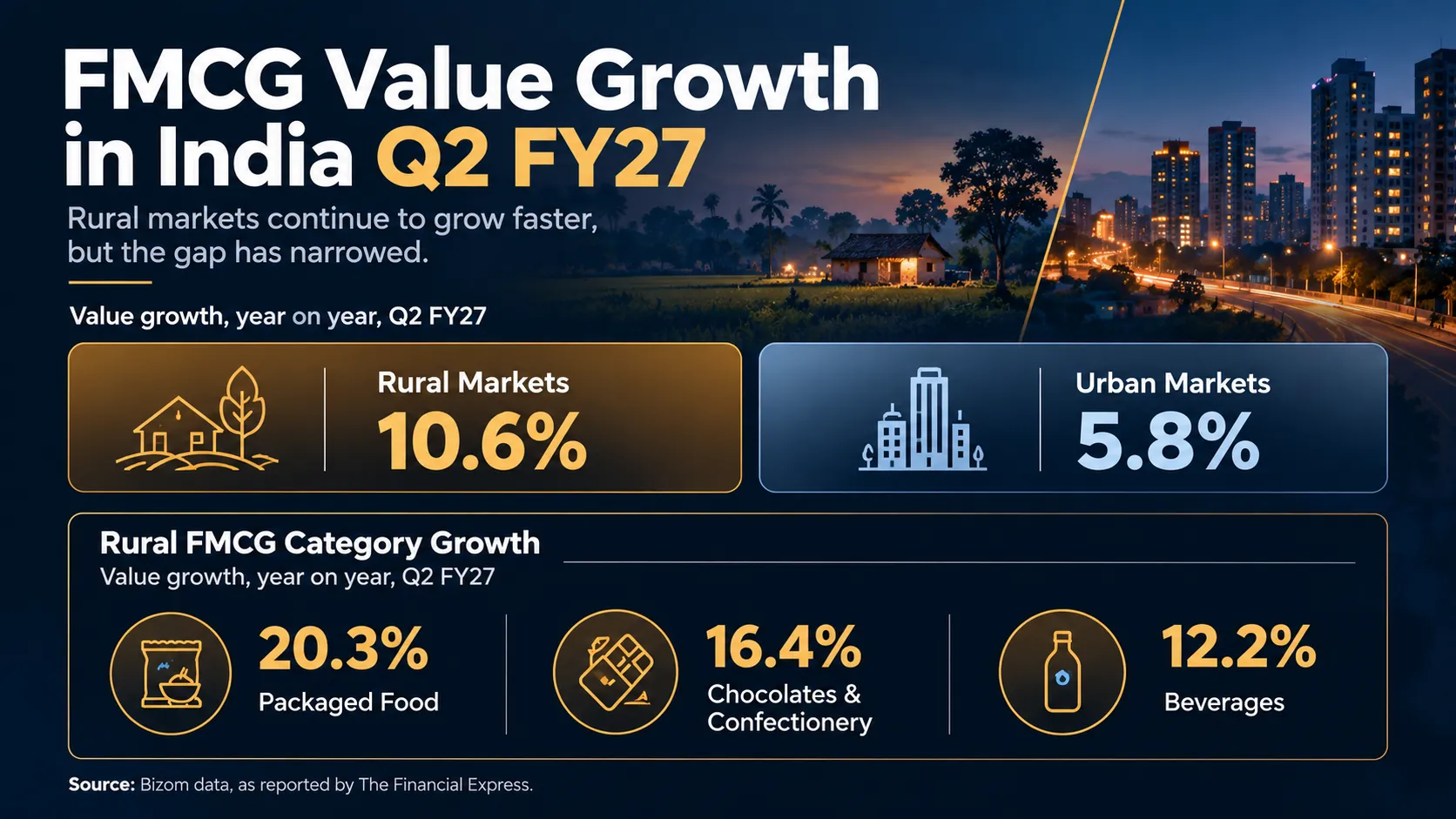
Bizom tracks value growth, not volume growth. Sales value can increase because consumers buy more units, prices rise, or the mix of products purchased changes. A headline growth rate alone cannot establish which factor is responsible. This distinction also matters when examining the relationship between sales value and underlying demand in India’s consumer markets.
The distinction matters when brands decide whether to expand distribution, adjust pricing, change pack sizes or invest more heavily in demand creation. Each decision depends on a different understanding of what is actually happening in the market.
A narrowing gap changes the question for marketers
Urban growth has improved, while rural demand faces its own pressures. September 2026 data reported by The Financial Express showed rural inflation at 6.08%, compared with 4.88% in urban India. Inflation for agricultural and rural labourers was also elevated.
These figures do not prove that every rural household is cutting spending. They do, however, highlight why brands should be cautious about assuming that strong category growth translates into the same purchasing power or price tolerance everywhere.
Rural India is not a single consumer segment. Markets differ in income, access, local preferences, product availability and purchase occasions. Even within the same category, the reasons one product succeeds may differ from the reasons another struggles.
The opportunity, therefore, is not to replace a rural-first strategy with an urban-first one. It is to understand the conditions under which each market can deliver sustainable growth.
What FMCG brands should reconsider
1. Identify where growth is actually coming from
National and rural-wide growth rates are useful signals, not complete investment plans. Brands should examine performance by category, geography, price tier and channel wherever reliable data is available.
The objective is to distinguish broad market momentum from specific opportunities that justify additional investment.
2. Treat affordability as a market question
When household budgets face pressure, price and pack architecture deserve closer examination. But smaller packs or lower price points should not be assumed to be the right answer everywhere.
Brands need evidence about purchasing behaviour, product value and the trade-offs customers are making. They also need to connect market understanding with brand positioning so that their proposition reflects what customers value and why they should choose it. The appropriate response may differ by category and market.
3. Connect availability with customer choice
Distribution can make a product accessible, but availability alone does not establish preference or repeat purchase.
Brands should examine whether customers understand the product’s value, consider it relevant and can find it consistently. Distribution and demand creation need to work together, with local retail execution, brand communication and product positioning reinforcing one another.
4. Separate sales value from underlying demand
Marketing and sales teams should distinguish value growth from volume growth and investigate the contribution of pricing, product mix and unit sales where the data permits.
Without that distinction, a business can mistake higher revenue for stronger underlying demand—and make investment decisions on an incomplete picture.
The real opportunity is more precise growth strategy
Rural India’s continued contribution to FMCG growth matters. So does the narrowing gap with urban markets. Neither figure, on its own, tells a brand exactly where to invest next.
The more useful approach is to connect market intelligence with affordability, availability and customer choice. That means understanding not just where sales are rising, but what is driving them and whether those conditions are likely to persist.
Sustainable growth does not come from following the strongest headline number. It comes from understanding the demand behind it—and building a strategy that fits the market.