

A brand positioning strategy can look convincing in a presentation and still have very little influence on the business.
The company has identified its target audience. It has written a positioning statement. It may even have agreed on a set of brand attributes and a few words it wants customers to associate with the business.
Then marketing begins.
The website talks about one set of benefits. Social content emphasizes another. Campaigns are built around whichever message seems most relevant that week. Salespeople explain the company in their own words, and every new initiative seems to reopen decisions the positioning exercise was supposed to settle.
The business has a positioning statement. What it lacks is a positioning strategy that guides decisions.
That distinction matters because positioning is not simply the language a company uses to describe itself. It is a strategic choice about the customers it wants to serve, the value it wants to be known for, the alternatives against which it competes and the reasons customers should believe its claims.
Marketing is where those choices become visible.
A useful brand positioning strategy should therefore do more than produce a memorable sentence. It should help teams decide what to communicate, what to prioritize, which proof to present, how to express the brand across channels and what to stop doing.
This article explains how to turn positioning from a statement into a practical decision-making system.
Why a Positioning Statement Often Fails to Guide Marketing
The problem is not necessarily that the positioning statement is poorly written. It may be clear, concise and strategically sensible.
Understanding why brand positioning matters for business growth is the starting point; the next challenge is making those strategic choices influence everyday marketing decisions.
The problem is that the business has treated the statement as the final deliverable rather than the beginning of implementation.
Consider a B2B services company that wants to be known for helping growing businesses make better marketing decisions.
That sounds reasonable. But what should the marketing team do differently because of it?
Should the homepage lead with marketing services or business problems? Should the company emphasize campaign execution, commercial diagnosis or senior strategic guidance? Should its content focus on platform tactics or on the business decisions that determine whether marketing works? What evidence should salespeople use to support the promise?
The positioning statement alone does not automatically answer these questions.
Teams need to translate the strategic choice into operating decisions. Without that translation, every department fills in the gaps independently.
Three problems tend to follow.
First, marketing becomes inconsistent. Individual campaigns may be competent, but they do not build a coherent impression of the business.
Second, differentiation becomes superficial. Teams rely on broad claims such as “innovative,” “customer-focused” or “results-driven” because the company has not decided what makes its value meaningfully different.
Third, positioning loses authority. When the statement does not help people make real decisions, it becomes a reference document rather than a working strategy.
The solution is not to repeat the positioning statement more frequently. It is to make the statement useful at the points where marketing decisions are made.
Start With the Business Choice, Not the Brand Sentence
A positioning strategy should begin with a business decision: which customers should understand the business as particularly relevant to them, and why?
This sounds straightforward, but many companies start with a list of everything they do well.
They have experienced people, a broad service offering, good customer relationships, flexible delivery and a commitment to quality. All of these may be true. But a list of strengths does not establish a clear market position.
Positioning requires prioritization.
This is also why positioning should not be confused with identity. Brand positioning and brand identity serve different strategic roles: one establishes the place a business wants to occupy in the customer’s mind, while the other shapes how the brand is expressed and recognized.
Choose the audience that matters most
“Small businesses,” “modern consumers” and “growth-oriented companies” may be useful starting descriptions, but they are often too broad to guide execution.
An audience definition becomes more useful when it identifies the situation in which the business is especially relevant.
For example, a marketing consultancy might decide that its priority audience is not simply small businesses. It may be growing service businesses whose marketing activity has increased but whose strategic direction remains unclear.
That distinction changes the work.
The website can speak to the tension between activity and commercial progress. Articles can explain why more campaigns do not necessarily solve a growth problem. Sales conversations can explore the relationship between business goals, positioning and marketing decisions.
The audience definition is now doing more than describing a demographic or company size. It is identifying a meaningful business situation.
Ask:
- Which customers experience the problem we are best equipped to address?
- What makes that problem important enough for them to act?
- Which customers can recognize and value our particular approach?
- Which audience should receive priority when not every opportunity can be pursued?
A clear positioning strategy does not require a business to reject every other customer. It requires the business to know whose needs should lead its strategic decisions.
Define the alternative customers are choosing against
A company does not compete only with businesses that offer similar services.
Customers may compare it with a direct competitor, an internal team, a less expensive provider, a different solution or the option of doing nothing.
For the marketing consultancy in our example, the alternatives might include hiring a generalist agency, adding another marketing employee, using freelancers for individual tasks or continuing with the current approach.
Each alternative creates a different decision problem.
If the customer believes the main problem is insufficient execution capacity, a consultancy focused on strategic diagnosis may initially appear unnecessary. If the customer believes the real problem is that marketing activity is not connected to business priorities, the same consultancy may become much more relevant.
The company needs to understand the decision customers are actually making—not merely the category in which the company operates.
Decide what should make the business worth choosing
Differentiation is not the same as claiming to be better at everything.
A meaningful difference must satisfy three conditions:
- Relevance: It matters to the intended customer.
- Credibility: The business can support the claim with evidence or demonstrated capability.
- Distinction: It gives the customer a useful reason to consider the business over realistic alternatives.
The strongest point of difference may come from specialization, expertise, a delivery model, a particular outcome, a distinctive process or the way the business combines capabilities.
It does not need to be unique in every respect. It needs to create a defensible reason for the right customer to prefer the business.
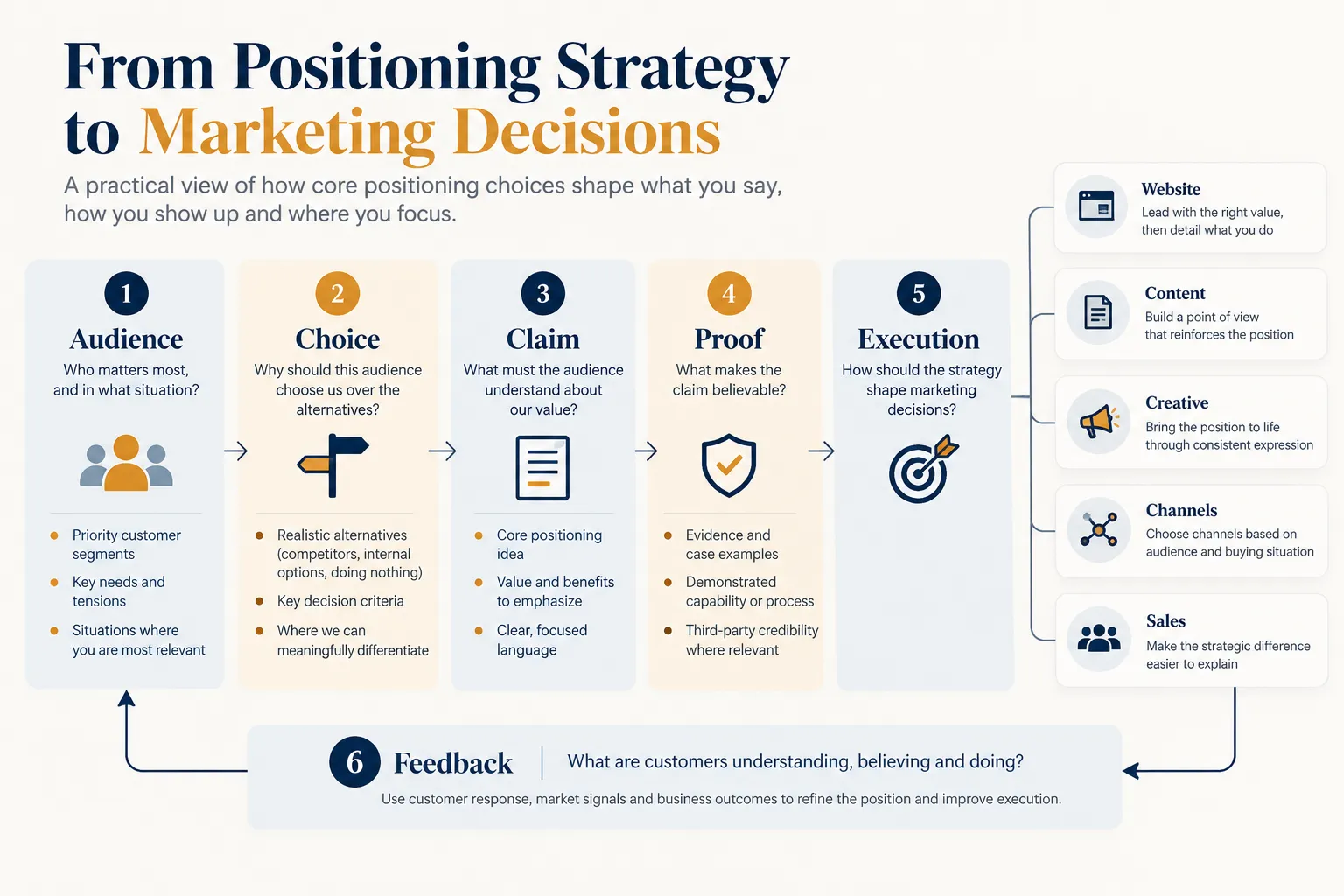
The Positioning-to-Execution Chain
Once the business has made its central positioning choices, it needs a practical way to carry them into marketing.
Marcom Trends uses the following model to make that connection explicit.
Each decision should give the next one direction.
The Positioning-to-Execution Chain
Each decision should give the next one direction.
Audience
Who matters most, and in what situation?
Choice
Why should this audience choose us over the alternatives?
Claim
What must the audience understand about our value?
Proof
What makes the claim believable?
Execution
How should the strategy shape website, content, creative, channels and sales?
Feedback
What are customers understanding, believing and doing?
The chain is not a one-time production checklist. It is a way to test whether marketing execution follows from the intended position.
If the audience is unclear, the claim will probably be broad. If the claim is broad, the proof may be generic. If the proof is weak, execution may depend on polished language rather than credible reasons to choose the business.
And if feedback reveals that customers misunderstand the offer, the team should be able to identify which decision needs attention.
Audience determines relevance
The same capability can be relevant for different reasons to different customers.
A founder may want clarity about which marketing investments deserve priority. A marketing manager may want a stronger framework for aligning teams and agencies. A procurement team may want predictable scope and delivery.
A company can serve all three, but its communication should not assume that one message will be equally useful to every audience.
The positioning decision establishes the priority. Marketing can then adapt the expression without losing the underlying strategic direction.
Choice determines the central claim
The claim is the main idea the company wants its priority audience to understand.
It should not be a catalogue of services. It should express why the business is relevant and what makes its approach worth considering.
For the hypothetical consultancy, a possible central claim could be:
We help growing service businesses identify the strategic constraints behind underperforming marketing, then turn those findings into clearer priorities.
That statement is more specific than “we provide integrated marketing solutions.” It describes a problem, an approach and a useful outcome.
It is still a hypothesis, not a proven market position. The business would need to validate whether customers value the problem, whether its approach is genuinely distinctive and whether it can demonstrate the outcome.
Proof makes the claim credible
Every important claim raises a question in the customer’s mind: why should I believe this?
The answer might involve case studies, a transparent methodology, relevant experience, demonstrations, documented outcomes, customer evidence or a clear explanation of how the service works.
Proof should be connected to the claim.
If the company says it helps businesses identify the real constraint behind weak marketing performance, showing a generic list of digital services will not do much to substantiate the promise. A worked diagnostic example or an explanation of its decision process may be more relevant.
The aim is not to surround every sentence with evidence. It is to make the core reason to choose the business credible.
Translate Positioning Into Marketing Decisions
The positioning strategy starts to earn its value when teams can use it to make different choices.
The website: make the value clear before listing everything you do
The homepage should help the right visitor understand three things quickly:
- Is this business relevant to my situation?
- What does it help me achieve or resolve?
- Why should I consider its approach?
That does not mean every homepage must use the same formula. It means the page should reflect the strategic priority.
If the business is positioned around solving a particular growth problem, leading with an undifferentiated list of services may weaken the position. The services still matter, but the page should explain how they relate to the problem the business is best equipped to address.
Service pages can then provide detail, scope, process and evidence.
Decision test: If the positioning strategy changed, would the homepage’s central message or information hierarchy change too? If not, the strategy may not be influencing the website.
Content: build a point of view rather than a pile of topics
Positioning should influence what the company chooses to explain publicly.
A business that wants to be known for strategic marketing diagnosis should not publish only platform tips, trend summaries and generic advice. Those formats may be useful, but they should support a recognizable point of view.
Once that strategic direction is clear, a brand messaging framework can help translate the position into consistent messages for different audiences, channels and customer situations.
Its content might examine why marketing activity fails to produce commercial progress, how to distinguish a positioning problem from a channel problem, or how to evaluate whether more leads will solve the actual constraint.
This gives individual articles a shared strategic direction while allowing each to answer a different question.
The goal is not to repeat the same message in every article. It is to build a connected body of thinking that helps the audience understand the business’s expertise.
Creative: express the position without reducing everything to the same advertisement
Creative execution needs consistency, but consistency does not mean identical visuals and headlines.
A brand can express the same strategic position through different stories, formats and emotional registers. One campaign may focus on the cost of an unresolved problem; another may show the value of a better approach.
The common thread is the strategic idea beneath the execution.
Before approving a creative concept, ask:
- Does it matter to the audience we have prioritized?
- Does it reinforce the value we want to be known for?
- Does it make a meaningful distinction easier to understand?
- Is the promise supported by what the business can deliver?
If a creative concept is attractive but could belong to almost any competitor, it may be entertaining without strengthening positioning.
Channels: choose based on audience and buying situation
A positioning strategy does not automatically determine a channel mix. Audience behavior, budget, category, geography and the purchase process still matter.
But it can help determine what each channel should accomplish.
Search content may address a problem customers are actively trying to solve. LinkedIn may help a B2B business explain its point of view and demonstrate expertise. Sales material may clarify the business’s approach and show how it differs from alternatives. Paid campaigns may test a specific claim with a defined audience.
The channel is the delivery mechanism. Positioning supplies the strategic direction.
Decision test: Can the team explain what role each major channel plays in making the intended position understood, believed or chosen?
Sales: make the strategic difference easier to explain
Sales conversations are a useful test of positioning.
If every salesperson describes the business differently, the issue may not be a training problem alone. The company may not have made sufficiently clear decisions about its audience, value and distinction.
Sales enablement should translate the position into language customers can understand, relevant proof, answers to common objections and a clear explanation of fit.
This does not mean forcing everyone to recite a script. It means giving the team a shared strategic foundation so individual conversations remain consistent without becoming mechanical.
Turn the Positioning Statement Into a Working Brief
A practical brand positioning strategy should be supported by a working brief that connects the intended position to everyday marketing decisions.
But it should be accompanied by a short working brief that connects the statement to execution.
A practical version should answer:
| Decision | What the brief should clarify |
|---|---|
| Priority audience | Who should recognize themselves in the proposition? |
| Customer problem | What meaningful situation or need makes the offer relevant? |
| Competitive alternatives | What else might the customer choose, including doing nothing? |
| Intended position | What should the audience understand about the business? |
| Point of difference | Why is the business worth considering over alternatives? |
| Core claim | What is the most important idea marketing should communicate? |
| Proof | What evidence supports that claim? |
| Execution implications | What should change across the website, content, creative, channels and sales? |
| Boundaries | What claims, audiences or opportunities are not a priority? |
| Feedback | What evidence will indicate whether the position is being understood? |
The final two decisions are often neglected.
Boundaries matter because positioning is about choice. If every audience, service, message and opportunity remains equally important, the strategy is not prioritizing anything.
Feedback matters because a positioning document cannot prove that the market understands or values the intended position. That requires observation and testing.
The brief should be detailed enough to guide decisions but concise enough for teams to use. If it becomes a large document that nobody consults, it has recreated the original problem in a different format.
Test the Positioning Before Scaling the Execution
Internal agreement is not the same as market validation.
Leadership may like a positioning statement because it reflects the company’s ambitions. Customers may interpret it differently, fail to notice the intended distinction or care more about another benefit.
Testing helps reveal that gap before the business invests heavily in rolling out the position.
Useful methods depend on the business and the decision being made. They can include customer interviews, sales-call reviews, message-comprehension tests, landing-page experiments, qualitative feedback or comparisons of how different audience groups respond to a proposition.
The question is not simply whether people like the language.
A message can sound attractive and still fail to communicate the intended value.
Test whether people understand:
- Who the offer is for.
- What problem or need it addresses.
- Why the approach is relevant.
- What makes it different from realistic alternatives.
- What evidence makes the claim credible.
For a website, this may mean checking whether target customers can explain the proposition after reading the page. For sales, it may mean reviewing whether prospects consistently understand the difference the business is trying to communicate. For campaigns, it may mean testing alternative expressions of the same strategic idea.
Testing should improve the strategy, not encourage constant changes based on small or noisy samples. A short-term performance difference does not automatically mean the positioning is wrong. The team must distinguish a weak strategic proposition from a weak execution, a poor audience match or an inadequate test.
Measure Whether Positioning Is Influencing Business Outcomes
Positioning is not usually measured through one isolated metric. It influences several parts of the customer decision process, and the appropriate measures depend on the business model.
It helps to separate three levels.
1. Understanding: Can the intended audience accurately explain what the business does, whom it serves and why its approach is relevant?
2. Preference: Is the business being considered for the reason it wants to be known for? Do customers recognize the intended difference, or do they still compare it mainly on price and convenience?
3. Commercial impact: Is the position contributing to better-fit enquiries, more productive sales conversations, stronger conversion, improved retention or other outcomes that matter to the business?
These outcomes have multiple causes. A positioning strategy cannot be credited with every improvement in conversion or revenue, nor should every weak result be treated as a positioning failure.
The point is to connect strategic intent to evidence.
For example, if the goal is to attract more suitable B2B enquiries, the business might monitor enquiry quality, the proportion of leads matching its priority audience, recurring reasons for choosing the company and how frequently sales conversations require basic clarification of the offer.
If the goal is to strengthen brand preference, the business may need customer research that directly examines awareness, associations, consideration and reasons for choice.
The measures should follow the intended business outcome. They should not be chosen merely because they are easy to collect.
Know When to Change Execution—and When to Revisit Positioning
Not every marketing problem requires a new positioning strategy.
A campaign can underperform because its creative is weak, its audience targeting is inaccurate, the landing page is confusing, the offer is poorly timed or the channel is unsuitable. Repositioning the business every time performance dips can create instability without solving the real issue.
If these execution problems persist, explore why marketing strategy isn’t working before assuming the brand needs a new position.
A more disciplined diagnosis separates three situations.
The position is sound, but execution is weak
The intended audience recognizes the value and believes the claim, but a particular campaign, page or channel is not communicating it effectively.
The response should focus on execution.
The position is relevant, but the proof is insufficient
Customers understand the intended benefit but remain unconvinced. The business may need stronger evidence, a clearer process, better demonstrations or a more credible way to substantiate the promise.
Changing the headline alone will not solve a credibility gap.
The position no longer fits the business or market
The company has changed its offer, its most valuable audience has shifted, competitors have adopted the same claim, or customer needs have materially evolved.
This is when a positioning review becomes more important. If you are unsure whether the business has outgrown its current position, review the signs that a brand may need repositioning.
A position should not be treated as permanent. But it should also not be changed simply because the marketing team wants something new to say.
The right question is whether the strategic conditions that made the position useful have changed.
A Practical Review for Marketing Leaders
Use these questions to assess whether your positioning strategy is guiding the work or merely sitting in a presentation.
- Audience: Can the team identify the customers and situations that deserve priority?
- Choice: Can it explain why those customers should choose the business over realistic alternatives?
- Claim: Is there a clear central idea that marketing should communicate?
- Proof: Can the business substantiate its most important claims?
- Execution: Can the team point to decisions across the website, content, creative, channels and sales that have been shaped by the position?
- Boundaries: Is there a clear understanding of what the business will not prioritize or claim?
- Feedback: Is there evidence that the intended audience understands and values the position?
If the team struggles with the first three questions, the underlying strategy may need more work.
If the first four are clear but execution varies widely, the business may need a better working brief, stronger coordination or clearer decision ownership.
If the strategy is well understood but the market response remains weak, investigate the evidence, customer relevance and commercial assumptions before deciding what to change.
This is the practical difference between having a positioning statement and having a positioning strategy.
Final Takeaway: Positioning Should Reduce Decision-Making Friction
A brand positioning strategy is not successful because the statement sounds distinctive or the presentation looks polished.
It is successful when it helps the business make better decisions.
It gives marketing a clearer audience to prioritize, a more meaningful reason to communicate, evidence to support its claims and a basis for choosing how the brand should show up across channels.
It also creates boundaries. Not every customer is equally important. Not every message deserves equal attention. Not every channel or opportunity supports the intended position.
That focus is what makes the strategy useful.
As the business evolves, the position should be reviewed against changing customer needs, competitive alternatives and the company’s actual capabilities. But the starting point remains the same: make deliberate choices, translate them into execution and check whether the market understands the value.
If your marketing is active but the business still struggles to explain why customers should choose it, the next step may not be another campaign. It may be to examine the strategic decisions underneath the campaigns.
Marcom Trends helps businesses examine the relationship between brand positioning, marketing direction and growth priorities. If the real constraint is unclear, a Business Growth Diagnostic can help identify where the real friction sits and what deserves attention first.