

D2C brand growth often looks straightforward at first. A direct-to-consumer brand finds a winning product, digital campaigns bring customers in, marketplaces generate orders, and revenue climbs. Then growth begins to demand more money, more channels and more effort than before.
The instinct is often to increase advertising budgets. But what if the problem is no longer customer acquisition?
A report by WPP Media, Google and Elevation Capital, in partnership with Kantar, argues that India’s emerging challenger brands can reach ₹100 crore in revenue within two to four years. Scaling towards ₹500 crore, however, requires broader distribution and a shift in marketing strategy.
The more useful lesson is not that ₹100 crore is a fixed growth ceiling. It is that the next stage of growth may require a different business model, not simply a larger advertising budget.
Digital acquisition can only take a brand so far
Digital advertising and commerce platforms help brands reach people who are already searching, browsing or considering a purchase. For a challenger brand, that can be an efficient way to establish demand without immediately building a large physical distribution network.
But capturing existing demand is different from creating new demand.
A brand may perform well among consumers who know the category, recognise the problem and are actively comparing products. Growth becomes harder when the business needs to reach people who have not considered the brand, buy through different channels or have different reasons for choosing a product.
Increasing performance marketing may bring more visitors into the same funnel. It does not automatically expand the pool of relevant buyers.
That is where a successful acquisition model can begin to show its limits.
Three changes that can unlock the next stage
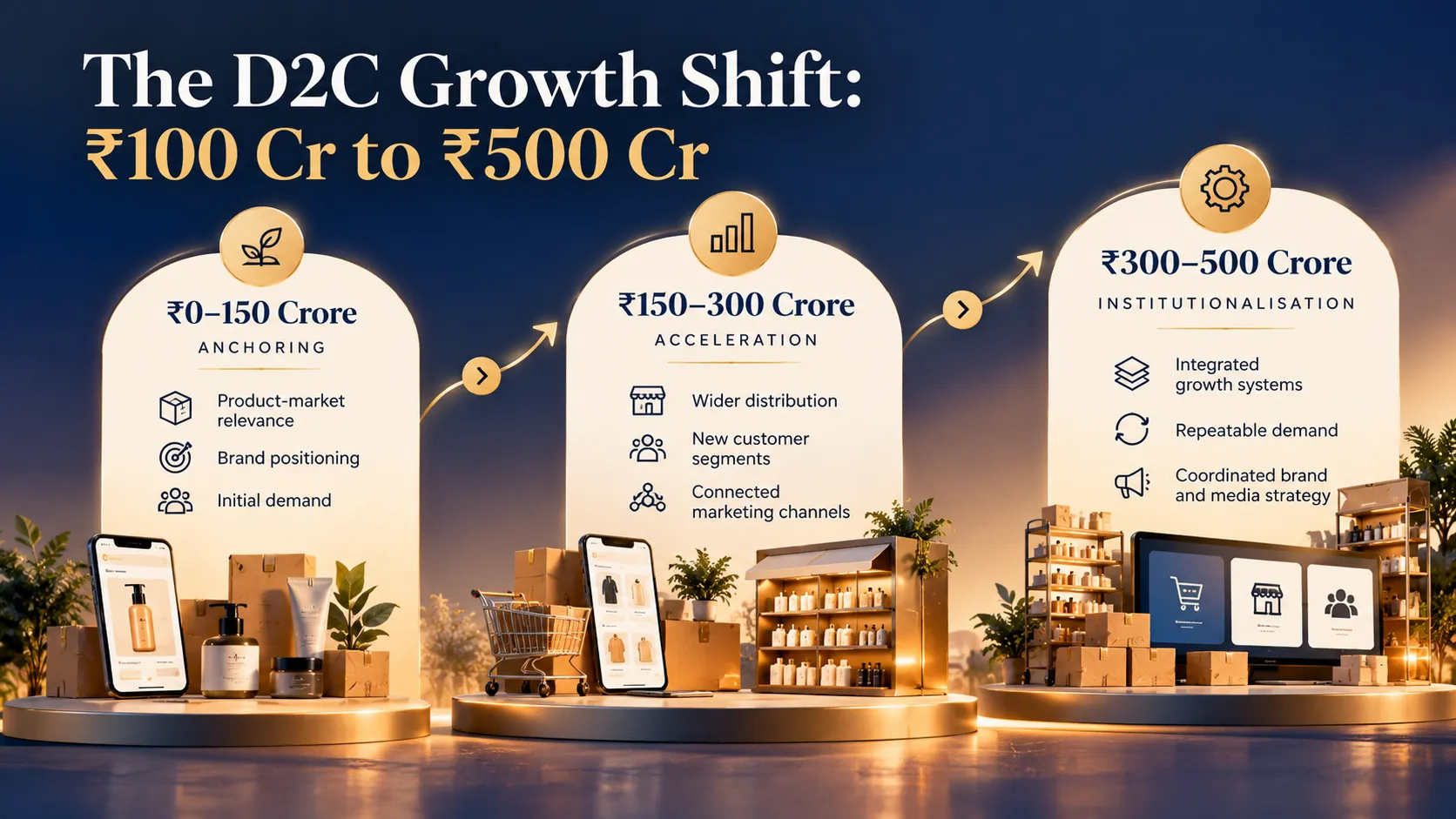
Sustained D2C brand growth requires more than increasing acquisition spend. Three changes can help brands build the capabilities needed for the next stage.
1. Move from product awareness to brand preference
A product may win its first customers because it solves a specific problem, offers an attractive price or performs well in online searches. As competitors enter, those advantages can become easier to match.
The brand then needs a clearer reason to be chosen: distinctive positioning, credible proof and a proposition that customers can recognise and remember.
The report identifies brand positioning, credibility and creative strategy among the areas shaping challenger-brand growth. These are not decorative additions to performance marketing. They help explain why a customer should choose one brand over another.
2. Expand distribution to reach new customers
A digital-first business does not necessarily need to open physical stores everywhere. The decision depends on its category, margins, customer behaviour and operational capacity.
However, the brand should examine whether its existing channels are limiting its reach. Marketplaces, selected retail partnerships, offline distribution and other relevant commerce channels can expose it to customers who would not otherwise encounter the product.
The objective is not to be everywhere. It is to become available in the places where the next relevant customers discover and purchase the category.
3. Build a connected marketing system
Performance advertising, brand advertising, creators, commerce platforms and customer retention should not operate as isolated activities.
The report coverage cites WPP Media findings that consumers exposed to both brand advertising and direct-response performance advertising had 1.8 times higher conversion rates than those exposed only to direct-response ads. This is a reported finding, not a guarantee that every brand will achieve the same result.
The implication is that demand creation and demand capture can reinforce each other. Brand activity can build recognition and consideration; performance campaigns can help convert that interest when customers are ready to buy.
Before spending more, diagnose the constraint
A slowdown does not always mean a brand has exhausted its audience. It could reflect weak repeat purchasing, limited distribution, unclear positioning, rising acquisition costs, operational bottlenecks or a product range that has expanded without a coherent strategy.
Before increasing budgets, leadership should ask:
- Are we reaching new customer segments or repeatedly targeting the same buyers?
- Do customers choose us for a distinctive reason beyond price and promotions?
- Are distribution and product availability restricting sales?
- Are first-time buyers returning, and are the economics sustainable?
- Does our marketing build future demand as well as generate immediate conversions?
The answers should determine the next investment—not the assumption that more media will solve every growth problem.
The Marcom Trends view
The journey from ₹100 crore towards ₹500 crore is not simply a larger version of the journey that came before. It can require new capabilities in distribution, brand strategy, customer understanding and coordinated marketing.
For D2C founders, the critical question is whether the business is still optimising for the customers it already knows—or building the conditions to attract the customers it has yet to reach.
The next growth phase begins when a brand stops asking only how to acquire more customers and starts asking how to create more reasons, occasions and opportunities for people to choose it.