

AI recommendations are becoming an important consideration for businesses that want to remain visible as customers explore options through AI-powered search experiences.
A business can rank first on Google for an important search term and still be missing when a potential customer asks an AI system which companies to consider.
That creates an uncomfortable question for business leaders: if your website is visible in search, why might your brand not appear in an AI-generated answer?
The answer is not simply that traditional SEO no longer works. Google’s own guidance confirms that established SEO fundamentals remain relevant to AI-powered search experiences. But a search ranking and an AI-generated recommendation are not the same outcome.
A ranking makes a page discoverable for a particular query. An AI response may need to synthesise information from multiple sources to answer a broader question, compare options or identify businesses that appear relevant to a particular need.
For a business, this changes the question worth asking. Instead of looking only at where a page ranks, it becomes important to examine whether the business is clearly described, whether its claims are supported, and whether its digital presence helps people—and search systems—understand why it is relevant.
The strategic challenge is no longer just to be found. It is to be understood accurately and considered for the right reasons.
Ranking Well and Being Recommended Are Different Outcomes
Traditional search and AI-generated search experiences can overlap, but they should not be treated as interchangeable.
A traditional search result generally directs a user to a page that may answer a query. An AI-generated response can combine information, explain relationships, compare alternatives or provide a recommendation-style answer. The sources and links shown can vary according to the question and the system generating the response.
Google describes AI Overviews and AI Mode as experiences that can surface supporting links and help users explore more complex questions. It also makes clear that eligibility for these features does not guarantee that a page will appear in them.
This distinction matters because a business may have a well-optimised page without having built a sufficiently clear and credible overall picture of what it does.
Consider a consultancy that ranks well for a phrase related to business growth. Its website may attract visitors searching for that phrase. But a potential customer might ask an AI system a more specific question:
“Which consultancy can help a mid-sized business identify why its marketing generates leads but not enough customers?”
The question is no longer just about the phrase “business growth”. It is about a particular business problem, the expertise needed to diagnose it, and the kind of provider that might be appropriate.
The consultancy’s ranking alone cannot establish whether it will appear in the answer. The clarity of its services, the relevance of its content and the evidence available about its work are all worth examining.
This is not a claim that AI systems follow a single checklist. Different systems use different methods, and their answers can change. It is a way to identify weaknesses that a ranking report may not reveal.
Why a Strong Google Ranking May Not Translate Into AI Recommendations
1. Your content answers a keyword, not the buyer’s wider question

A page can be well aligned with a search phrase and still be too narrow to help a buyer make a decision.
For example, an article targeting “digital marketing strategy” may define the term, outline common channels and explain why planning matters. That can satisfy an informational search.
But a business leader may need to understand how to choose a strategy when sales quality is weak, the brand is poorly differentiated or several marketing channels are producing activity without commercial progress.
Those are related questions, but they require different levels of diagnosis.
The implication is not that every article should become longer. It is that content should address the actual decision or problem behind the search, explain the mechanisms involved, and make clear where a particular solution is relevant.
A useful test is to ask:
- What business problem would lead someone to search for this topic?
- What would they need to understand before choosing a provider or approach?
- Does the page explain the conditions under which its advice applies?
- Does it distinguish between symptoms and underlying causes?
Content that helps answer these questions is more useful to human readers and gives a clearer account of the business problem being addressed.
This broader approach to discoverability connects with our guide to AI search visibility, which explores how businesses can improve their presence as search behaviour evolves.
2. Your brand positioning is difficult to interpret
A business may describe itself as innovative, customer-centric, results-driven and strategic. Those descriptions sound positive, but they do little to distinguish one provider from another.
A clearer positioning statement explains what the business does, whom it helps, which problems it addresses and why its approach is relevant.
Compare two descriptions:
Broad: “We help businesses grow through innovative marketing solutions.”
More specific: “We help growing businesses identify where their marketing, brand positioning and sales process are preventing demand from turning into customers.”
The second description establishes a more concrete business context. It identifies an audience, a problem and areas of work.
That does not guarantee an AI mention or recommendation. It does, however, make the company’s proposition easier for prospective customers to understand and assess.
The same clarity should appear across the website. The homepage, service pages, case studies and articles should reinforce a coherent account of the business rather than describe unrelated capabilities without explaining how they connect.
Brand positioning is therefore not only a messaging exercise. It is a way of making the business intelligible.
A clear proposition also connects brand positioning and business growth, because the way a business is understood influences how its value is evaluated.
3. Your claims are not supported by useful evidence

Many businesses make claims such as “industry-leading expertise”, “proven results” or “trusted growth partner”. Unless these claims are supported by meaningful evidence, they offer little help to a buyer trying to evaluate credibility.
Useful evidence can take several forms:
- Case studies that explain the original problem, the work undertaken and the outcome.
- Named experts with relevant experience and clearly explained responsibilities.
- Original research or analysis that contributes something beyond commonly repeated advice.
- Specific descriptions of methodology, including where the approach works and where it may not.
- Independent sources that corroborate important facts about the business or its field.
Evidence should be proportionate to the claim. A case study should not imply that one result is typical of every engagement. A statistic should have a traceable source. An expert biography should describe real experience rather than rely on inflated titles.
This discipline helps human buyers evaluate a company and strengthens the overall quality of its digital presence.
This approach is consistent with Google’s guidance on generative AI content, which emphasises creating content that provides value for users rather than producing pages at scale without meaningful added value.
It is also consistent with Google’s guidance to create helpful, reliable, people-first content rather than generate pages at scale without adding meaningful value.
4. Your digital presence sends inconsistent signals
Imagine that a company’s website describes it as a strategic business-growth adviser, its service pages focus almost entirely on routine marketing execution, and its articles cover unrelated topics without a consistent point of view.
Each individual page may be understandable. Taken together, however, they may leave a prospective customer uncertain about the company’s core expertise.
Inconsistency can also arise when service names differ across pages, leadership biographies are outdated, case studies describe capabilities the current website no longer explains, or third-party profiles contain conflicting business information.
The answer is not to repeat the same keywords everywhere. It is to establish a consistent and accurate account of the business while allowing each page to serve a distinct purpose.
Reviewing brand positioning and brand identity can help distinguish the market position a business wants to own from the visual and verbal identity used to express it.
A practical review should examine:
- Whether the core business description is consistent.
- Whether each service has a clear scope and intended audience.
- Whether articles reinforce relevant areas of expertise.
- Whether evidence supports the claims being made.
- Whether outdated or contradictory information needs to be corrected.
A coherent presence benefits customers first. It also reduces avoidable ambiguity in the information available about the business.
5. Your measurement stops at rankings and traffic
Rankings, impressions and website sessions remain useful measures. They show whether parts of a search strategy are generating visibility and attracting visits.
But they do not tell the whole commercial story.
Research suggests that AI summaries can change how people interact with traditional search results. In an analysis of Google browsing activity from March 2025, Pew Research Center found that users clicked a traditional search result in 8% of visits when an AI summary appeared, compared with 15% of visits when no AI summary appeared. These findings describe the US browsing sample studied at that time; they should not be treated as universal or current click-through rates for every business or search platform.
If customers increasingly use AI-generated summaries or recommendation-style answers during discovery, some relevant interactions may not produce a traditional website visit. At the same time, a mention in an AI answer may not indicate meaningful buyer intent, and an isolated mention may be difficult to reproduce.
Businesses therefore need a broader measurement approach without abandoning established SEO reporting.
Alongside rankings and organic traffic, examine:
- Which search queries lead people to important service pages.
- Whether organic visitors engage with relevant content or take meaningful next steps.
- Whether qualified enquiries and opportunities can be connected to organic discovery.
- Whether the brand appears in a consistent way across a defined set of relevant AI queries.
- Which sources are cited in AI responses, where observable.
- Whether changes in visibility are followed by changes in qualified demand.
AI visibility checks should be treated as directional observations, not as a complete or standardised measure of performance. Responses can vary by platform, location, timing, wording and context.
The purpose is to improve business understanding—not to replace one vanity metric with another.
The Five-Part Brand Visibility Framework
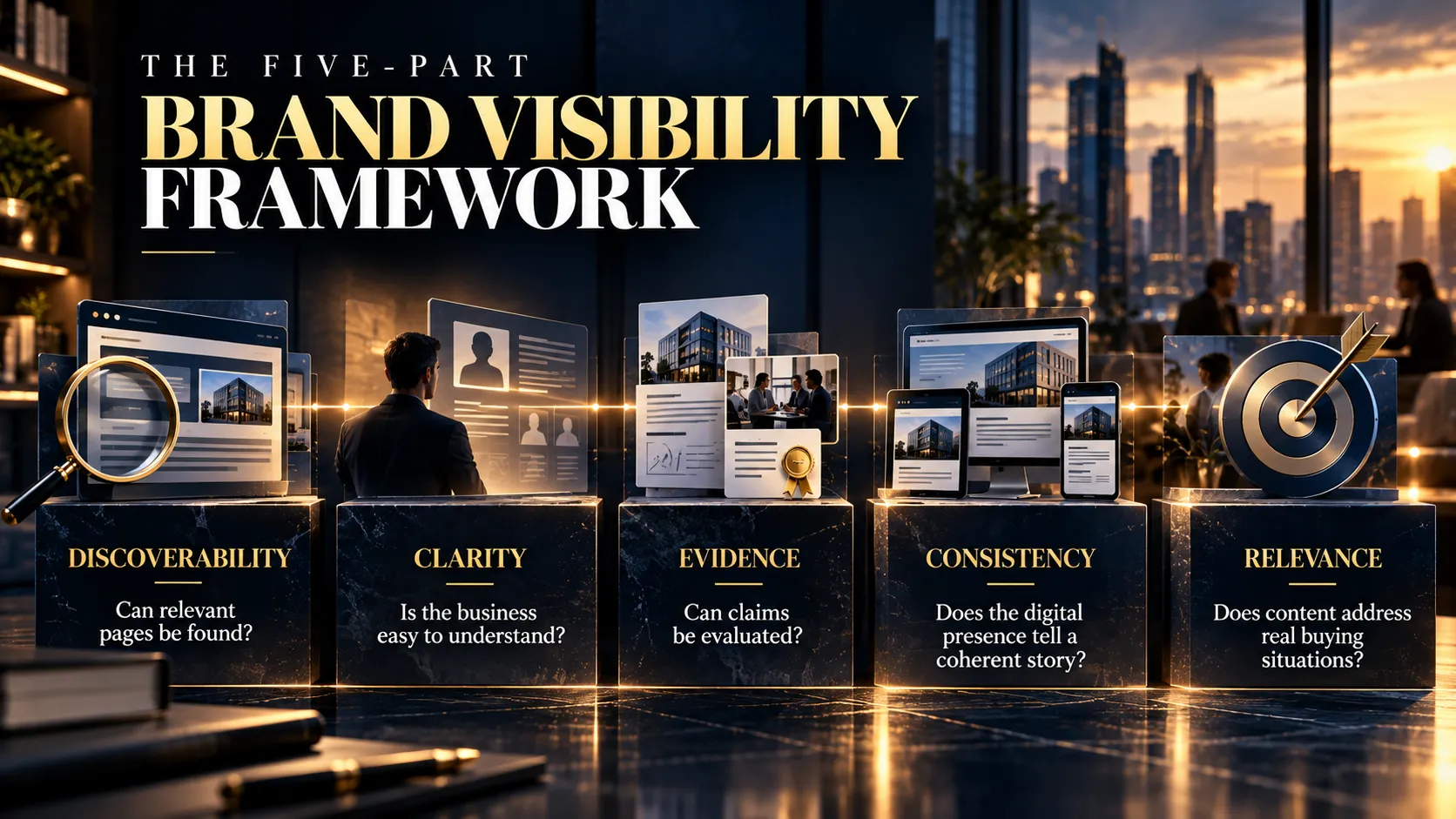
Marcom Trends’ framework for addressing the gap between search visibility and being considered by potential customers has five parts: Discoverability, Clarity, Evidence, Consistency and Relevance.
These are strategic areas to audit, not a ranking formula or a guarantee of AI recommendations.
1. Discoverability: Can relevant pages be found?
Start with technical and content fundamentals. Important pages should be accessible to search engines, indexable where intended, internally linked and useful for the topics they address.
Review page titles, headings, page structure and internal links. Check for accidental noindex directives, crawl issues, broken links or competing pages targeting the same intent.
Google’s official guidance says the same foundational SEO practices apply to its AI search features. There is no separate technical checklist that guarantees inclusion.
2. Clarity: Is the business easy to understand?
Review the homepage, service pages, about page and key articles.
Can a prospective customer quickly understand what the business does, whom it serves, which problems it solves and how its services differ?
Replace vague descriptions with precise explanations. Use terminology customers understand. Define specialist terms when necessary. Make the relationship between the business’s expertise and its audience’s problems explicit.
3. Evidence: Can important claims be evaluated?
Audit the proof behind the company’s main claims.
Add substantive case studies, explain the reasoning behind your methodology, identify genuine subject-matter expertise and cite reliable sources for factual claims.
Where evidence is unavailable, narrow the claim rather than making it sound more certain than it is.
4. Consistency: Does the wider presence tell a coherent story?
Compare the website, service descriptions, leadership information, case studies and relevant third-party profiles.
Correct outdated details and resolve contradictions. Build a connected content architecture in which articles support core areas of expertise and link naturally to relevant service pages.
Consistency does not mean identical wording on every platform. It means the underlying facts and business proposition remain coherent.
5. Relevance: Does the content address real buying situations?
Move beyond publishing solely to target keywords.
Create useful content around the problems customers are trying to solve, the trade-offs they need to understand, the questions they ask before buying, and the criteria they use to evaluate alternatives.
For example, a business-growth consultancy might cover not only growth strategy but also the reasons lead generation fails to produce customers, the relationship between brand positioning and sales quality, and the decisions involved in choosing an advisory partner.
This gives readers a connected body of thinking rather than a collection of disconnected pages.
The five parts work together as a diagnostic framework. A technically accessible website with unclear positioning still has a clarity problem. A clearly positioned company with unsupported claims has an evidence problem. Improving one area does not guarantee that every AI system will mention the business, but the exercise can reveal weaknesses that rankings alone leave hidden.
What Businesses Should Do Differently
The practical response is not to abandon SEO, create hundreds of AI-targeted pages or chase every new optimisation tactic.
Instead, organise the work into three stages.
First, audit the existing foundation. Identify the most commercially important services and pages. Check indexability, technical accessibility, internal links, positioning, evidence and consistency. Correct obvious weaknesses before producing more content.
Second, strengthen the content that matters most. Prioritise the pages that explain the business, its services, its expertise and the problems it solves. Improve them with substantive examples, precise language, relevant evidence and clear connections to other useful content.
Third, test visibility and commercial outcomes. Select a small set of realistic questions that potential customers might ask AI systems. Test them consistently across the platforms relevant to your audience, recording the date, exact wording, response and cited sources where available. Repeat the tests rather than drawing conclusions from a single answer.
Compare those observations with Search Console data, website analytics and qualified-enquiry trends. Keep the limitations visible: AI responses vary, attribution can be incomplete, and a change in mentions does not automatically establish a cause-and-effect relationship with sales.
The goal is to build a better-informed search and brand strategy, not to promise control over systems a business does not own.
How to Measure Progress Without Chasing AI Mentions

A useful measurement approach separates three questions.
Is the business discoverable? Monitor indexability, organic impressions, relevant rankings and the performance of important landing pages.
Is the business being understood and considered? Review the clarity of service enquiries, the quality of customer conversations, relevant referral paths and repeatable observations from a defined set of AI queries.
Is discovery contributing to business growth? Examine qualified leads, opportunity progression, sales conversations and revenue where reliable attribution is available.
These measures should not be collapsed into one score without a defensible methodology. A ranking, an AI mention, a website visit and a qualified opportunity represent different stages and types of evidence.
For example, a business may see an increase in AI mentions without an increase in qualified enquiries. That could indicate weak buyer intent in the tested questions, a mismatch between the answer and the service, insufficient demand, or simply the limits of the measurement. It should prompt investigation rather than a declaration of success.
Likewise, the absence of an AI mention in a small set of tests does not establish that a brand is invisible across all AI experiences.
The strongest reporting connects observable search performance to the outcomes that matter commercially while treating emerging AI visibility measures with appropriate caution.
Conclusion
Ranking first on Google remains a meaningful achievement. It can demonstrate that a page is competitive for a particular search. It does not guarantee that the business will be included in an AI-generated answer or recommended when a buyer describes a more complex need.
The response is not to choose between traditional SEO and AI search. It is to build on sound search fundamentals while improving the quality and coherence of the business’s digital presence.
That means being discoverable, explaining the business clearly, supporting claims with evidence, maintaining consistency and addressing relevant customer problems in depth.
These are not shortcuts to guaranteed AI recommendations. They are fundamentals of a credible, useful and commercially effective brand presence.
For business leaders, the more valuable question is therefore not simply, “Are we ranking?”
It is: “When a potential customer is trying to understand a problem and evaluate their options, is our business clearly relevant, credible and worth considering?”
That is the standard worth building towards.