

A new logo can make a business look different. A new visual identity can make it feel more current. But neither guarantees that customers will understand the offer, see greater value in it, or choose the business over its competitors.
That distinction matters when growth slows.
Leads may be arriving, but too few are converting. Prospects may understand what a business sells without understanding why it is the better choice. Sales conversations may repeatedly return to price. Or the company may have expanded its capabilities while its market perception remains tied to an earlier version of the business.
These problems can make the brand feel outdated or ineffective. Rebranding then appears to be a tangible way forward: change the identity, relaunch the business and give the market a new reason to pay attention.
Sometimes that is the right decision. But sometimes the brand is being asked to solve a problem that belongs elsewhere.
The important question is not whether the brand needs to change. It is what needs to change for the business to grow.
Rebranding, repositioning, improving the offer and correcting marketing execution address different problems. Choosing between them requires a diagnosis before a design brief.
Understanding rebranding vs repositioning helps establish whether growth requires a new identity, a clearer market position or a different business intervention.
Rebranding vs Repositioning: Why the Distinction Matters
Rebranding and repositioning are related, but they are not interchangeable.
The decision between rebranding vs repositioning should follow evidence about what is limiting growth, not simply a preference for a different visual identity.
Understanding rebranding vs repositioning is the first step in deciding whether a growth problem requires a new brand identity, a clearer market position or a different business intervention.
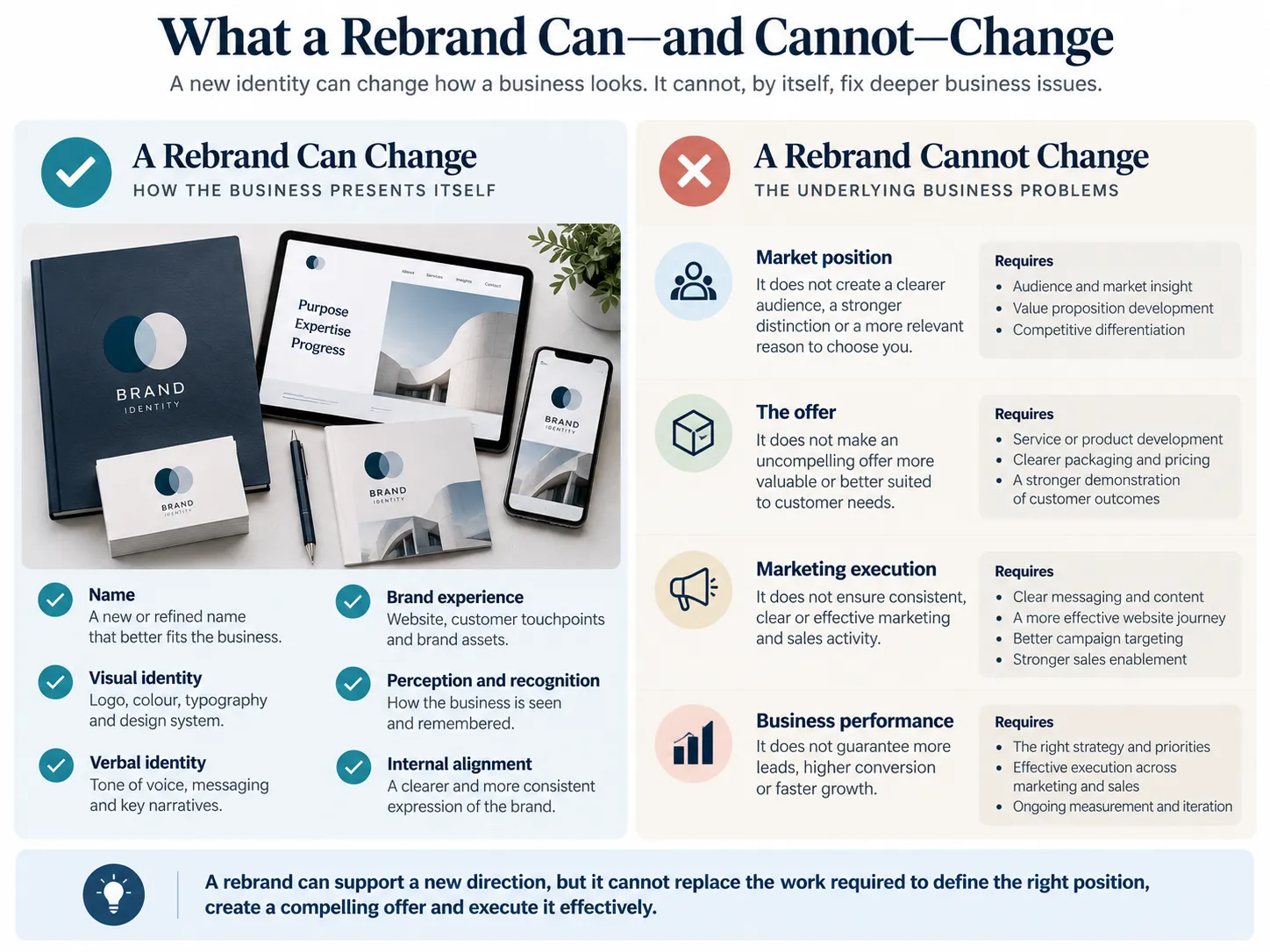
Rebranding changes how a business presents and expresses itself. Depending on its scope, it can involve the name, visual identity, verbal identity and wider brand experience. A refresh is a lighter intervention that updates selected elements while retaining more of the existing brand.
The distinction matters because brand positioning and brand identity serve different roles: positioning establishes the place a business wants to occupy in the customer’s mind, while identity shapes how the brand is expressed and recognized.
The two can happen together. If a company has changed its strategy substantially, its existing identity may no longer communicate what it has become. In that case, repositioning may establish the new strategic direction, while rebranding helps express it. Research on rebranding also treats it as a multidimensional process rather than simply a visual redesign.
But neither change is automatically necessary whenever growth becomes difficult.
Consider a B2B consultancy whose website looks dated. If buyers understand its expertise, value its approach and recognise its difference from competitors, a focused identity refresh may be sufficient.
Now consider a consultancy whose website looks polished but describes its services in the same terms as every competing firm. The issue may be its positioning, not its appearance.
A third consultancy may have clear positioning and a credible identity, yet struggle because its offer is poorly packaged or its sales process fails to demonstrate value. A new brand will not resolve that problem by itself.
The distinction is commercially important. Before investing in a visible change, a business needs to establish which part of the system is actually limiting growth.
Four Growth Problems That Are Often Mistaken for a Branding Problem
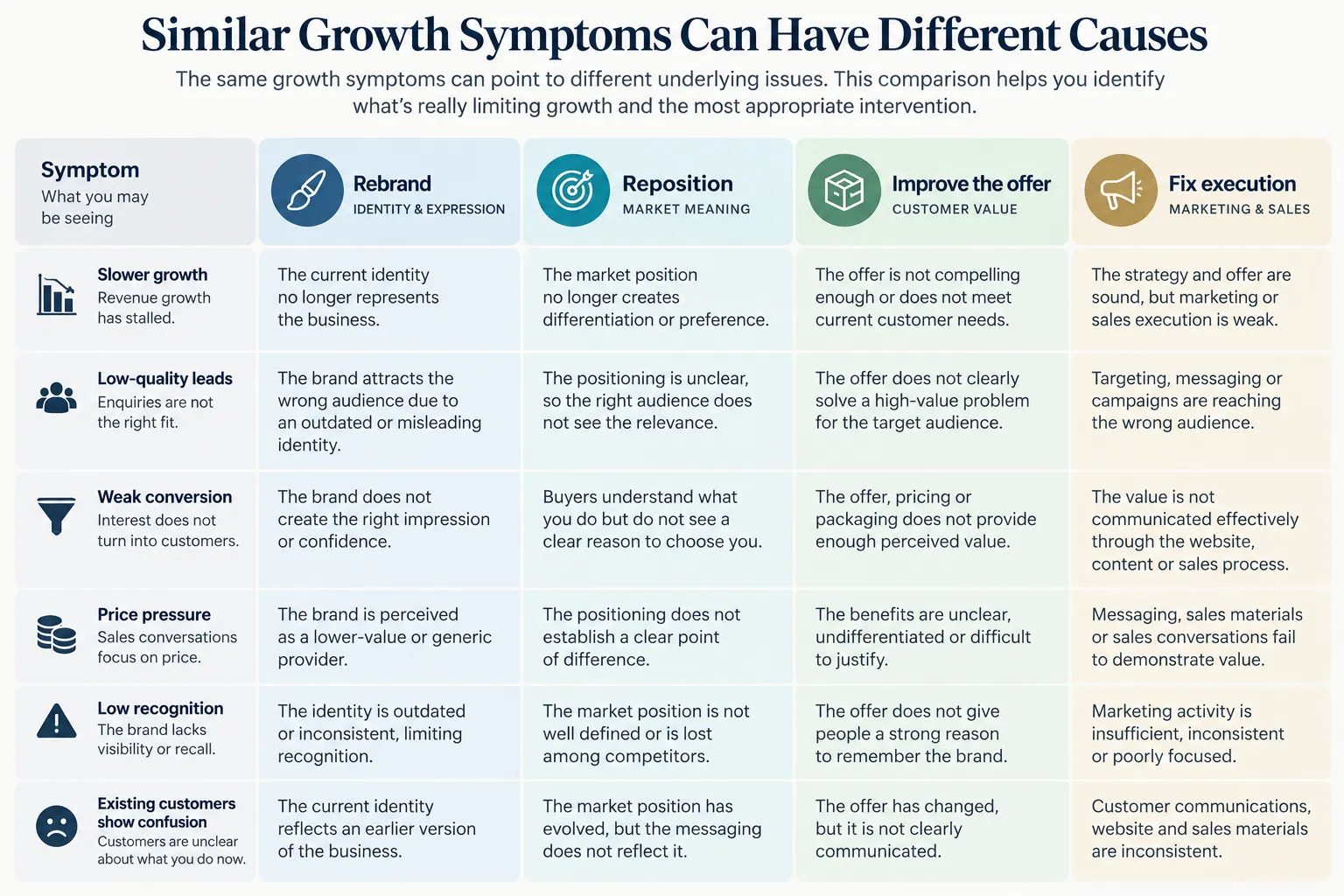
1. The identity no longer represents the business
Sometimes the brand really has become a constraint.
A business may have moved from a narrow service to a broader advisory offering. It may have entered a new market, developed a different business model or begun serving customers whose expectations differ from those of its original audience.
Its name, identity or brand experience may now communicate a business that no longer exists.
For example, a specialist provider that has evolved into a broader strategic partner may still present itself as a supplier of one tactical service. If that mismatch creates confusion or undermines credibility with the intended audience, an identity change may be justified.
The test is whether the current identity misrepresents the business or prevents it from communicating its genuine direction—not whether the leadership team has grown tired of the logo.
2. The business has not established a compelling market position
A different problem arises when customers cannot clearly answer three questions:
- What does this business do particularly well?
- Who is it best suited to help?
- Why should a buyer choose it over a credible alternative?
If the answers remain vague, a new visual identity may simply make the same unclear proposition look more polished.
Repositioning may be needed to clarify the target audience, the problem the business solves, its distinctive value and the alternatives against which it competes.
The identity can then be assessed against that direction. It may need a substantial change, a modest refresh or no major redesign at all.
This is why a positioning problem should not automatically become a rebranding project. The strategic choice comes first; the creative expression should follow.
3. The offer does not create enough perceived value
Sometimes the business is clear about its audience and its positioning, but the offer itself is not compelling enough.
The scope may be poorly defined. The benefits may be difficult to distinguish from competing alternatives. The package may not match what customers need, or the price may be difficult to justify against the perceived outcome.
These are offer and value problems.
A rebrand may attract attention, but attention does not make an unconvincing offer more useful. Nor does a new brand promise create value that the business cannot deliver.
The appropriate response may involve changing the service structure, sharpening the value proposition, improving the customer experience or demonstrating outcomes more convincingly.
Brand strategy still matters here. It helps communicate value. But it cannot substitute for value itself.
4. The strategy is sound, but marketing execution is weak
A business can have a relevant position, a strong offer and an appropriate identity while still struggling to generate results.
Its website may bury the most important message. Campaigns may attract the wrong audience. Sales materials may use different explanations of the offer, or marketing may fail to give buyers enough evidence to trust the business.
In this situation, the problem is execution.
The first task is to identify where the intended value is being lost between the business’s strategy and the customer’s experience. A clear strategy should translate positioning into marketing decisions, from website messaging and campaign priorities to sales materials and customer touchpoints. The solution might be clearer messaging, a more effective website journey, better qualification or stronger sales enablement.
Changing the identity before examining these issues risks adding a new layer of work without correcting the original weakness.
The Growth Intervention Test: What Should You Change First?
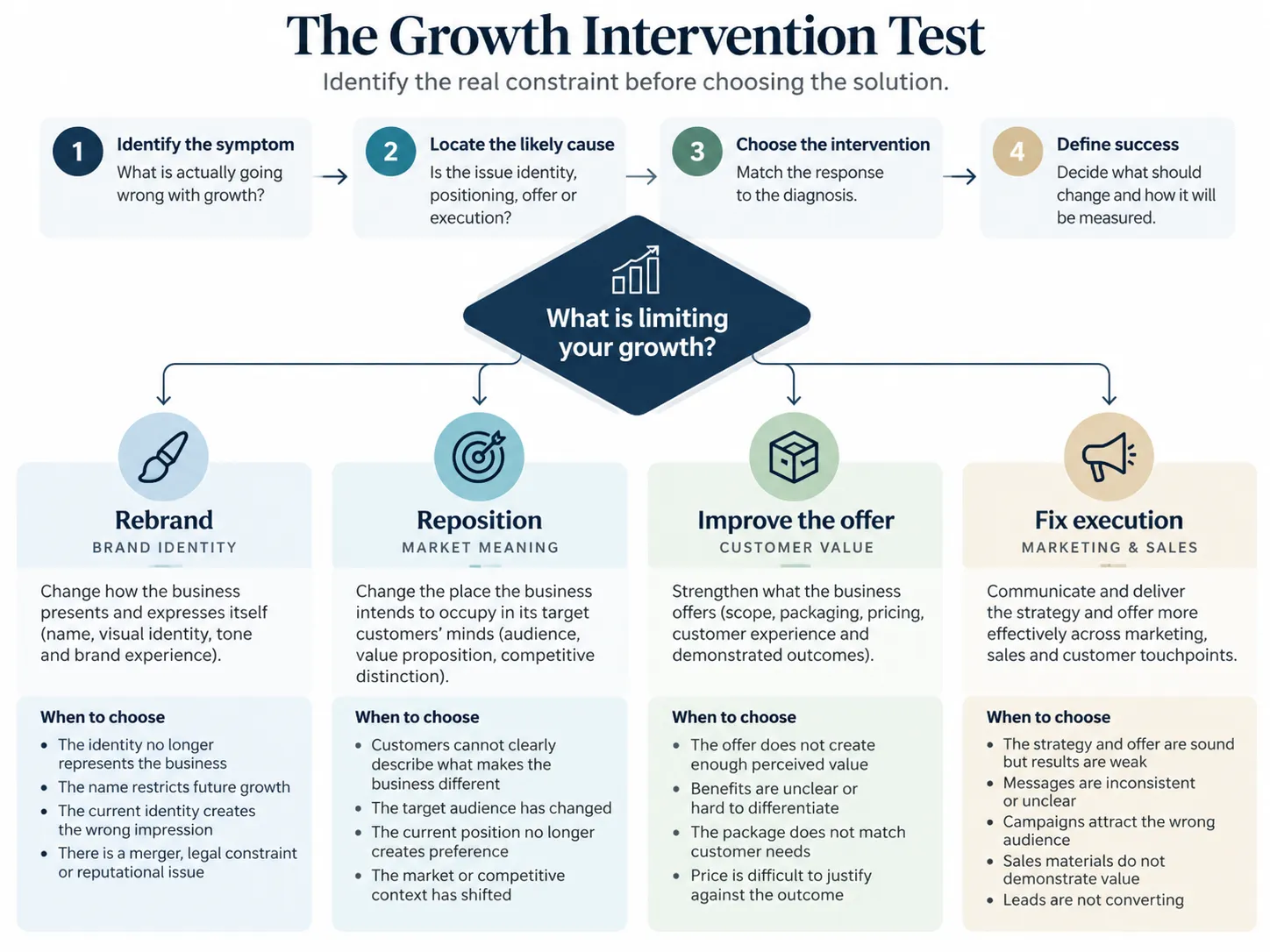
When several problems look similar from the outside, it helps to separate the symptom from its likely cause.
Use this four-stage test before approving a rebrand or repositioning project.
Step 1: Identify the symptom
What is actually going wrong? Is the business losing qualified opportunities, struggling to justify its price, attracting the wrong audience, or failing to communicate its value?
Avoid treating a broad statement such as “our brand is not working” as a diagnosis.
Step 2: Locate the likely cause
Examine customer feedback, lost-deal reasons, website behaviour, sales conversations, competitor alternatives and the clarity of the offer.
Look for evidence that distinguishes an identity issue from a positioning, offer or execution issue. For example, if customers understand the offer but consistently see it as interchangeable with competitors, positioning deserves closer scrutiny. If customers understand and value the offer but the identity misrepresents the business, identity may be the more relevant issue.
These signals are clues, not proof. Confirm them before committing to a major change.
Step 3: Choose the appropriate intervention
Match the response to the diagnosis:
- Rebrand or refresh the identity when the expression of the business is outdated, misleading or unsuitable for its intended direction.
- Reposition the brand when the intended audience, competitive meaning or reason to choose the business needs to change.
- Improve the offer when the value, packaging, relevance or customer experience is not compelling enough.
- Fix marketing and sales execution when the strategy and offer are sound but are not being communicated or delivered effectively.
Several interventions may be necessary. The objective is to understand their relationship and sequence the work deliberately.
Step 4: Define the evidence of success
Decide what the intervention is expected to change before work begins.
Depending on the diagnosis, that could mean stronger buyer understanding, more relevant enquiries, improved conversion, less price-led selling or greater consistency across customer touchpoints.
Choose measures that relate to the original problem. A successful launch, positive internal feedback or a more attractive website does not, by itself, establish a commercial improvement.
This framework is a practical decision aid, not a substitute for research. Its purpose is to help leaders ask better questions before committing resources.
When Rebranding Really Is the Right Decision
Avoiding unnecessary rebranding does not mean preserving an identity at all costs.
There are situations in which the existing brand has become a genuine barrier to the next stage of the business.
The business has materially changed. A new business model, a substantial shift in services or a different strategic direction may leave the current identity communicating an outdated promise.
The name restricts future growth. A name tied too closely to one product, location or narrow service may no longer represent the business’s intended scope. This should be established through strategic and naming analysis, not assumed simply because expansion is planned.
The current identity creates the wrong impression. If research shows that the identity consistently signals the wrong category, level of expertise or audience fit, changing it may help align perception with reality.
There is a merger, legal constraint or serious reputational issue. These situations can make a name or broader identity change necessary. However, a new identity alone cannot resolve the operational or reputational problem that created the need for change.
In each case, the decision should begin with a clear reason for change and a realistic understanding of what the rebrand can—and cannot—achieve.
A rebrand can help communicate a new direction, but the business must also deliver on that direction. It may require changes to messaging, customer experience, internal understanding and the way the organisation fulfils its promise.
The Cost of Choosing the Wrong Intervention
The cost of a misguided rebrand is not limited to design fees.
A business may spend time rebuilding its website, replacing collateral, updating sales materials, changing customer communications and introducing a new identity across its channels. It may also need to help existing customers understand what has changed and why.
Those activities can be justified when the brand genuinely needs to change. The risk is undertaking them before resolving the problem the investment is supposed to address.
If positioning remains unclear, a new identity inherits that ambiguity. If the offer is weak, the business will still struggle to demonstrate value. And if execution is inconsistent, a new visual system may simply be applied inconsistently. These are among the commercial consequences of weak positioning: marketing can become more expensive without making the business easier to choose.
There is also a cost to changing a brand that still carries recognition and trust. Research into brand identity elements highlights why consumer associations matter: elements that marketers consider expendable may carry recognition value for customers. That makes testing assumptions about existing brand assets important before replacing them.
A business should therefore understand which elements of its existing identity have value before discarding them.
This is why the decision should be based on evidence and scope. The objective is not to choose the smallest project automatically. It is to choose the intervention that addresses the actual constraint without creating unnecessary disruption.
Five Questions to Answer Before Committing to a Rebrand
Before approving a major identity project, leadership should be able to answer five questions.
1. What specific business problem are we trying to solve? Define the symptom in concrete terms rather than using “the brand feels old” as the entire rationale.
2. What evidence connects that problem to the brand? Use customer feedback, market research, sales patterns or other relevant evidence. Internal dissatisfaction is a reason to investigate, not proof of the cause.
3. Is the problem about identity, market position, the offer or execution? These areas interact, but they require different responses.
4. What should remain unchanged? Identify existing recognition, trust, customer associations and other assets worth preserving.
5. How will we evaluate the result? Set realistic measures linked to the original problem. A successful launch or positive internal reaction does not, by itself, establish a commercial improvement.
If these questions cannot be answered, the next step is not necessarily to cancel the rebrand. It is to complete the diagnosis before committing to the solution.
Diagnose the Growth Problem Before Changing the Brand
A business that is not growing may genuinely need a rebrand. It may need repositioning instead. Or it may have a clear, relevant brand and a problem that sits elsewhere in the business.
The mistake is treating the most visible part of the problem as the cause.
Rebranding is most useful when it helps the business represent a genuine change, correct a meaningful identity mismatch or support a clearly defined strategic direction. It is much less useful when it is expected to compensate for an unclear position, an unconvincing offer or ineffective execution.
The order matters: understand the problem, choose the intervention, then invest in the change.
If the cause of slow growth is unclear, a structured review of brand, marketing, sales and business priorities can help identify where the real constraint sits. The Business Growth Diagnostic™ examines these areas to uncover clarity gaps and growth barriers, then identify priorities for action.
Before changing how the business looks, establish what the business needs to change—and why.