

A business can spend more on marketing without becoming more effective at marketing.
The campaigns get bigger.
The content calendar gets fuller.
The agency produces more creative.
The sales team follows up with more prospects.
The company adds another channel.
The advertising budget increases.
And yet the business still feels difficult to explain.
Prospects ask basic questions.
Sales conversations take too long.
Marketing keeps changing its message.
Competitors sound similar.
Price becomes part of too many conversations.
And the business starts wondering whether it simply needs to spend more.
Sometimes it does.
But sometimes the real problem is further upstream.
The market does not have a clear enough reason to choose the business.
That is where weak brand positioning becomes expensive.
Brand positioning is the process of defining the position a business occupies relative to its competitors and target audience. The American Marketing Association also describes positioning as a guide for communicating a brand’s value and benefits to its target audience.
The important part is what happens next.
If that position is unclear, marketing has to compensate.
Every campaign has to explain more.
Every piece of content has to establish relevance from scratch.
Every sales conversation has to do more work.
And every channel has to carry some of the burden of differentiation.
The result isn’t necessarily a higher invoice from an agency.
The real cost is broader:
More effort. More repetition. More wasted attention. More difficult conversion.
That is the hidden cost of weak positioning.
Weak Positioning Doesn’t Always Look Like a Branding Problem
Positioning problems rarely arrive saying:
“Your positioning is weak.”
They usually appear somewhere else.
Marketing says the campaigns aren’t performing.
Sales says leads aren’t qualified.
The founder says prospects don’t understand the business.
The content team says they have run out of things to say.
The website gets traffic but generates few enquiries.
The sales team keeps explaining the same things.
The business starts competing on price.
Then someone suggests:
“Maybe we need more marketing.”
This is where the diagnosis can go wrong.
The business may indeed need more marketing.
But before increasing activity, it is worth asking:
What is the marketing currently being asked to accomplish?
If marketing has to simultaneously explain the category, identify the target customer, establish credibility, differentiate the offer and create urgency, the problem may not be a lack of marketing.
The problem may be that the strategic foundation underneath the marketing is doing too little work.
This is why brand positioning and business growth are closely connected: when the position is unclear, the problem can extend well beyond marketing communication.
That is the distinction between a marketing activity problem and a positioning problem.
Marcom Trends’ existing marketing strategy diagnosis makes a similar diagnostic point: when positioning is weak, every advertisement, sales conversation and piece of content can require more effort to create distinction.
What Weak Brand Positioning Actually Does to Marketing
A useful way to think about the relationship is:
Weak Positioning
↓
More Explaining
↓
More Marketing Effort
↓
More Competition for Attention
↓
Harder Differentiation
↓
Harder Conversion
↓
Higher Effective Cost of Growth
This is not a claim that every business with weak positioning will automatically see a specific percentage increase in advertising costs.
It is a strategic mechanism.
The weaker the position, the more work downstream functions often have to perform to create the clarity that should have existed earlier.
There are several ways this happens.
1. Your Marketing Has to Explain the Business Before It Can Sell the Business
Strong positioning gives marketing a starting point.
It tells the market:
- who the business is for
- what problem it is relevant to
- what it wants to be known for
- how it differs
- why that difference matters
Weak positioning removes that shortcut.
So the advertisement has to start with explanation.
The website has to start with explanation.
The sales presentation has to start with explanation.
The social content has to start with explanation.
Consider the difference.
Weak positioning
We provide innovative business solutions for growing companies.
It may be true.
But what does the buyer actually understand?
Who is this for?
What problem does it solve?
What makes the business different?
Why this company rather than another?
The marketing now has to answer all of those questions.
Stronger positioning
We help founder-led businesses identify and remove the strategic constraints preventing their next stage of growth.
Now marketing has something more specific to reinforce.
The audience is clearer.
The problem is clearer.
The relevance is clearer.
The content can go deeper because it does not have to spend every sentence introducing the business.
Clear positioning reduces the explanatory burden placed on marketing.
2. Weak Positioning Makes Every Campaign Work Harder
A campaign has limited attention.
The customer may give you a few seconds.
If the business is difficult to distinguish, the campaign has to spend some of that limited attention explaining what the business actually means.
That creates a difficult sequence:
Attention → Explanation → Differentiation → Trust → Consideration → Action
Ideally, the positioning makes the early part of that sequence easier.
When it doesn’t, the campaign has to carry more weight.
This is particularly difficult in competitive categories.
Imagine ten companies all saying:
Experienced team.
Customer-first approach.
Innovative solutions.
End-to-end service.
Proven results.
Each statement may be legitimate.
Together, they create very little distinction.
Harvard Business Review’s work on brand positioning makes a related point: effective positioning isn’t only about having points of difference; brands also need to understand their competitive frame of reference and the points they share with competitors.
The goal isn’t to sound different.
It is to create a meaningful reason to choose.
3. Weak Positioning Creates a Content Problem
This is one of the less obvious costs.
A business with clear positioning has a strategic territory it can repeatedly explore.
A business with weak positioning often has to keep inventing topics.
The content team asks:
What should we post this week?
Then:
What should we post next week?
Then:
What else can we say?
Eventually the content becomes generic.
Tips.
Quotes.
Industry observations.
Company updates.
Product announcements.
Promotional posts.
Nothing is necessarily wrong with any individual piece.
But there is no strong idea connecting them.
That creates a strange paradox:
The business is producing more content because it doesn’t have enough strategic clarity to know what it should consistently stand for.
Strong positioning does the opposite.
It creates boundaries.
It tells the business:
These are the conversations we should own.
And just as importantly:
These are the conversations we don’t need to chase.
That makes content creation more focused.
4. Weak Positioning Makes Audience Targeting Less Efficient
Positioning and audience selection are closely connected.
If the business wants to be relevant to everyone, the marketing message usually becomes broad enough to avoid excluding anyone.
That sounds safe.
It often makes the message less powerful.
Compare:
Marketing services for businesses.
with:
Brand-led growth strategy for founder-led businesses that have outgrown their current positioning.
The second statement will not appeal equally to everyone.
That’s precisely the point.
A strong position is supposed to create relevance for some people more strongly than for everyone equally.
That can improve the efficiency of marketing because the business has a clearer idea of who it wants to attract.
The American Marketing Association describes positioning in relation to competitors and target audiences, reinforcing that positioning isn’t simply a visual branding exercise.
Weak positioning often produces a broad audience.
A broad audience produces broader messaging.
Broad messaging makes differentiation harder.
And marketing ends up paying to reach people who may never have been the right customers.
5. Weak Positioning Pushes Marketing Toward Price
Price is not always a positioning problem.
Some customers will always compare price.
Some categories are naturally price-sensitive.
And sometimes the lower-priced option genuinely wins.
But when customers cannot see meaningful differences between competing businesses, price becomes an easier comparison mechanism.
Imagine three businesses offering what appears to be the same service.
Same category.
Similar promises.
Similar website language.
Similar credentials.
Similar deliverables.
What can the buyer compare?
Often:
Price.
This is one reason differentiation matters commercially.
Research and strategy work on positioning has long connected distinctiveness with customer choice and pricing outcomes. HBR’s work on the centrality-distinctiveness framework, for example, explicitly connects brand position with business outcomes such as sales and price.
The important lesson is not:
“Good positioning lets you charge more.”
That is too simplistic.
The better lesson is:
Meaningful differentiation gives customers more than price to evaluate.
That changes the conversation.
6. Weak Positioning Creates More Work for Sales
Marketing and sales are often treated as separate functions.
Positioning connects them.
Suppose a prospect arrives after seeing an advertisement.
Marketing has described the business one way.
The website describes it another.
The prospect still isn’t sure why the company is different.
The salesperson now has to rebuild the argument.
They explain the category.
They explain the problem.
They explain the company’s approach.
They explain why it is different.
They establish credibility.
Then they finally discuss the actual opportunity.
That’s expensive organisationally.
Not necessarily because the salesperson’s salary has increased.
Because valuable sales time is being spent explaining what the business should have made easier to understand before the sales conversation began.
A stronger position gives marketing and sales a shared strategic foundation.
The message can change by channel.
The explanation shouldn’t change at its core.
7. Weak Positioning Can Increase the Cost of Poor-Fit Leads
This is where positioning connects to lead quality.
A vague message can attract a large number of people.
That may look successful in a dashboard.
More enquiries.
More downloads.
More calls.
More leads.
But what if the majority are not a good fit?
The business then spends money acquiring attention that sales cannot use efficiently.
This creates a misleading growth equation:
More leads ≠ better marketing.
The more useful equation is:
Relevant audience → qualified demand → meaningful opportunities → customers
If positioning is unclear, the first part of that chain can become noisy.
The marketing attracts attention without sufficiently signalling:
Who this is really for.
Marcom Trends’ existing article on lead quality explores this broader distinction between lead volume and commercially useful demand.
The positioning question comes even earlier:
Have you given the right customer enough reason to recognise that your business is for them?
8. Weak Positioning Creates Creative Fatigue
There is another cost that doesn’t appear neatly in a marketing dashboard.
Creative fatigue.
When a brand lacks a strong strategic idea, teams often compensate by constantly changing execution.
New campaign.
New headline.
New visual.
New offer.
New content format.
New messaging.
New agency.
New campaign again.
The business keeps changing the surface because the underlying idea isn’t strong enough to sustain repetition.
But repetition is not inherently a problem.
In fact, important brand ideas often need repetition to become associated with a business.
The problem is repetition without meaning.
Strong positioning gives the business something worth repeating.
Weak positioning creates pressure to constantly invent.
That can increase creative workload without necessarily improving brand memory.
9. The Real Cost Is Not Always the Marketing Budget
This distinction matters.
When we say weak positioning can make marketing more expensive, we shouldn’t reduce the idea to:
“Your advertising CPC will definitely increase.”
That is too narrow.
The broader cost can appear as:
More content required
Because the business keeps explaining itself.
More creative variations
Because the message isn’t landing clearly.
More sales effort
Because prospects need more explanation.
More poor-fit enquiries
Because the audience isn’t being filtered clearly.
More price conversations
Because differentiation isn’t obvious.
More campaign changes
Because each campaign tries to solve a strategic problem.
More internal debate
Because teams don’t share a clear idea of what the brand should stand for.
More wasted attention
Because the business reaches people without creating enough relevance.
This is the hidden cost of weak positioning.
The business may not know exactly how much it is spending to compensate for the problem.
But it can often see the symptoms.
A Simple Diagnostic: Is Your Marketing Paying the Positioning Tax?
Before increasing your marketing budget, ask these seven questions.
1. Can a prospect explain what makes us different?
Not what you do.
Not how long you’ve been doing it.
Not how many services you offer.
Why should they choose you?
If the answer is vague, investigate positioning.
2. Does our marketing require a lot of explanation?
Look at your homepage, advertisements and social content.
How much space is spent explaining the business before the customer gets to the reason it matters?
If the explanation is consistently long, the positioning may not be doing enough work.
3. Do different teams describe the business differently?
Ask the founder.
Ask sales.
Ask marketing.
Ask someone who joined recently.
If you get four different versions of the business, there may be a strategic clarity problem.
4. Are we attracting attention from the wrong people?
Don’t just count enquiries.
Look at who is enquiring.
If marketing creates volume but sales repeatedly says:
“These aren’t our customers,”
look upstream.
The issue may be targeting.
It may be the offer.
Or it may be positioning.
5. Are we frequently changing the message?
Constant messaging changes can be healthy when based on evidence.
But if the business changes its story every few weeks because nobody agrees on what it should stand for, the problem is different.
The business may not have made the underlying positioning decision.
6. Do customers compare us mainly on price?
Again, price comparison isn’t automatically a positioning failure.
But if customers consistently struggle to see meaningful differences between you and alternatives, ask whether your positioning is giving them enough to evaluate.
7. Does our marketing have a clear strategic territory?
Can you finish this sentence?
“We want to be known for…”
If the answer is a list of services rather than a meaningful market position, there is probably more positioning work to do.
The Hidden Cost Chain
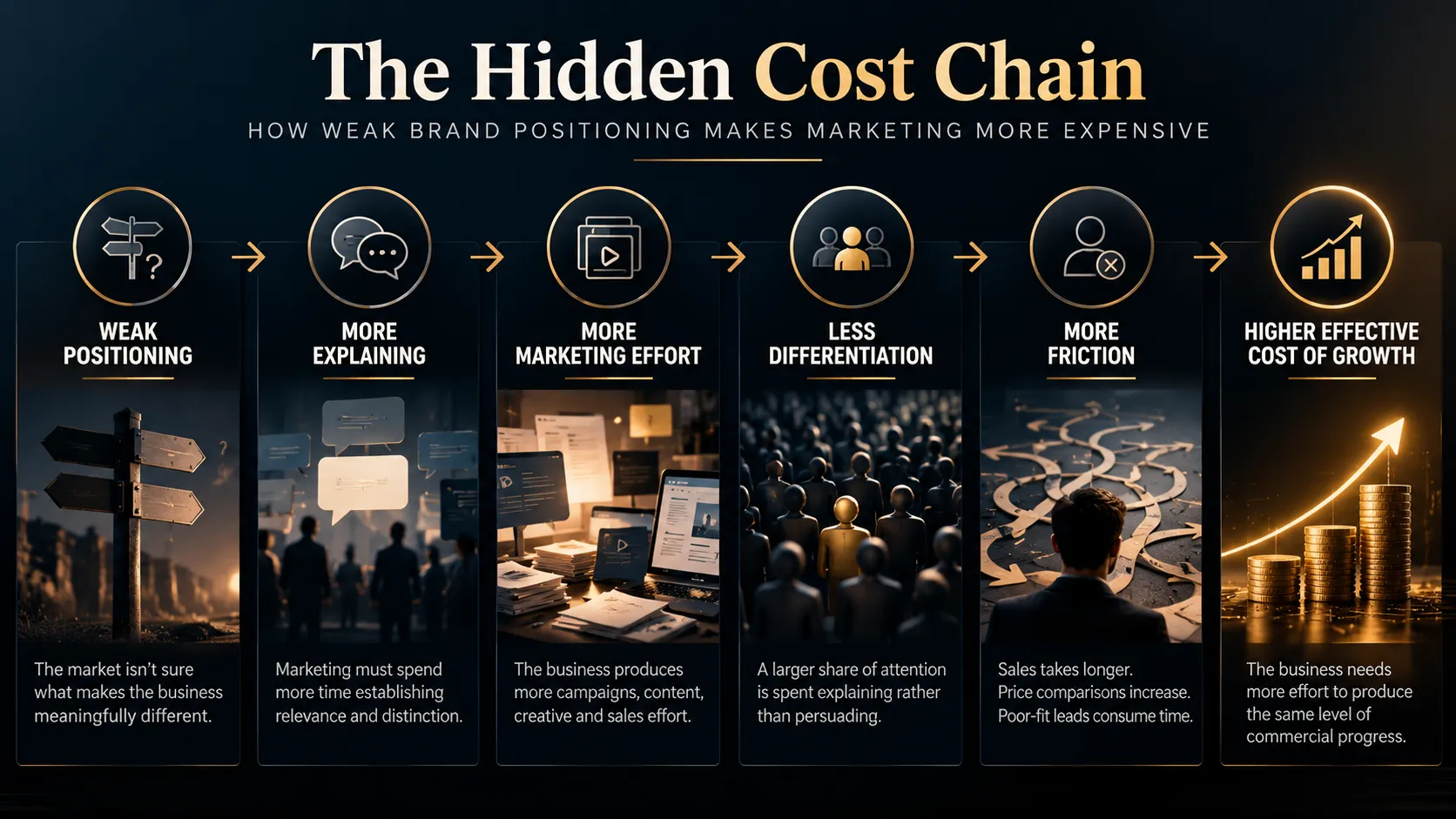
This is the simplest model to remember.
1. Weak Positioning
The market isn’t sure what makes the business meaningfully different.
↓
2. More Explaining
Marketing must spend more time establishing relevance and distinction.
↓
3. More Activity
The business produces more campaigns, content, creative and sales effort.
↓
4. Less Efficient Attention
A larger share of attention is spent explaining rather than persuading.
↓
5. Weaker Preference
Customers understand the category but have less reason to choose one provider.
↓
6. More Friction
Sales takes longer. Price comparisons increase. Poor-fit leads consume time.
↓
7. Higher Effective Cost of Growth
The business needs more effort to produce the same commercial progress.
That is the positioning tax.
Not always a bigger marketing invoice.
A bigger burden on the entire growth system.
What Strong Positioning Gives Marketing Instead
Strong positioning doesn’t eliminate marketing costs.
Marketing will always require investment.
What positioning can do is give that investment a stronger strategic foundation.
A Clear Audience
You know who you are trying to matter to.
A Clear Problem
You know what problem you want the market to associate with your business.
A Clear Difference
You know what makes your approach meaningfully distinct.
A Clear Message
Marketing has something specific to reinforce.
A Clear Sales Story
Sales doesn’t have to invent the explanation from scratch.
A Clear Content Territory
The business knows which conversations it should repeatedly contribute to.
A Clear Decision Filter
Not every customer, channel, partnership or opportunity needs to be pursued.
That last point is important.
Good positioning doesn’t only tell you what to say.
It helps you decide what not to do.
Positioning Is Not a Substitute for Good Marketing
There is an equally important warning.
A business cannot blame positioning for every marketing problem.
You can have strong positioning and poor execution.
You can have a clear position and weak creative.
You can have excellent differentiation and poor distribution.
You can have a strong brand and a weak sales process.
You can have a good strategy and inconsistent execution.
Positioning is not magic.
It is infrastructure.
It gives marketing a clearer strategic foundation.
The marketing still has to do its job.
That is why the correct sequence is not:
Positioning instead of marketing.
It is:
Positioning → Strategy → Marketing → Sales → Experience
Each layer has a different job.
When Weak Positioning Is Actually a Repositioning Problem
Not every positioning problem requires a completely new brand position.
Sometimes the business simply needs to sharpen what already exists.
But there are situations where the original position has genuinely stopped fitting the business.
For example:
- the business has moved into a different market
- the target customer has changed
- the offer has materially expanded
- competitors have copied the original differentiation
- the business has moved upmarket
- the customer problem has changed
- the original brand promise no longer reflects the company’s capabilities
At that point, the question may not be:
“How do we communicate our positioning better?”
It may be:
“Is this still the position we should own?”
That is a repositioning question.
For businesses experiencing that kind of shift, Marcom Trends has explored the signs that a brand has stopped supporting growth.
What to Fix Before Spending More on Marketing
If several of the symptoms above are familiar, resist the temptation to immediately increase activity.
Start here.
Clarify the priority customer
Who matters most?
Clarify the problem
What problem do you want to be known for solving?
Define meaningful differentiation
What can you credibly do or own that matters to that customer?
Decide what you will not compete on
A position becomes stronger through choices.
Align the offer
Does what you sell actually support the position?
Align marketing
Can the marketing repeatedly reinforce the same strategic idea?
Align sales
Can the sales team explain the same difference without reinventing the story?
Test the experience
Does the actual customer experience prove the position?
This is where positioning becomes a business decision rather than a branding exercise.
The Bigger Mistake: Treating Marketing as the Place Where Strategy Gets Fixed
Marketing is often expected to compensate for strategic ambiguity.
A business isn’t clear about its audience.
Marketing is asked to target better.
The offer isn’t differentiated.
Marketing is asked to make it more attractive.
The business hasn’t decided what it wants to be known for.
Marketing is asked to create stronger content.
Sales struggles to explain the value.
Marketing is asked for more leads.
Customers don’t understand why the business is different.
Marketing is asked to create awareness.
Eventually marketing becomes the department carrying problems that originated elsewhere.
That is not a sustainable model.
Marketing should amplify a strategic position.
It shouldn’t have to invent one every morning.
Final Takeaway
Weak brand positioning doesn’t necessarily make every marketing activity more expensive in a literal media-buying sense.
It can do something more consequential.
It can make the entire marketing system work harder.
More explanation.
More content.
More creative iterations.
More sales effort.
More poor-fit demand.
More price comparison.
More internal confusion.
More campaign changes.
And ultimately, more effort to create the same level of commercial progress.
That is why positioning deserves to be treated as a business decision rather than a branding exercise.
A clear position gives marketing something to reinforce.
A weak position gives marketing something to compensate for.
So before asking:
“How can we get more marketing results?”
ask the more uncomfortable question:
“How much of our marketing effort is compensating for the fact that the market still doesn’t have a clear reason to choose us?”
That is where the cost of weak positioning begins.
Frequently Asked Questions:
What is weak brand positioning?
Weak brand positioning occurs when customers cannot clearly understand who a business is most relevant to, what it should be known for, how it differs from alternatives, or why they should choose it.
Can weak positioning increase marketing costs?
It can increase the amount of marketing and sales effort required to create relevance and preference. The cost may appear through additional content, creative work, sales effort, poor-fit leads, price pressure or inefficient campaigns rather than through advertising costs alone.
How does positioning affect marketing efficiency?
Clear positioning gives marketing a defined audience, problem, difference and strategic message to reinforce. Weak positioning forces marketing to spend more effort establishing those things repeatedly.
Is weak positioning the same as weak marketing?
No. A business can have strong marketing execution and weak positioning. It can also have strong positioning and poor marketing execution. The two problems require different diagnoses.
How do I know if my positioning is weak?
Ask whether customers can clearly explain why they should choose you over a credible alternative. Also examine whether your marketing sounds generic, sales conversations require excessive explanation, price dominates discussions, or different teams describe the business differently.
Can rebranding fix weak positioning?
Not by itself. A new visual identity can improve recognition and consistency, but it does not automatically determine who the business should serve, what it should be known for or why customers should choose it.
Should I fix positioning before increasing my marketing budget?
If there is evidence that unclear differentiation, audience confusion or weak relevance is limiting marketing performance, it is worth diagnosing the positioning before simply increasing activity. More budget cannot automatically solve a strategic clarity problem.