

A brand does not usually become a problem overnight.
More often, the business changes first.
The company enters a new market.
Its customers become more sophisticated.
The offer becomes more valuable.
The team develops new capabilities.
The business starts competing at a different level.
But the brand continues communicating the same story it told several years earlier.
That is where the problem begins.
A brand can remain recognizable, visually consistent and even well regarded while becoming increasingly disconnected from the business it represents.
The website still looks professional.
The logo still works.
The messaging still sounds reasonable.
Customers still recognize the company.
And yet growth starts becoming harder.
The business attracts the wrong conversations.
Prospects misunderstand its value.
The company is compared on price when it should be compared on capability.
New services feel difficult to explain.
Sales conversations require too much clarification.
The founder keeps having to explain what the business really does.
At that point, the problem may not be that the business needs more marketing.
It may be that the brand is no longer supporting the direction in which the business is trying to grow.
This is where brand repositioning becomes a strategic consideration.
Repositioning is not about changing a logo because the existing one looks old.
It is about changing how the market understands the business when the existing position no longer reflects the value, capabilities or direction of the company.
A Brand Can Stop Supporting Growth Without Looking Broken
One of the most difficult things about brand positioning problems is that they rarely look like obvious failures.
There may be no dramatic decline.
The website may still generate enquiries.
Existing customers may remain satisfied.
The sales team may continue closing business.
So why change anything?
Because a brand should not only represent where the business has been.
It should also support where the business is going.
A useful question is:
Does the market understand us in the way we need to be understood to reach our next stage of growth?
If the answer is no, the brand may have become a constraint.
For example, a company may have started as a specialist service provider for smaller businesses.
Over time, it develops stronger capabilities, builds a larger team and begins serving more complex clients.
But the market still sees it as a small specialist provider.
The company has changed.
The perception has not.
That gap creates friction.
And the larger the gap becomes, the more work marketing and sales have to do to correct it.
The First Sign: Your Business Has Outgrown Its Original Position
This is one of the clearest reasons to consider repositioning.
Businesses change.
The original market changes.
The customer base changes.
The competitive environment changes.
The offer changes.
The company’s ambitions change.
But positioning often remains untouched.
A business that originally positioned itself around one narrow service may eventually become much broader.
A specialist consultancy may develop into a strategic advisory business.
A small agency may become a larger growth partner.
A technical provider may start influencing business strategy.
A founder-led practice may develop a team capable of delivering work without constant founder involvement.
The business has moved forward.
The brand is still describing the previous version.
That creates a structural problem.
The brand is effectively asking the market to evaluate today’s business through yesterday’s frame.
The Second Sign: Your Best Capabilities Are Not What the Market Associates With You
Businesses often evolve faster than their positioning.
They add new capabilities.
They improve their processes.
They hire stronger people.
They develop intellectual property.
They solve more complex problems.
But none of that automatically changes how the market perceives them.
Your customers may still associate you with the thing you were known for five years ago.
That creates an uncomfortable situation.
The business knows it has become more capable.
The market does not necessarily know.
This is particularly common in founder-led businesses.
The founder may have personally evolved the business considerably while the public-facing brand remains anchored to the original proposition.
Ask yourself:
What are we actually better at today than when our current positioning was created?
Then ask:
Does our website, messaging and sales narrative communicate those capabilities clearly?
If the answer is no, there may be a positioning gap.
The Third Sign: You Keep Having to Explain What the Business Really Does
Some explanation is normal.
Complex B2B businesses cannot always be reduced to one sentence.
But there is a difference between explaining complexity and correcting misunderstanding.
If prospects repeatedly ask:
What exactly do you do?
Who do you work with?
Why are you different?
Why should we choose you?
What makes your approach different?
Why does this cost more?
Then the problem may not be the sales team’s communication.
The positioning itself may not be doing enough work.
Strong positioning creates an initial understanding before the sales conversation begins.
It gives the buyer a useful mental model.
It establishes relevance.
It makes the company’s value easier to understand.
When positioning is weak, every sales conversation begins with education.
That increases friction.
And when the business grows, the cost of that friction grows with it.
The Fourth Sign: Your Brand Attracts the Wrong Customers
Not every lead is a good lead.
A company can generate enquiries and still have a positioning problem.
Consider what happens when the brand communicates primarily around services rather than business outcomes.
The market may respond by comparing those services as commodities.
A buyer sees several providers offering similar things.
The conversation becomes:
Who is cheaper?
Who can deliver faster?
Who includes more?
Who has more features?
That is rarely where a differentiated business wants the conversation to remain.
Positioning should help establish why the company is valuable to a particular type of buyer in a particular situation.
If your brand consistently attracts prospects who are outside your ideal market, looking for a different level of service or evaluating you primarily on price, it is worth examining the positioning before simply increasing lead generation.
The Fifth Sign: Your Business Is Being Compared on the Wrong Dimension
A business may have significant expertise, experience or strategic value. But if its brand positioning does not communicate those differences clearly, buyers compare it using easier dimensions.
This is one of the most commercially important positioning problems.
A business may have significant expertise, experience or strategic value.
But if the market does not understand those differences, buyers compare it using easier dimensions.
Usually price.
Sometimes speed.
Sometimes features.
Sometimes availability.
The problem is not necessarily that competitors are cheaper.
The problem may be that the company has failed to establish a meaningful reason for being evaluated differently.
Positioning influences the comparison frame.
If you are positioned as another provider of a commodity service, you will probably be compared like one.
If you are positioned around a specific business problem, distinctive expertise or measurable strategic value, the comparison can become more meaningful.
This is why positioning is closely connected to growth.
It influences not just visibility, but the quality of the commercial conversation.
The Sixth Sign: New Services Feel Like Add-Ons
Another warning sign appears when every new service requires a new explanation.
The company launches something new.
Then the website needs another page.
The sales team needs another presentation.
The founder needs to explain how it fits.
The customer needs to understand why the company is suddenly offering it.
This can indicate that the underlying positioning is too narrow.
A strong position should provide enough strategic space for the business to evolve.
That does not mean becoming vague.
Quite the opposite.
The business needs to be clear about the problem it solves, the value it creates and the market position it wants to occupy.
Then individual services can become expressions of that position rather than disconnected products.
The Seventh Sign: Sales and Marketing Are Telling Different Stories
Positioning problems often reveal themselves internally before they become obvious externally.
Marketing says one thing.
Sales says another.
The founder explains the company differently.
The website uses another description.
Employees describe the business in their own language.
None of these statements may be completely wrong.
But together they create inconsistency.
This matters because buyers build their understanding from multiple interactions.
If the company’s website says it is a strategic partner while the sales conversation focuses almost entirely on individual deliverables, the market receives mixed signals.
A repositioning exercise should therefore involve more than marketing.
It should include leadership, sales and the people closest to customers.
The goal is to establish one coherent answer to a simple question:
What do we want the market to understand about us?
The Eighth Sign: The Founder Has Become the Brand
Founder-led businesses have a particular challenge.
The founder may be the reason the business became successful.
Clients trust the founder.
The founder understands the market.
The founder knows the company’s history.
The founder may personally lead major sales conversations.
That can work extremely well in the early stages.
But eventually, the company needs to become bigger than the founder’s personal explanation of it.
If prospects consistently say:
I want to speak to the founder.
The founder understands this better.
Can the founder personally handle this?
I know the founder, so I trust the company.
then the business may have developed a founder dependency problem.
This is closely connected to the issue discussed in The Founder Bottleneck: When Business Growth Starts Depending Too Much on the Founder.
The objective is not to remove the founder from the brand.
The objective is to make the business proposition strong enough to stand alongside the founder’s reputation.
That distinction matters.
The Ninth Sign: Growth Has Made Your Old Messaging Too Small
Sometimes the business simply becomes more sophisticated than its original message.
The original website may have been written when the company was smaller.
The language may have been appropriate at the time.
But several years later, the business may have deeper expertise, larger clients, stronger processes and more ambitious goals.
Yet the messaging still says:
We help businesses with…
Our services include…
We provide…
Our team can help…
There is nothing inherently wrong with these statements.
The issue is whether they communicate enough strategic value.
A growing business often needs to move from describing what it does toward explaining why its approach matters.
That is a positioning shift.
And it can significantly change how the business is perceived.
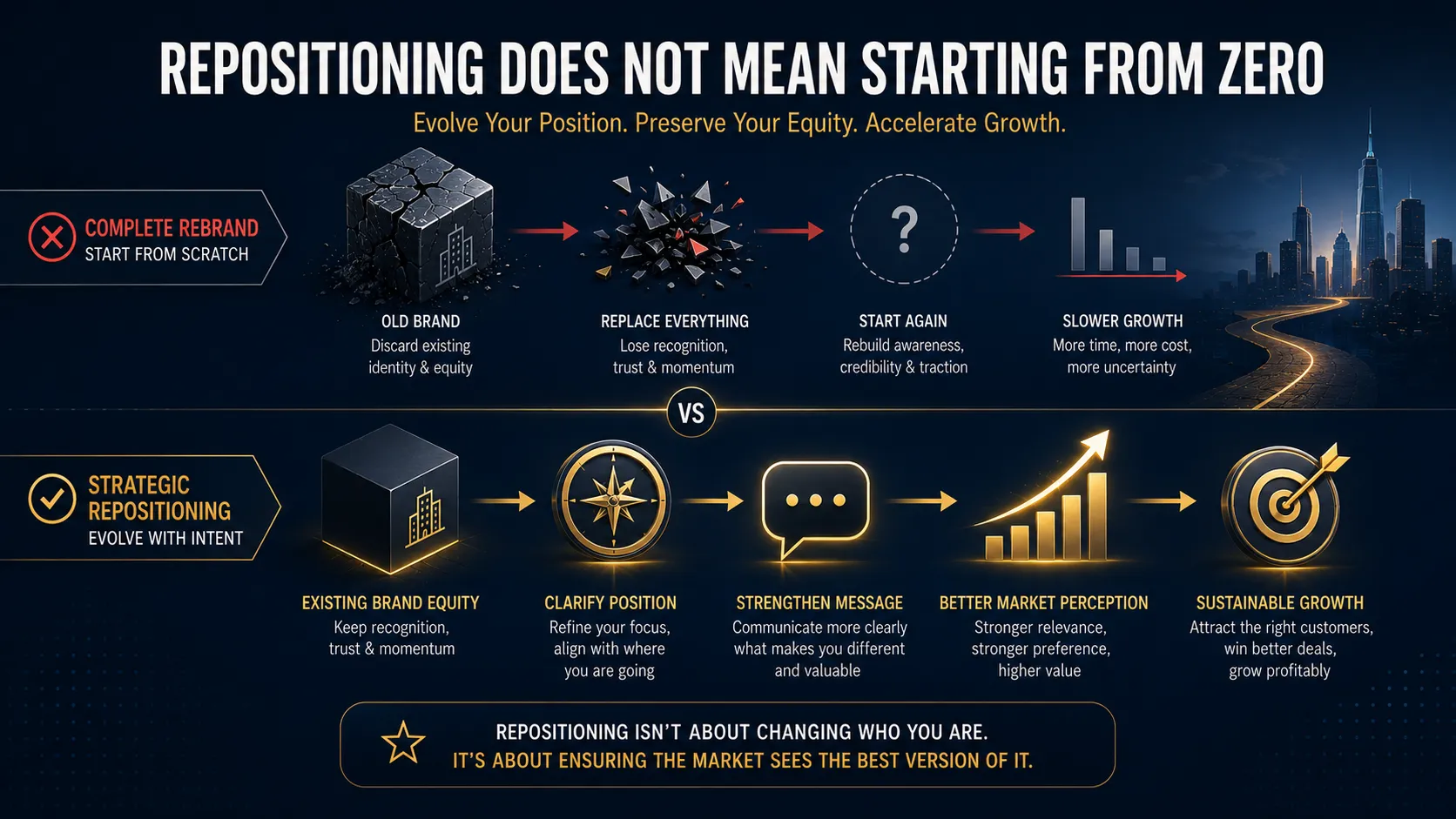
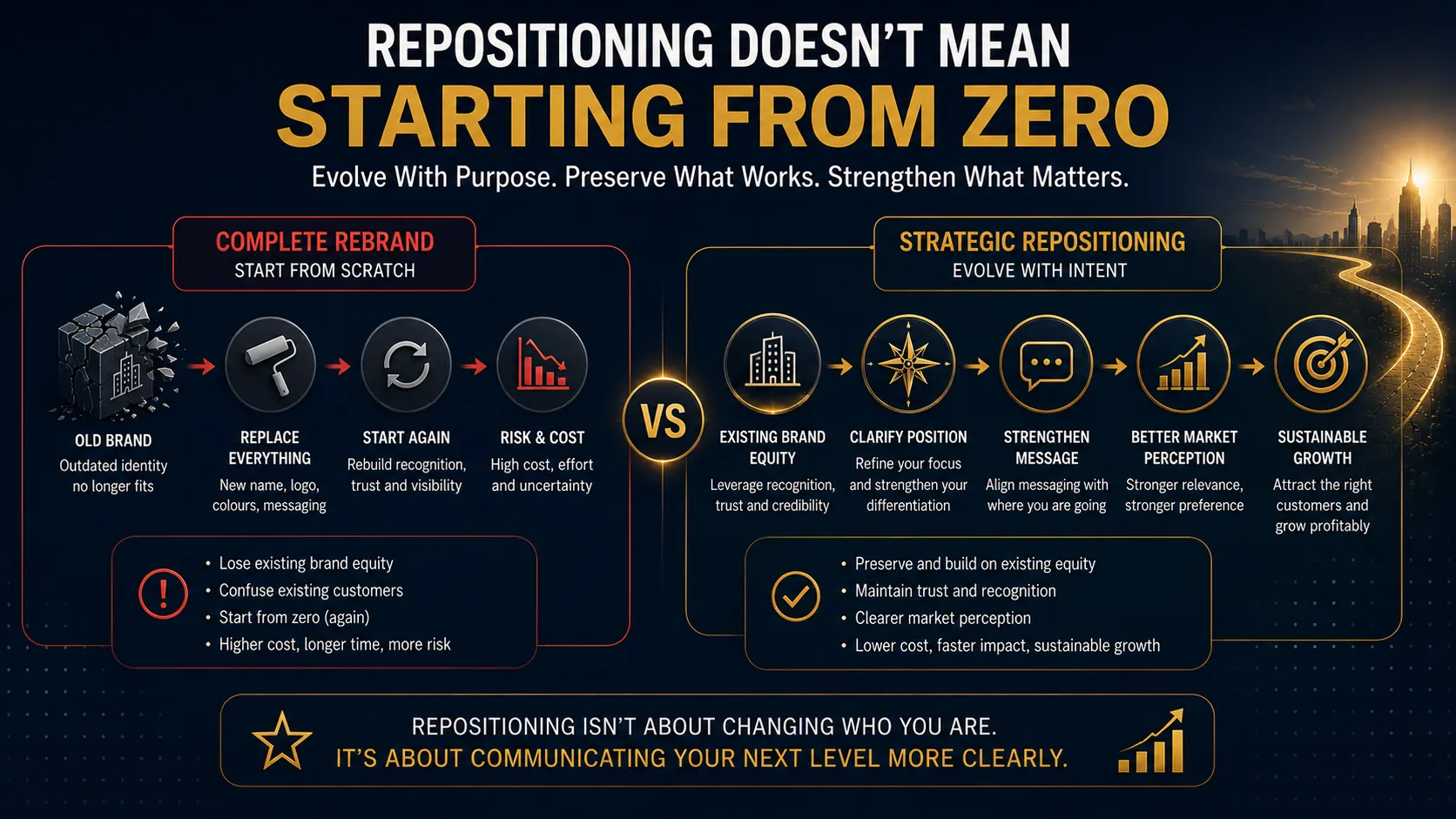
Repositioning Does Not Mean Starting From Zero
This is important.
When companies hear the word repositioning, they sometimes imagine a complete rebrand.
New logo.
New colours.
New website.
New tagline.
New everything.
That is not necessarily repositioning.
A company can reposition without throwing away the equity it has already built.
In fact, unnecessary change can create its own problems.
Existing customers already recognize the brand.
Employees understand it.
Search engines may already associate the domain with established content.
The business may already have valuable reputation and recognition.
The question is not:
How do we make ourselves look completely different?
The better question is:
What needs to change in how the market understands us?
That distinction keeps repositioning strategic rather than cosmetic.
What Should Actually Be Repositioned?
A useful repositioning exercise should examine several connected elements.
The Market
Who are we actually trying to serve?
Has that market changed?
Are we targeting the same level of buyer we were targeting when the current positioning was created?
The Problem
What important problem do we solve?
Has that problem become more valuable?
Have customers’ expectations changed?
The Value
What does the customer actually gain from working with us?
Is our messaging focused on activities or outcomes?
The Differentiation
Why should the market choose us rather than another credible alternative?
Is that difference meaningful?
Can the customer understand it quickly?
The Proof
Can we demonstrate the position?
Case studies, experience, expertise, processes, outcomes and customer evidence all matter.
A positioning statement without proof is simply a claim.
The Growth Direction
Where does the business want to go next?
The brand needs enough strategic space to support that direction.
Otherwise, the company will repeatedly outgrow its positioning.
Repositioning Should Strengthen the Entire Growth System
This is why adding more channels does not automatically solve a growth problem.
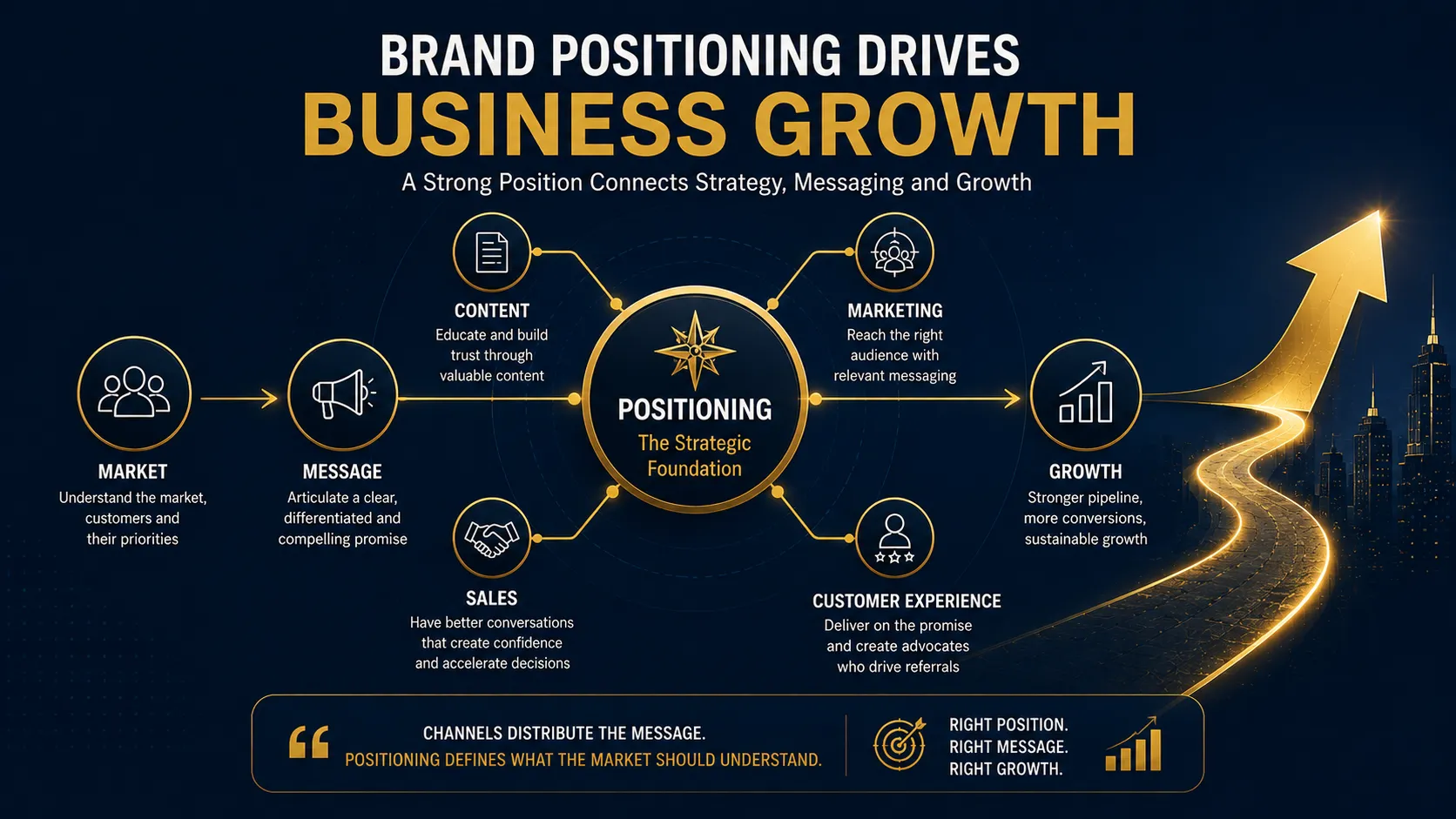
This is where positioning connects with the broader marketing system.
A new position is not useful if it lives only on the website.
It should influence:
Messaging
What the company says.
Content
What the company teaches the market.
Marketing
Where and how the company reaches potential buyers.
Sales
How the value proposition is communicated in commercial conversations.
Customer Experience
Whether the actual experience reinforces the promised position.
Leadership
How the company makes strategic decisions.
This is why adding more channels does not automatically solve a growth problem.
As discussed in B2B Marketing in 2026: Why More Channels Are Not Creating More Growth, a business can keep adding LinkedIn, email, webinars, search, events and other channels without fixing the underlying strategic system.
Channels distribute the message.
They do not decide what the market should believe.
That work starts with positioning.
The Right Question Is Not Should We Rebrand?
It is tempting to ask:
Do we need a rebrand?
That may be the wrong starting point.
Start with:
Is our current position helping or limiting the business we are trying to build?
Then look for evidence.
Are the right prospects finding you?
Are they understanding your value?
Are you attracting the customers you actually want?
Are sales conversations becoming easier or harder?
Are you being compared on the right criteria?
Does the market understand your current capabilities?
Does your positioning leave room for your next stage of growth?
If the answers are consistently negative, repositioning may be worth serious consideration.
A Simple Repositioning Test
Before changing anything, write down these five statements.
We Help
Who exactly?
With
What important problem?
By
What distinctive approach?
So That
What meaningful outcome?
Unlike
What alternative or competitor?
Now compare those statements with your current website, sales presentations, content and customer conversations.
If the business team gives five different answers, you have discovered something important.
The problem may not be a lack of marketing.
It may be a lack of strategic clarity.
When Should a Business Reposition?
There is no universal timetable.
A company does not need to reposition simply because its website is several years old.
It should consider repositioning when there is a meaningful gap between the business it has become and the business the market thinks it is.
That gap can emerge after:
- A major change in target market.
- A significant expansion of capabilities.
- A move upmarket.
- A change in competitive conditions.
- A shift in customer needs.
- A change in business model.
- A merger or acquisition.
- A major change in leadership.
- Or simply several years of growth.
The trigger is not age.
The trigger is strategic misalignment.
The Goal Is Not to Become Different. It Is to Become More Accurately Understood.
This may be the most important point.
Good repositioning does not manufacture a new identity.
It clarifies the strongest and most commercially relevant truth about the business.
The company may already have the expertise.
It may already have the capabilities.
It may already have the customer results.
It may already have the experience.
The market simply may not understand those things in the right context.
Repositioning closes that gap.
And when the gap closes, marketing becomes more focused.
Sales conversations become clearer.
Content becomes more purposeful.
The right customers become easier to identify.
The business becomes easier to explain.
Growth becomes less dependent on correcting misunderstandings.
Final Thought: Your Brand Should Be an Asset to Growth, Not an Explanation You Have to Defend
A strong brand should make the business easier to understand.
It should help the right customers recognize relevance.
It should give sales conversations a stronger starting point.
It should differentiate the company in a meaningful way.
And it should be capable of evolving as the business grows.
When that stops happening, the answer is not automatically more advertising, more content or more channels.
Sometimes the business needs to step back and reconsider the position itself.
Because when the market is still seeing the company you used to be, while the business is trying to become something more valuable, growth becomes unnecessarily difficult.
The purpose of repositioning is to close that gap.
Your brand should not simply describe where your business has been. It should help the market understand where your business is going.