

There is a frustrating stage in business growth when the company is not exactly failing.
Customers are still coming in.
The team is still working.
Marketing is still happening.
Sales conversations are still taking place.
Revenue may even be higher than it was a year ago.
But something has changed.
Growth has become harder.
The business is working harder for smaller gains.
The founder starts asking:
Why is my business not growing like it used to?
That question often produces the wrong answers.
Maybe we need more leads.
Maybe we need more marketing.
Maybe we need to launch a new product.
Maybe we need to hire more salespeople.
Maybe we need to enter a new market.
Maybe competitors are simply better positioned.
Sometimes one of those explanations is correct.
But often, the real problem is less obvious.
The business has a growth constraint that has not yet been identified.
And until that constraint is understood, adding more activity can create more complexity without solving the underlying problem.
Current growth research continues to point toward this distinction. McKinsey’s 2026 work on sustainable growth notes that growth strategies often stall not because leaders lack ambition, but because strategy, resource allocation, capabilities and execution are not sufficiently connected.
That creates a better starting question:
What is actually preventing this business from growing further?
Not:
What else can we do?
That distinction is where effective growth diagnosis begins.
A Business Can Be Busy Without Growing
One of the easiest mistakes to make is confusing activity with progress.
The team is busy.
The marketing calendar is full.
Salespeople are making calls.
The founder is taking meetings.
New proposals are going out.
The website is being updated.
New campaigns are launching.
But the business is not becoming meaningfully stronger.
This creates an uncomfortable gap:
High activity → Low incremental growth
That gap matters.
Because when growth slows, businesses often respond by increasing activity.
More campaigns.
More channels.
More discounts.
More content.
More sales outreach.
More products.
More meetings.
But if the underlying constraint remains untouched, the additional activity may simply put more pressure on the same weak point.
The first task, therefore, is not to find another initiative.
It is to find the constraint.
Growth Problems Rarely Have Only One Symptom
A business that is not growing may show several symptoms at the same time.
For example:
- sales have become inconsistent
- customer acquisition costs are rising
- existing customers are buying less
- margins are under pressure
- the founder is involved in everything
- the sales pipeline looks full but conversion is weak
- marketing generates attention but little commercial impact
- competitors are becoming easier to choose
- employees are busy but accountability is unclear
- new initiatives keep starting but few reach scale
The temptation is to treat each symptom as a separate problem.
That can be expensive.
Several symptoms may actually come from one underlying constraint.
For example:
Weak positioning → weaker lead quality → lower sales conversion → higher acquisition cost.
Or:
Founder dependency → slow decisions → delayed delivery → poor customer experience → weaker retention.
Or:
Weak offer → low perceived value → price pressure → lower margins → less ability to reinvest in growth.
This is why diagnosis needs to happen across the system, not only inside the marketing department.
Why Business Is Not Growing: What Has Actually Changed?
When you’re trying to understand why business is not growing, start by identifying what changed before assuming what needs to be added.
Customers
Are you attracting the same type of customer?
Demand
Is the market still asking for the same solution?
Positioning
Is your differentiation still relevant?
Competition
Have competitors changed their offers, pricing or positioning?
Sales
Has the conversion process changed?
Retention
Are customers staying as long?
Economics
Are acquisition costs or delivery costs increasing?
Capacity
Can the business handle additional demand?
Leadership
Are important decisions becoming slower or more centralized?
This creates an important diagnostic distinction:
A business does not simply stop growing. Something changes in the system that produces growth.
Your job is to find it.
Problem #1: The Market May Have Changed
Sometimes the business has not become worse.
The environment has changed.
Customers may have new expectations.
New competitors may have entered.
Technology may have altered how customers discover and compare businesses.
A previously effective channel may have become less productive.
An offer that once felt differentiated may now look standard.
This is especially important because businesses often interpret external change as an internal execution problem.
They respond by saying:
“We need to market harder.”
But if the market has changed, the answer may be:
“We need to rethink where and how we compete.”
McKinsey’s recent work on growth similarly emphasises the need to identify where growth opportunities actually exist and allocate resources deliberately rather than assuming existing approaches will continue producing the same results.
Problem #2: Your Positioning May Have Lost Its Edge
A business can remain good at what it does and still become harder to choose.
This happens when the market becomes crowded.
At one point, your offer may have been distinctive.
Over time, competitors copy features.
They adopt similar language.
They offer similar services.
They publish similar content.
They make similar promises.
Eventually, customers see a category rather than a clear choice.
That creates a positioning problem.
The business may still generate awareness.
But awareness is not preference.
Customers may know you exist without understanding why they should choose you.
This is why brand positioning can become a growth issue before it becomes a marketing issue.
Problem #3: You May Be Solving a Problem Customers No Longer Prioritize
Businesses naturally become attached to the problems they were originally built to solve.
But customer priorities change.
A problem can remain real while becoming less urgent.
That distinction matters.
A customer may say:
“Yes, this is useful.”
But not:
“I need this now.”
That difference can dramatically affect growth.
When demand slows, examine whether customers still consider the problem important enough to spend money solving.
Ask:
- Has the customer’s situation changed?
- Has another problem become more urgent?
- Has the customer found an easier workaround?
- Has technology changed the way the problem is solved?
- Has the value proposition become less differentiated?
If the answer is yes, more marketing may simply produce more awareness of an offer that customers no longer prioritise.
Problem #4: Your Leads May Be Increasing While Lead Quality Falls
As discussed in our article on lead quality, lead volume alone doesn’t tell you whether the pipeline is becoming commercially stronger.
A business can generate more leads and still experience weaker growth.
Why?
Because the composition of those leads has changed.
Suppose:
100 leads → 20 qualified → 8 opportunities → 3 customers
Later:
200 leads → 15 qualified → 6 opportunities → 2 customers
Lead volume doubled.
Commercial performance deteriorated.
This is why lead generation should not be evaluated independently of qualification and conversion.
If growth has slowed, ask:
Are we generating fewer opportunities—or simply more activity around poorer opportunities?
If lead quality has deteriorated, the problem may sit in targeting, positioning, offer design or channel strategy rather than sales capacity.
Problem #5: The Sales Process May Have Become the Constraint
Sometimes demand is healthy.
The business simply isn’t converting enough of it.
Look at:
- response time
- qualification
- proposal quality
- follow-up
- objection handling
- pricing
- sales ownership
- close rates
A pipeline can look healthy while producing weak revenue.
This is especially dangerous because a full pipeline creates psychological reassurance.
The business thinks:
“We have plenty of opportunities.”
But the more useful question is:
“What percentage of those opportunities actually become profitable customers?”
If conversion has fallen, increasing lead generation may not be the first move.
Fix the conversion constraint first.
Problem #6: Existing Customers May Be Becoming Less Valuable
Growth isn’t only about acquiring new customers.
It is also about what happens after acquisition.
Ask:
- Are customers renewing?
- Are they buying again?
- Are they expanding their relationship?
- Are they referring others?
- Has churn increased?
- Has customer satisfaction changed?
A business that constantly replaces lost customers can look active without building momentum.
This creates a hidden growth problem.
Acquisition fills the bucket. Retention determines whether the bucket stays full.
If retention weakens, marketing may have to work increasingly hard simply to maintain the same customer base.
Problem #7: Your Economics May Be Blocking Growth
Revenue growth is not automatically healthy growth.
Suppose revenue rises by 20%.
But:
- customer acquisition costs rise 30%
- delivery costs rise 25%
- discounts increase
- gross margins fall
The business may be getting bigger without becoming stronger.
This is why profitability belongs inside the growth diagnosis.
McKinsey’s research on Indian companies found that high-growth companies can combine revenue growth with profit growth, and highlighted the importance of deliberate growth choices, resource allocation and multiple growth levers.
The relevant question is therefore not simply:
“Can we grow revenue?”
It is:
“Can we grow revenue in a way that strengthens the economics of the business?”
Problem #8: The Founder May Have Become the Constraint
This is particularly common in founder-led businesses.
The founder becomes the final decision-maker.
The sales closer.
The quality controller.
The client relationship owner.
The strategic thinker.
The escalation point.
The person who knows how everything works.
That model can work for years.
Until the business becomes too complex for one person’s attention.
Then:
Decisions slow.
Teams wait.
Customers depend on the founder.
Opportunities get delayed.
The founder’s calendar becomes the company’s operating system.
This is not necessarily a leadership failure.
It is often a consequence of successful founder-led growth.
But it can become a serious business growth challenge.
This is where the founder bottleneck discussed in becomes relevant.
Problem #9: The Business Has Too Many Priorities
Another common reason growth stalls is not a lack of ideas.
It is too many ideas.
The business is simultaneously trying to:
- launch a new product
- enter a new market
- redesign the website
- improve SEO
- launch social campaigns
- hire salespeople
- change the CRM
- redesign the brand
- introduce new services
Every initiative sounds reasonable.
Together, they create fragmentation.
People become busy.
Resources are divided.
Nothing receives enough sustained attention.
McKinsey’s 2026 research describes deliberate resource allocation and a small number of clear growth bets as important to translating growth intent into sustained performance.
Growth often requires fewer priorities, not more.
Problem #10: The Business May Not Have a Clear Growth Strategy
This is the deepest issue.
Some businesses have:
- marketing plans
- sales targets
- content calendars
- advertising budgets
- product roadmaps
But they don’t have a coherent answer to:
Where will growth come from?
That requires decisions about:
Where to compete
Which customers, markets or segments matter?
How to win
What makes the business meaningfully different?
What to offer
Which products or services deserve investment?
Where to allocate resources
What deserves more people, money and attention?
What to stop doing
Which activities consume resources without creating sufficient value?
That is the role of business growth strategy.
Not a document.
Not a presentation.
A set of choices about where the business will focus and how it intends to create value.
Why Business Growth Stalls Even When the Business Is Doing Many Things Right
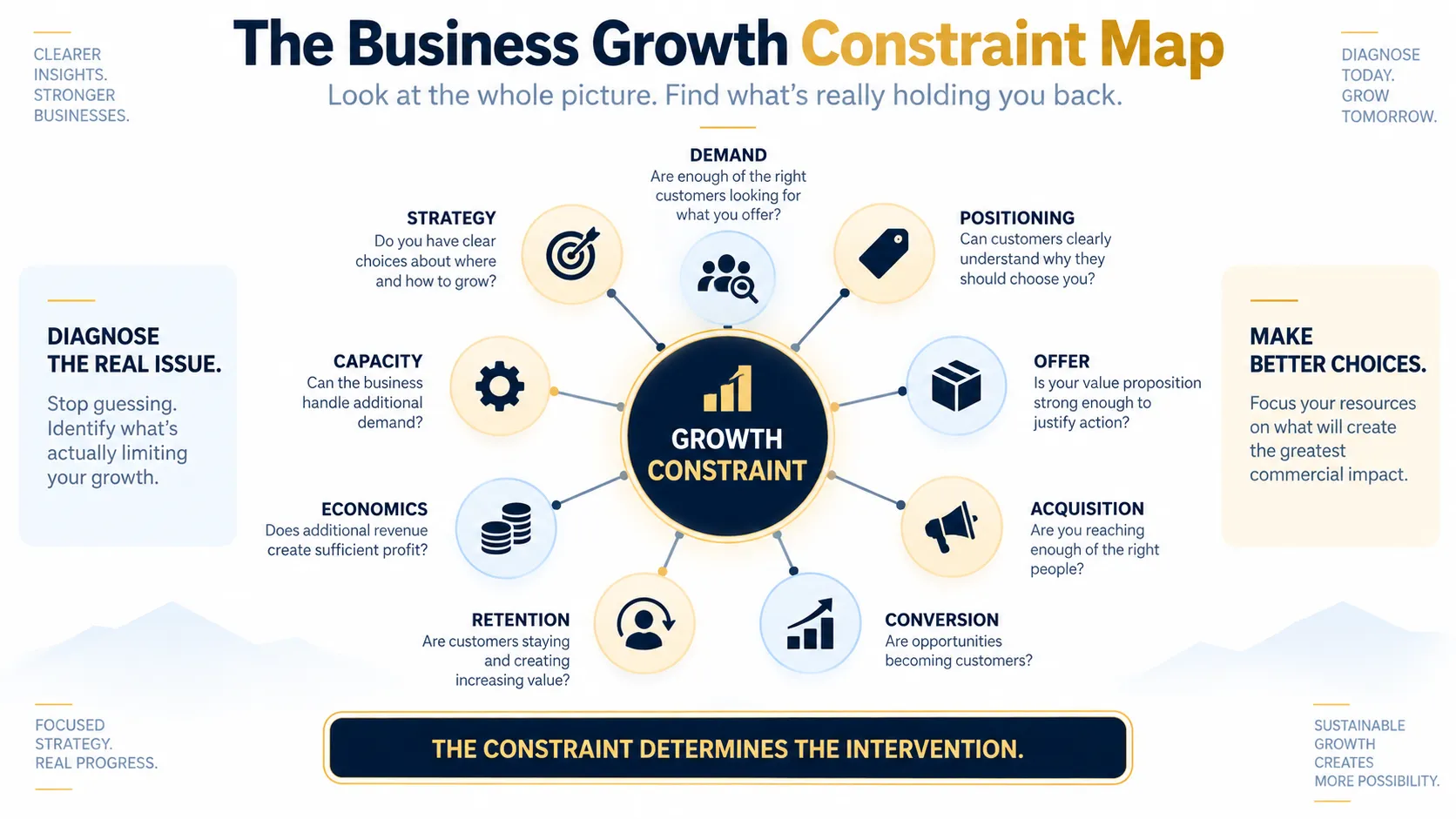
Understanding the growth constraint is therefore more useful than treating every symptom as an independent problem.
This is where the diagnosis becomes more useful.
A business can have:
- a good product
- loyal customers
- capable employees
- strong expertise
- a functioning sales team
- a healthy brand
and still stall.
Why?
Because growth is constrained by the weakest important part of the system.
The constraint might be:
Demand
Not enough qualified market demand.
Positioning
The market cannot clearly distinguish the business.
Offer
Customers don’t perceive sufficient value.
Conversion
Existing opportunities aren’t becoming customers.
Retention
Customers aren’t staying or expanding.
Economics
Growth isn’t generating enough profit.
Capacity
The business cannot absorb more demand.
Leadership
Too many decisions depend on a small number of people.
Strategy
The organization hasn’t made clear choices about where growth should come from.
This is why there is rarely one universal answer to:
“Why is my business not growing?”
The answer depends on where the system is constrained.
A Practical Growth Constraint Diagnostic
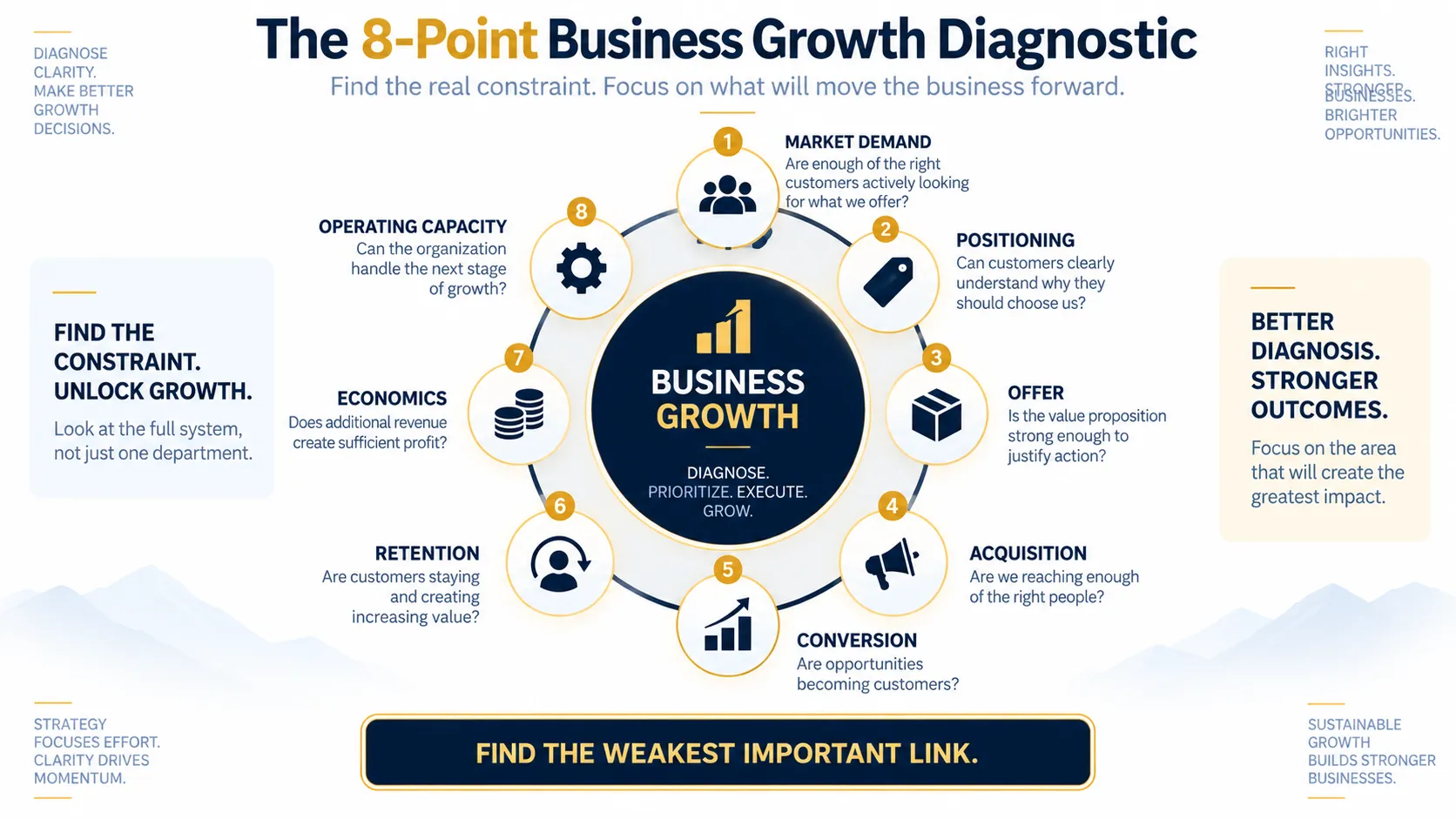
Instead of immediately launching another growth initiative, score the business across eight areas.
1. Market Demand
Question:
Are enough of the right customers actively looking for what we offer?
2. Positioning
Question:
Can customers clearly understand why they should choose us?
3. Offer
Question:
Is the value proposition strong enough to justify action?
4. Acquisition
Question:
Are we reaching enough of the right people?
5. Conversion
Question:
Are qualified opportunities becoming customers?
6. Retention
Question:
Are customers staying and creating increasing value?
7. Economics
Question:
Does additional revenue create sufficient profit?
8. Operating Capacity
Question:
Can the organization handle the next stage of growth?
Don’t simply identify the lowest score.
Ask a second question:
If we improved this area substantially, would the rest of the system actually allow growth to continue?
That is the difference between finding a weakness and finding a constraint.
Don’t Fix Everything at Once
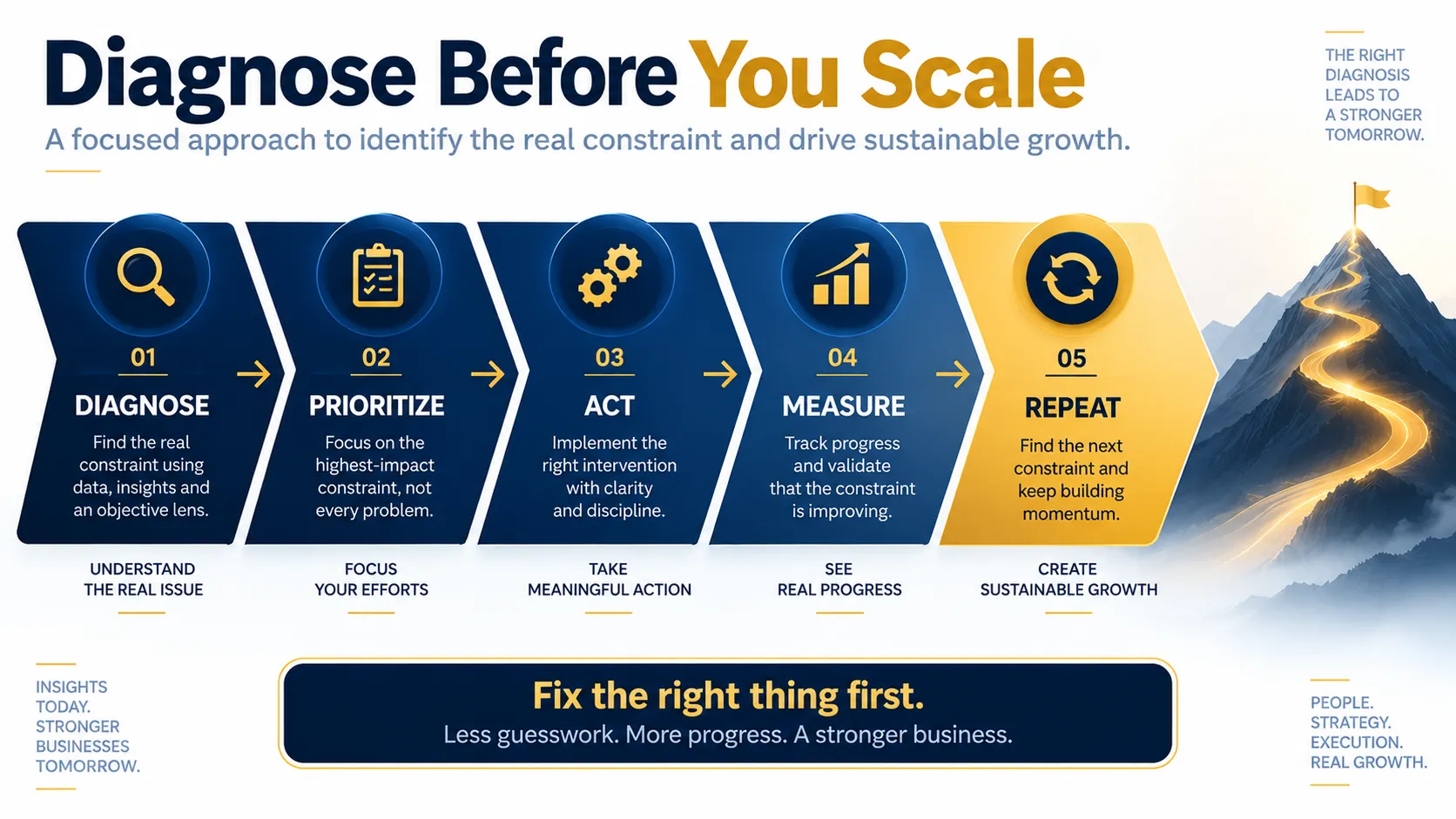
Once businesses identify problems, another mistake appears.
They try to solve all of them simultaneously.
That usually produces another layer of complexity.
A better approach is:
Step 1 — Identify the constraint
What is most directly limiting growth?
Step 2 — Establish evidence
What data, customer feedback or operational evidence supports that conclusion?
Step 3 — Choose one intervention
What change is most likely to relieve the constraint?
Step 4 — Measure the effect
Did the constraint actually improve?
Step 5 — Find the next constraint
Once the first bottleneck is relieved, another may become visible.
This creates a more disciplined growth process.
Diagnose → Prioritize → Act → Measure → Repeat
That is far more useful than continuously adding initiatives.
The Difference Between a Growth Problem and a Growth Constraint
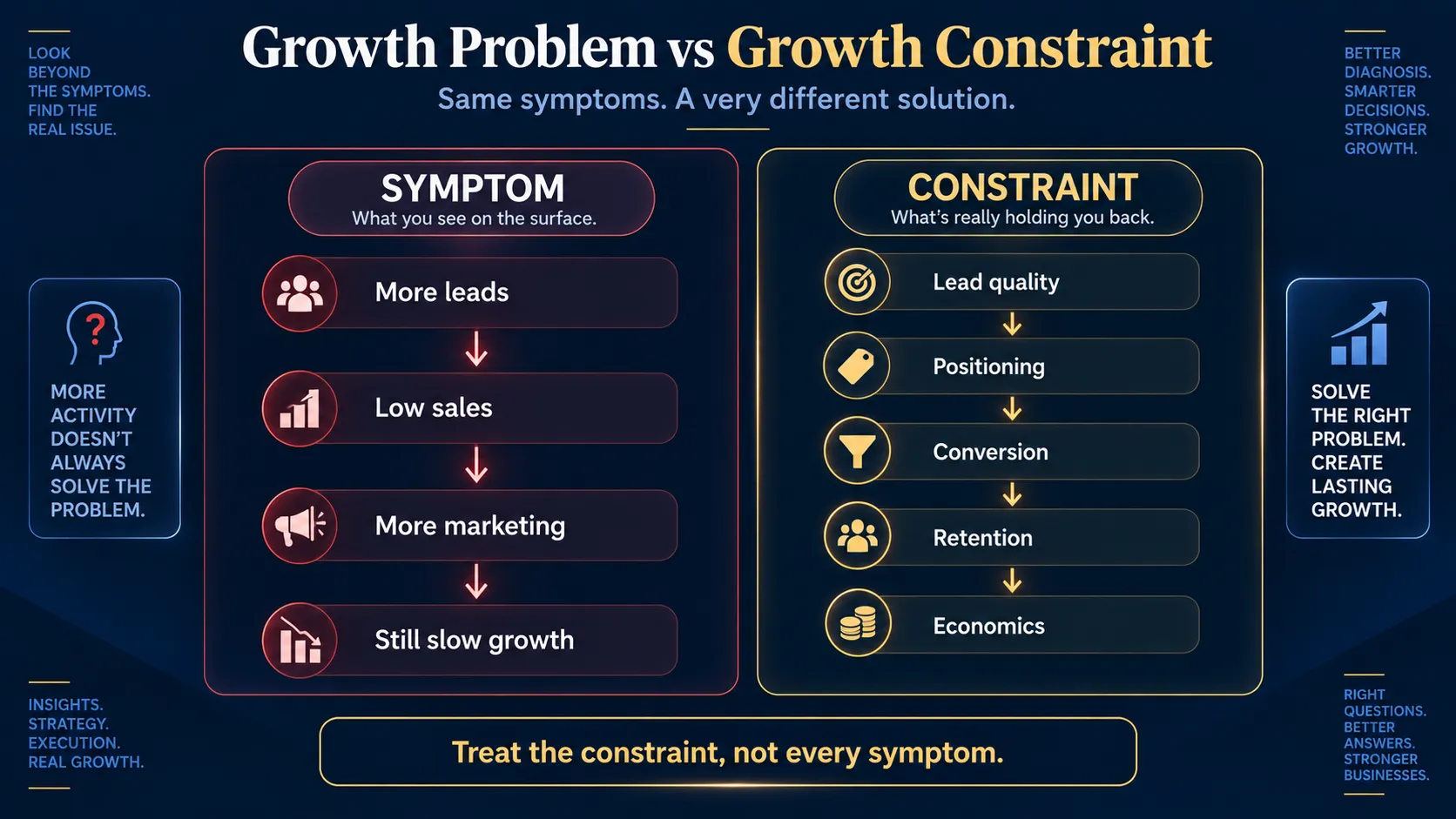
These terms are often treated as interchangeable.
They are not.
A growth problem is something that is going wrong.
A growth constraint is the problem currently limiting the system’s ability to move forward.
For example:
Your website may be slow.
That’s a problem.
But if most qualified prospects come through referrals and the sales conversion rate is extremely low, website speed may not be the current growth constraint.
Your social media engagement may be weak.
That’s a problem.
But if your existing sales pipeline is full and conversion is poor, social engagement may not be the immediate constraint.
Your team may need more training.
That’s a problem.
But if the business lacks demand, more training alone won’t create growth.
This distinction helps businesses stop treating every weakness as equally urgent.
The Founder Diagnostic: Five Questions to Ask This Week
If you’re trying to understand why your business is not growing, start with these five questions.
1. Where did growth slow first?
Revenue?
New customers?
Average customer value?
Repeat purchases?
Margins?
The first change often provides the strongest clue.
2. What has changed since growth was stronger?
Market?
Customers?
Competition?
Positioning?
Team?
Pricing?
Sales process?
Founder involvement?
3. What part of the system is under the most pressure?
Demand?
Sales?
Delivery?
Leadership?
Cash flow?
Customer retention?
4. What are we doing more of without seeing better results?
This is often revealing.
More leads but no more customers.
More content but no more qualified enquiries.
More sales activity but no more revenue.
More employees but no faster execution.
5. If we could fix only one thing in the next 90 days, what would create the greatest commercial impact?
That question forces prioritization.
And prioritization is often what stalled businesses need most.
The Goal Is Not to Make the Business Do More
This may be the most important conclusion.
When growth slows, the instinct is to increase activity.
But sustainable growth often comes from better alignment, not simply more effort.
Better positioning.
Better customers.
Better offers.
Better conversion.
Better retention.
Better economics.
Better decision-making.
Better allocation of resources.
Better operating capability.
The business becomes more effective rather than simply more active.
McKinsey’s recent growth research similarly identifies the gap between wanting growth and building the organizational capabilities, resource allocation and execution discipline required to sustain it.
The Marcom Trends Growth Diagnosis
At Marcom Trends, we look at stalled growth as a diagnostic problem before treating it as a marketing problem.
Because when a business says:
“We’re not growing.”
the immediate answer should not be:
“Let’s do more marketing.”
It should be:
“Let’s find out why.”
Is demand weakening?
Has positioning become less relevant?
Are the wrong customers entering the funnel?
Is sales conversion falling?
Are existing customers leaving?
Are margins being squeezed?
Is the founder becoming a bottleneck?
Is the team overloaded?
Are resources spread across too many priorities?
Or has the business simply outgrown the strategy that got it to its current stage?
Each answer requires a different intervention.
That is why the first step is diagnosis.
Only then should the business decide what to change.
Final Takeaway
The answer to why business is not growing is rarely “do more of everything.” It is usually found by identifying the constraint that is limiting progress right now.
If your business isn’t growing, resist the temptation to immediately add more activity.
Don’t automatically increase advertising.
Don’t launch another channel.
Don’t add another product.
Don’t hire another salesperson.
Don’t redesign everything.
First find the constraint.
Look at:
Demand.
Positioning.
Offer.
Acquisition.
Conversion.
Retention.
Economics.
Operating capacity.
Leadership.
Strategy.
Then ask:
Which one is actually preventing the business from moving forward?
Because a business does not need to fix everything at once.
It needs to fix the right thing first.
That is the difference between reacting to slow growth and actually diagnosing it.