

More leads.
For many businesses, that sounds like the obvious answer to a growth problem.
Sales are slowing, so increase advertising.
The pipeline looks thin, so generate more enquiries.
Competitors appear everywhere, so publish more content.
The website isn’t converting, so drive more traffic.
The sales team isn’t closing enough, so give them more leads.
It sounds logical.
But there is a problem.
More leads do not automatically create more growth.
If your positioning is weak, more people may simply ignore you.
If your offer is unclear, more prospects may leave.
If your sales process is inconsistent, more enquiries may create more follow-up work rather than more customers.
If customers don’t stay, you may keep paying to replace the customers you just acquired.
And if your business cannot deliver consistently, generating more demand can expose operational weaknesses faster.
That is why a strong business growth strategy starts somewhere different.
It starts by asking:
What needs to become stronger before the business tries to grow faster?
Current 2026 growth research increasingly points toward this broader view. Harvard Business School describes growth strategy as a deliberate process of deciding where to compete, how to create value and which opportunities to prioritise, rather than simply increasing activity.
For small businesses, the principle is even more important.
You usually don’t have unlimited cash, people or management capacity.
So every growth decision has an opportunity cost.
The wrong growth activity doesn’t just waste money. It uses capacity that could have been spent fixing the real constraint.
What Is a Business Growth Strategy?
A business growth strategy is the structured approach a business uses to increase revenue, customers, market presence or profitability while building the capability to sustain that growth.
It is broader than a marketing plan.
Marketing may help generate awareness and demand.
A growth strategy asks whether the entire business is prepared to convert that demand into sustainable business value.
That means looking at:
- who you serve
- what problem you solve
- how you are positioned
- what you sell
- why customers should choose you
- how customers discover you
- how prospects become customers
- how customers stay
- how the business makes money
- how the business delivers consistently
- what the team needs to handle growth
- what still depends on the founder
Harvard Business School similarly describes growth strategies as approaches that guide decisions about where to compete, how to allocate resources and which opportunities to prioritise.
So growth is not simply an acquisition problem.
It is a business-system problem.
Why More Leads Are Often the Wrong Starting Point
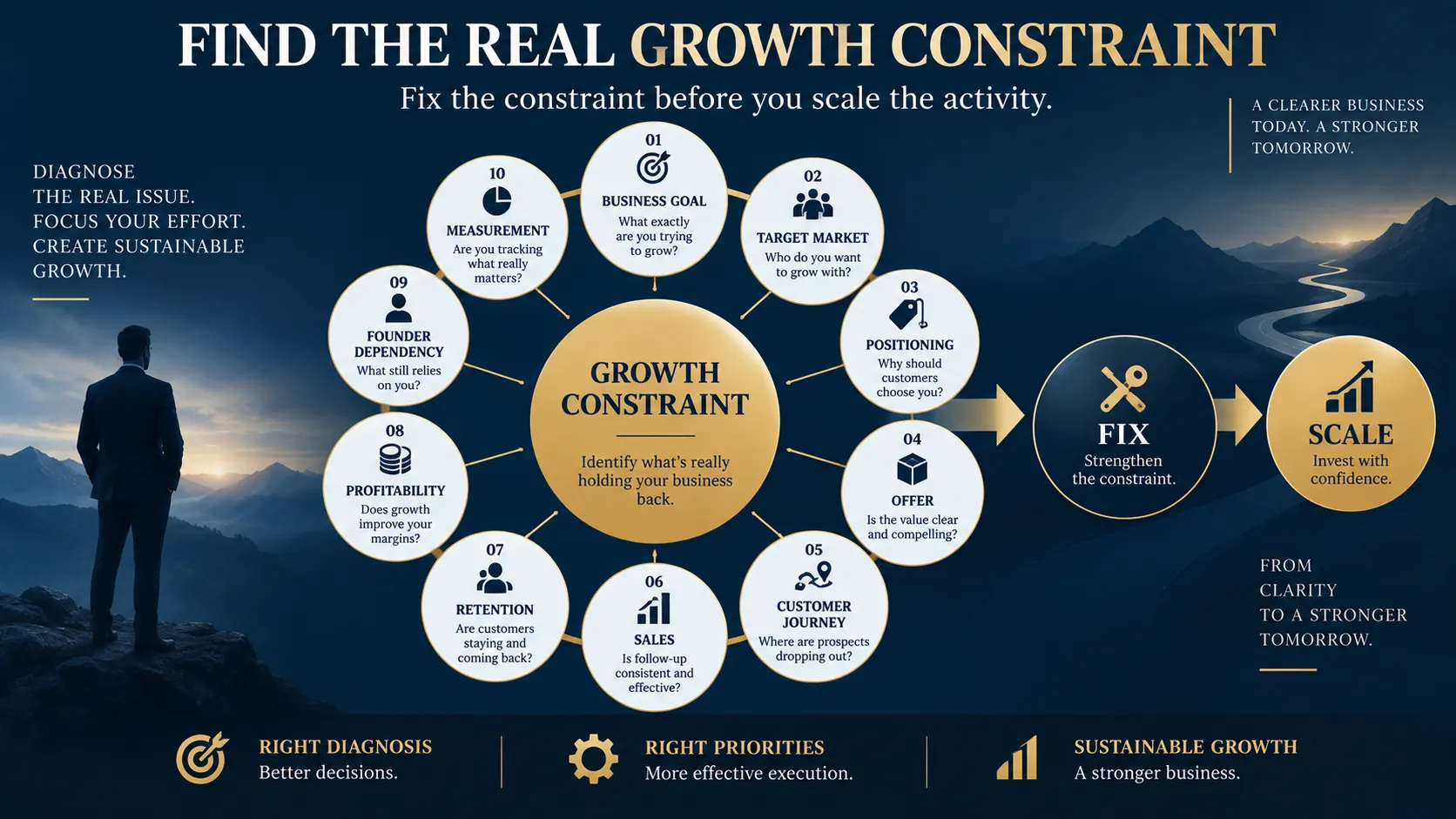
Imagine two businesses.
Business A
- 10,000 monthly website visitors
- clear positioning
- strong offer
- good conversion
- fast sales follow-up
- high customer satisfaction
Business B
- 2,000 monthly website visitors
- generic positioning
- confusing offer
- weak conversion
- slow follow-up
- inconsistent delivery
Which business should invest more heavily in lead generation?
Probably Business A.
Business B may certainly need more demand eventually.
But if the existing traffic is already leaking through poor positioning, conversion or follow-up, adding more traffic simply increases the number of people entering a weak system.
Recent 2026 discussion around small-business growth is making the same distinction: growth should begin by identifying the real constraint rather than automatically adding marketing activity.
This is the central idea behind this article:
Don’t scale the activity until you understand the system.
10 Things to Fix Before You Chase More Leads
1. Fix the Business Goal Before You Fix the Marketing
The first question should not be:
“How can we get more leads?”
It should be:
“What exactly are we trying to grow?”
Those are different questions.
A business may want:
- more revenue
- higher-value customers
- better margins
- more repeat business
- greater market share
- entry into a new market
- reduced founder dependency
- stronger brand preference
- more predictable sales
Each objective creates different strategic priorities.
For example, a company that needs higher profitability may not need twice as many leads.
It may need:
- better customers
- better pricing
- stronger retention
- a more profitable offer
- lower delivery costs
A company entering a new market may need stronger positioning before aggressive advertising.
A founder-led business overwhelmed by demand may need more operational capacity before generating additional enquiries.
This is why a business growth strategy should begin with the business outcome, not the marketing channel.
The diagnostic question
Ask:
If we doubled our leads tomorrow, what would actually improve?
If the answer is unclear, you may not have a lead problem.
You may have a strategy problem.
2. Get Specific About Who You Want to Grow With
One of the most common growth mistakes is trying to become relevant to everyone.
The logic seems attractive:
More people = more opportunities.
But broad targeting often produces generic positioning.
And generic positioning makes it harder for the right customer to immediately understand why your business is relevant.
A stronger growth strategy identifies the customers who matter most.
That doesn’t necessarily mean choosing an extremely narrow niche.
It means understanding:
- which customer segment is most valuable
- which problems they care about
- what creates urgency
- what alternatives they consider
- what makes them hesitate
- what influences their decision
- why they would choose you
The Test
Complete this sentence:
We are particularly valuable to ______ because we help them ______.
If twenty competitors could use exactly the same sentence, your market definition probably needs more work.
3. Strengthen Your Brand Positioning
A business can have:
- a good product
- experienced people
- competent marketing
- a functioning website
and still struggle to grow.
One reason is weak positioning.
When customers cannot quickly understand what makes a business different, marketing has to work harder to create preference.
That makes brand positioning part of the growth strategy, not a separate branding exercise.
Your positioning should make clear:
Who you are for.
What problem you solve.
What makes your approach different.
Why customers should believe you.
Why they should choose you instead of the alternatives.
This matters even more when markets become crowded.
A business can increase visibility without increasing preference.
More content can create more impressions.
More advertising can create more clicks.
More SEO can create more traffic.
But if the customer reaches your website and sees essentially the same promise as everyone else, visibility has not solved the commercial problem.
If your business needs to revisit this area, start with brand positioning.
4. Fix the Offer Before Buying More Attention
Sometimes the problem isn’t marketing.
The offer itself may be difficult to understand, difficult to compare or difficult to justify.
A strong offer should answer:
- What exactly am I getting?
- Who is this for?
- What problem does it solve?
- What outcome should I expect?
- Why should I choose this?
- Why should I act?
- Why is it worth the price?
This does not mean every offer needs discounts or artificial urgency.
It means the value needs to be obvious.
A simple test
Show your offer to someone who knows nothing about your business.
Give them ten seconds.
Then ask:
“What is this business offering, and who is it for?”
If the answer is vague, don’t immediately increase your advertising budget.
Fix the offer.
5. Make the Customer Journey Easier to Complete
Generating a lead is not the same as creating a customer.
A prospect may:
- discover your business
- visit your website
- understand the offer
- compare alternatives
- enquire
- wait for a response
- speak with sales
- receive a proposal
- make a decision
- become a customer
Growth can break at any point.
For example:
Good traffic + weak landing page = poor conversion
Good enquiries + slow response = lost opportunities
Good sales conversations + unclear proposal = stalled decisions
Good acquisition + poor onboarding = unhappy customers
This is why looking only at lead volume can be misleading.
A better question is:
Where are qualified prospects dropping out?
That question moves the conversation from marketing activity to business performance.
6. Fix Sales Follow-Up Before Generating More Enquiries
This is one of the most overlooked growth constraints.
Businesses invest heavily in generating enquiries but treat follow-up as an administrative task.
The result is a strange situation:
Marketing keeps filling the top of the funnel while sales leaks from the middle.
Before increasing lead generation, examine:
- response time
- number of follow-ups
- follow-up consistency
- qualification
- proposal quality
- objection handling
- sales ownership
- reasons for lost opportunities
- average time from enquiry to decision
A business growth strategy needs a connection between marketing and sales.
And this is particularly important for B2B businesses, where buying cycles can involve multiple conversations and decision-makers.
Your B2B marketing strategy should therefore not be separated from the commercial process that follows the initial interaction.
The diagnostic question
Don’t ask only:
“How many leads did marketing generate?”
Also ask:
“What happened to the qualified leads after they arrived?”
That is often where the real growth problem becomes visible.
7. Fix Customer Retention Before You Depend on Constant Acquisition
Growth becomes expensive when every month starts from zero.
If customers leave quickly, the business has to keep replacing them.
That creates pressure on:
- advertising
- sales
- promotions
- referrals
- founder effort
Retention changes the economics of growth because the business has already earned the customer’s trust and completed the initial acquisition process.
Current 2026 business guidance continues to treat retention as an important part of sustainable growth rather than something separate from acquisition. Salesforce, for example, describes retention as a way to maximise customer relationship value while reducing dependence on continual acquisition.
Retention doesn’t necessarily mean a complicated loyalty programme.
Start with simpler questions:
- Why do customers leave?
- Why do customers stay?
- Which customers generate repeat revenue?
- What happens after the first purchase?
- Are customers followed up proactively?
- Are there obvious repeat-purchase opportunities?
- What complaints keep appearing?
The strategic shift
Don’t ask only:
“How do we acquire more customers?”
Also ask:
“How do we create more value from the customers we already earned?”
8. Fix Profitability Before You Scale Volume
Revenue growth can look impressive while the business becomes financially weaker.
That happens when growth requires:
- excessive discounting
- expensive acquisition
- additional overhead
- high fulfilment costs
- inefficient processes
- low-margin customers
- excessive founder involvement
A growth strategy therefore needs to understand the economics behind growth.
At minimum, review:
- revenue by customer segment
- gross margin
- contribution margin
- acquisition cost
- average transaction value
- repeat revenue
- major operating costs
- cash-flow requirements
Current 2026 SME guidance continues to emphasise working capital, cash-flow management and operational readiness as prerequisites for sustainable expansion.
The principle is simple:
Don’t scale a model you haven’t understood.
If every additional customer creates almost as much cost as revenue, more customers may not solve the underlying problem.
They may make it worse.
9. Reduce Founder Dependency Before Growth Magnifies It
This is especially important for founder-led businesses.
At the beginning, the founder often does everything:
- sales
- client relationships
- approvals
- marketing
- operations
- hiring
- problem-solving
- quality control
It works because the business is small.
Then the business grows.
Suddenly every decision still needs the founder.
That creates a ceiling.
A growth strategy should therefore ask:
What currently depends on the founder that shouldn’t?
Look for:
- recurring approvals
- repetitive decisions
- undocumented processes
- customer relationships owned by one person
- sales knowledge sitting in the founder’s head
- content requiring founder approval
- operational tasks that could be delegated
- teams waiting for permission
Hiring more people doesn’t automatically solve this.
A recent 2026 discussion on business growth makes the same point: operational constraints and founder dependency can become limiting factors as businesses scale.
If this sounds familiar, read The Founder Bottleneck: When Business Growth Starts Depending Too Much on the Founder.
Growth should increase business capacity.
If growth simply increases the number of things the founder has to personally manage, the business hasn’t really scaled.
10. Fix Measurement Before You Change Everything
Finally, make sure you know what is actually working.
A business can be extremely busy with marketing and still have little clarity about business impact.
You may be tracking:
- impressions
- followers
- website traffic
- clicks
- enquiries
- content output
- engagement
These metrics can be useful.
But they are not automatically growth metrics.
A stronger measurement system connects activity to business outcomes.
For example:
Reach → qualified attention
Qualified attention → enquiries
Enquiries → opportunities
Opportunities → customers
Customers → revenue
Revenue → margin
Customers → repeat revenue
The objective isn’t to measure everything.
It is to know:
Which numbers should change when our strategy works?
That is the difference between reporting activity and managing growth.
How to Identify Your Real Growth Constraint
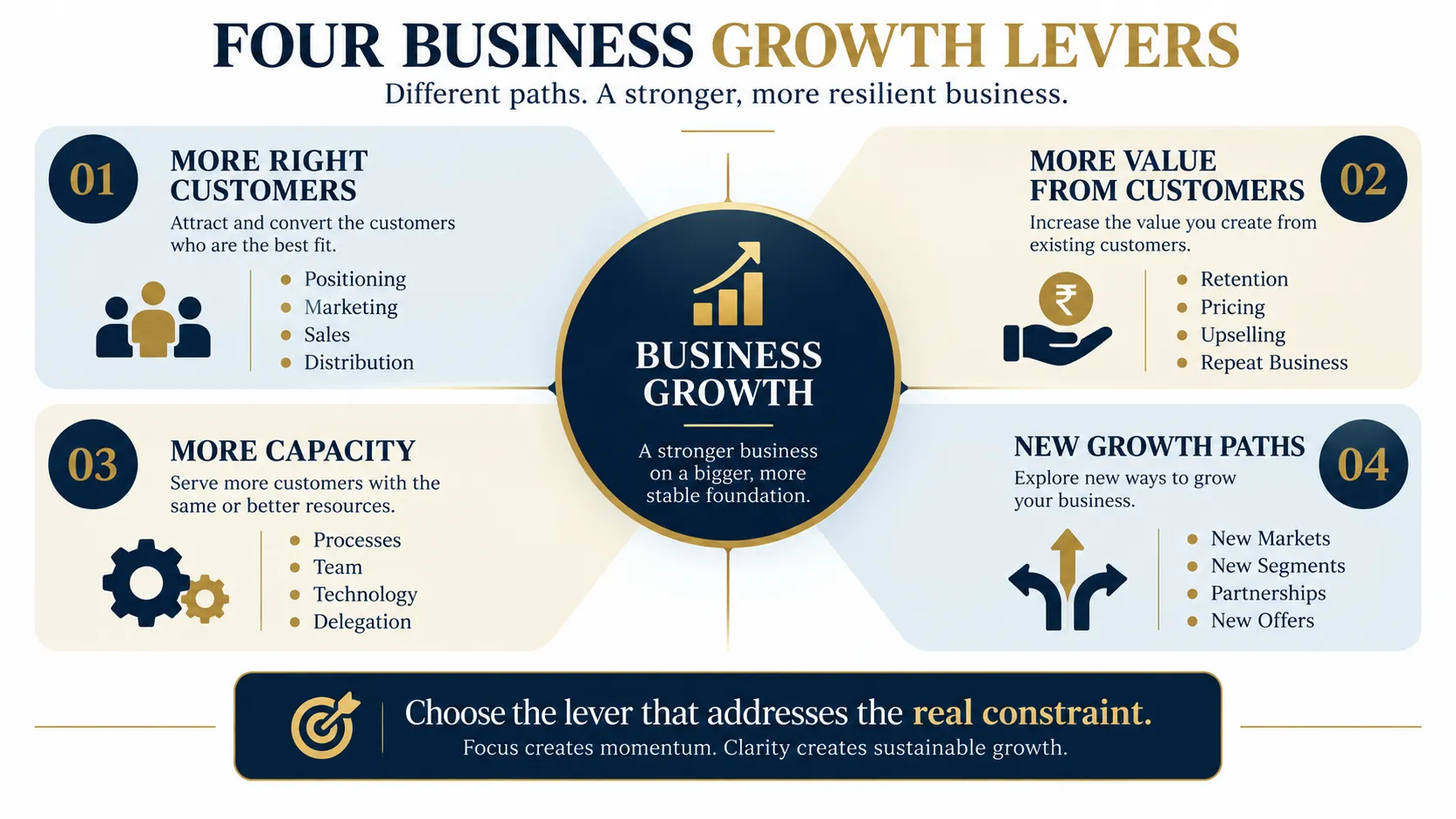
You don’t need to fix all ten areas simultaneously.
In fact, trying to fix everything at once can create another problem:
strategic overload.
Instead, diagnose the business in sequence.
Start With the Business
Ask:
- What are we actually trying to grow?
- Where does revenue currently come from?
- Which customers are most valuable?
- Where are margins strongest?
- What is limiting capacity?
Then Examine the Market
Ask:
- Who are we prioritising?
- What alternatives do customers have?
- Why should they choose us?
- Has the market changed?
Then Examine the Offer
Ask:
- Is the offer easy to understand?
- Is the value obvious?
- Is pricing logical?
- Does the offer solve a meaningful problem?
Then Examine the Customer Journey
Ask:
- Where do prospects drop off?
- How quickly are enquiries handled?
- How consistent is sales follow-up?
- What happens after purchase?
Finally Examine Acquisition
Only after the above questions should you ask:
- Which channels should we use?
- How much should we spend?
- Should we publish more content?
- Should we increase advertising?
- Should we add another channel?
This sequence matters.
Strategy should determine activity. Activity should not determine strategy.
The Four Growth Levers Most Businesses Actually Have
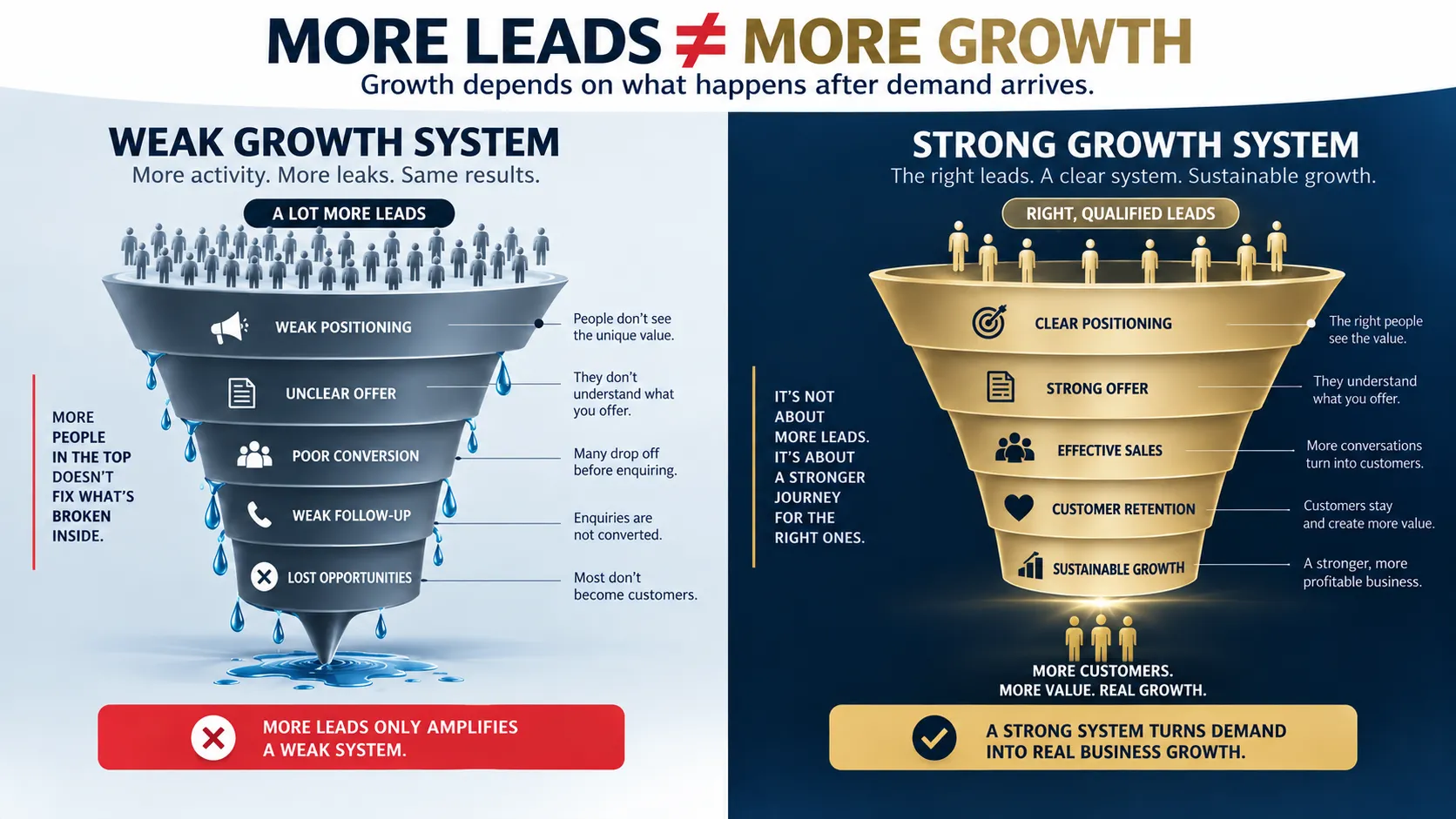
Most businesses have more than one possible path to growth.
But that doesn’t mean they should pursue all of them.
In practical terms, growth usually comes from improving one or more of these areas:
1. Get More of the Right Customers
Improve:
- positioning
- demand generation
- marketing
- sales
- distribution
2. Earn More From Existing Customers
Improve:
- pricing
- offer structure
- upselling
- cross-selling
- repeat purchases
- customer retention
3. Serve More Customers With Existing Capacity
Improve:
- processes
- technology
- team capability
- delegation
- operating systems
4. Enter a New Growth Path
Consider:
- new customer segments
- new markets
- partnerships
- new services
- new distribution channels
The strategic mistake is treating all four as equally urgent.
A strong growth strategy identifies which lever has the highest potential given the business’s current constraint.
Current small-business strategy guidance increasingly emphasises this idea of focus: select the growth lever that addresses the tightest constraint rather than stacking multiple initiatives simultaneously.
What Not to Do When Growth Slows
When growth slows, businesses often react emotionally.
That creates predictable mistakes.
Don’t Immediately Increase the Marketing Budget
If the problem is conversion, positioning or retention, more spending won’t solve it.
Don’t Add Another Channel Just Because a Competitor Uses It
Your competitor’s channel is not automatically your growth opportunity.
Don’t Rebrand Before Diagnosing the Problem
A visual rebrand cannot automatically fix a weak offer, poor sales process or operational bottleneck.
Don’t Publish More Content Just Because Traffic Is Low
Content should support a strategic objective.
More content without a clear role can simply create more work.
Don’t Hire Before Understanding the Bottleneck
More people don’t automatically create more capacity.
Sometimes they create more coordination.
Don’t Chase Every Growth Opportunity
A business with limited resources needs prioritisation more than it needs an endless list of opportunities.
A Simple Business Growth Strategy Diagnostic
If you want to know what to fix first, answer these ten questions.
1. What exactly are we trying to grow?
Revenue, profit, customers, market share, repeat business or something else?
2. Which customers are most valuable?
Not simply the easiest customers to acquire.
3. Why should those customers choose us?
Can the answer be explained clearly?
4. Is our offer easy to understand?
Could someone unfamiliar with the business understand its value quickly?
5. Where are prospects dropping out?
Discovery, website, enquiry, sales conversation, proposal or closing?
6. Are we retaining enough of the customers we acquire?
If not, why?
7. Does growth improve or weaken profitability?
Know the economics.
8. What currently depends too heavily on the founder?
Identify the bottleneck.
9. Which marketing activities actually contribute to business outcomes?
Separate activity from impact.
10. What is the single biggest constraint right now?
Choose one.
That final question is the most important.
Because the best growth strategy is rarely a list of twenty initiatives.
It is often a decision about what to fix first.
What If Your Problem Really Is More Leads?
There are situations where the answer genuinely is more demand.
If:
- your target market is clear
- positioning is strong
- the offer converts
- sales follow-up works
- customers stay
- margins make sense
- delivery capacity is available
then increasing qualified demand can accelerate growth.
That is the point.
Lead generation is not the problem.
Making lead generation the first answer to every problem is the problem.
When the foundation is working, more leads can create more growth.
When the foundation is weak, more leads can simply create more noise.
When Should You Increase Your Marketing Budget?
Increase marketing investment when the business has enough evidence that additional demand can be converted into profitable growth.
Look for:
- clear target market
- clear positioning
- strong offer
- acceptable conversion
- reliable sales follow-up
- healthy customer experience
- manageable delivery capacity
- understood acquisition economics
- meaningful measurement
Then increase investment systematically.
Don’t simply double the budget because the previous month was disappointing.
Diagnose first.
The Bigger Problem May Not Be Marketing
This is the uncomfortable conclusion many businesses avoid.
Sometimes the next stage of growth doesn’t require more leads.
It requires:
- better positioning
- a stronger offer
- better conversion
- better sales follow-up
- stronger retention
- better economics
- clearer processes
- stronger team capability
- less founder dependency
- better strategic focus
That is why business growth stalls even when a business appears to be doing many of the right things.
Growth problems are often interconnected.
A positioning problem can become a marketing problem.
A marketing problem can become a sales problem.
A sales problem can become a profitability problem.
A profitability problem can become a capacity problem.
And a capacity problem can eventually become a founder problem.
The business needs to identify where that chain is actually breaking.
The Marcom Trends Approach: Diagnose Before You Scale
At Marcom Trends, we believe growth should start with diagnosis.
Before recommending another campaign, another content calendar or another acquisition channel, the more important question is:
What is actually preventing this business from growing?
Sometimes the answer is marketing.
Sometimes it is positioning.
Sometimes it is the offer.
Sometimes it is sales.
Sometimes it is customer retention.
Sometimes it is operational capacity.
And sometimes the real constraint is the founder.
That is why our approach begins by understanding the business as a connected system.
The objective is not to create more marketing activity.
It is to create better strategic alignment between the business, its market, its brand and its growth engine.
That is the thinking behind the Marcom Growth System™:
Diagnose → Clarify → Position → Activate → Grow
If your business needs to identify what is actually limiting its next stage of growth, explore the Business Growth Diagnostic.
Final Takeaway
More leads can help a healthy growth system grow faster.
But leads cannot repair a weak growth system.
Before you increase your marketing budget, add another channel or ask your team to generate more enquiries, examine the fundamentals:
Business goal.
Target market.
Positioning.
Offer.
Customer journey.
Sales follow-up.
Retention.
Profitability.
Founder dependency.
Measurement.
Fix the constraint first.
Then scale what is working.
Because sustainable growth is not about creating more activity.
It is about creating more business value from the right activity.
And that starts with knowing what needs to change.