

A potential customer asks an AI assistant to recommend a business for a specific need.
The assistant returns a shortlist. Some companies are described clearly, their strengths are explained, and their suitability is connected to the question. Other businesses never appear—or are described in ways that do not reflect what they actually do.
For a business owner, this creates a new visibility problem.
Being present online is not the same as being understood.
A company may have a website, active social media accounts, published content and years of experience. Yet if its positioning is vague, its services are difficult to distinguish, or information about the business is inconsistent across sources, prospective customers may struggle to understand why it belongs on their shortlist.
This is where AI search visibility becomes more than a technical marketing concern. It becomes a question of business clarity.
AI-powered search experiences can draw on indexed web pages and other information to generate answers, summaries and recommendations. This shift is also relevant to AI-led shopping discovery, where consumers can use AI-assisted experiences to move from search towards a shortlist of potential products or brands. The precise process differs across platforms and queries. No single checklist guarantees a recommendation.
But businesses can improve the clarity, accessibility and credibility of the information available about them.
The question is not simply whether an AI system can find your website.
It is whether the information available gives it a clear, accurate basis for understanding what your business does, whom it serves, what makes it different and when it may be relevant.
AI Search Visibility Starts With Being Understood
Traditional search visibility is often discussed in terms of rankings, impressions, clicks and website traffic. These measures remain important, but AI-generated answers introduce another consideration: how a business is represented when someone asks a question rather than simply entering a keyword.
Consider two hypothetical consulting firms.
The first describes itself as a full-service partner offering innovative, customised solutions to help businesses achieve their goals.
The second explains that it helps founder-led B2B companies clarify their positioning, strengthen marketing strategy and reduce the gap between marketing activity and commercial outcomes.
The first description could apply to thousands of businesses.
The second gives a reader a clearer picture of the company’s audience, work and intended outcome.
That does not guarantee that an AI system will recommend the second firm. Its relevance, available evidence, source quality and the customer’s specific question still matter.
However, the second description gives people—and systems interpreting the information—a more concrete basis for understanding the business.
Google’s guidance for AI search features reinforces the importance of accessible, useful content and existing SEO fundamentals rather than special AI-only optimisation tricks.
developers.google.com
The strategic principle is simple: before trying to increase AI visibility, make the business easier to identify, explain and distinguish.
1. It Needs to Identify What Your Business Actually Is
A business name alone tells a prospective customer very little. Even a well-known name may not communicate what the company does, which markets it serves or which problems it solves.
A clear business identity connects several elements:
- The company’s name and primary website.
- Its category, industry and principal offerings.
- The audiences or customer types it serves.
- Its geographic or market focus, where relevant.
- The relationship between its brand, products, services and parent organisation, where applicable.
These details should be consistent across the website, company profiles, business listings and other relevant public sources.
This is not a call to repeat the same sentence everywhere. Different channels have different purposes. It is about ensuring that the underlying facts agree.
For example, if a company’s website positions it as a B2B brand strategy consultancy but its directory listings describe it primarily as a general advertising agency, the available information may communicate a less coherent picture than intended.
The business should first decide how it wants to be understood, then make that description clear wherever the information is relevant.
Start With a Clear Business Description
A useful business description should answer three questions without requiring the reader to interpret broad marketing language:
- What does the business do?
- Who does it do it for?
- What need does it address?
The description can be adapted to different channels, but the underlying meaning should remain stable.
This is also where clear brand positioning becomes relevant. Positioning defines the space a business intends to occupy in the customer’s mind. Understanding the relationship between brand positioning and brand identity helps clarify how a business wants to be perceived and how it expresses that identity through the information available online.
A business cannot completely control how an AI platform interprets its information. It can, however, reduce unnecessary ambiguity in the information it publishes.
2. It Needs to Understand What You Offer
Knowing a company’s category is only the beginning. A business can be easy to identify and still be difficult to evaluate.
A website that lists strategy, branding, marketing, consulting and digital services without explaining the relationships between them leaves important questions unanswered.
What does each service actually help the customer achieve? When should a business choose one service over another? What problem makes the service necessary?
Useful service information answers these questions directly.
For each core offering, explain:
- The problem: What business situation creates the need?
- The audience: Which organisations or decision-makers is the service designed for?
- The work: What does the engagement involve?
- The intended outcome: What is the service designed to improve?
- The distinction: How does this offering differ from related services?
For example, “brand strategy” becomes more meaningful when the page explains how positioning clarifies a company’s relevance to a specific audience and helps differentiate it from competing alternatives.
This is more useful than surrounding the service name with a long list of broad marketing claims.
Make Service Pages Explain the Business Problem
A service page should not function only as a list of deliverables.
It should help a potential customer recognise the situation in which the service becomes useful.
A company offering brand strategy might explain how unclear positioning can make a business harder to distinguish, force sales teams to explain its value repeatedly, or weaken the connection between marketing activity and customer choice.
That context helps a reader understand the service before evaluating whether to enquire.
It also creates a more coherent connection between the business’s stated expertise and the problems it claims to solve.
Clear service architecture helps potential customers navigate the website. AI visibility should not be pursued at the expense of human understanding.
3. It Needs to Understand Why Your Business Is Different
This is where brand positioning becomes central to AI search visibility.
A company can describe its services accurately and still give buyers no compelling reason to choose it over alternatives.
Claims such as “customer-centric”, “innovative”, “results-driven” and “end-to-end” are common across categories. Without supporting detail, they provide little meaningful differentiation.
A stronger positioning explains the relationship between four things:
- Audience: Who is the business particularly suited to serving?
- Need: What problem, ambition or decision does that audience have?
- Approach: How does the business address the need?
- Difference: What makes its approach or value meaningfully distinct?
Imagine two agencies that both offer marketing services.
One says it helps brands grow through integrated marketing solutions. The other explains that it works with businesses whose marketing generates activity but fails to create a clear connection between brand positioning, customer preference and commercial outcomes.
The second description defines a more specific problem and a clearer strategic perspective.
Again, this is not a formula for forcing an AI recommendation. It is a way to communicate the business’s relevance with greater precision.
Differentiation Must Be More Than a Claim
A business may describe itself as a specialist, strategic partner or market leader. Those labels alone do not explain what makes it different.
The useful question is: what can the business demonstrate that makes the claim meaningful?
That evidence might be a clearly defined approach, a relevant body of work, an identifiable customer focus, original research or a documented case study.
The objective is not to manufacture a distinctive phrase for every page. It is to make the business’s real strategic difference easier to understand.
If your own website cannot explain why a suitable customer should choose you, more content alone is unlikely to solve the underlying positioning problem.
4. It Needs Credible Evidence, Not Just Brand Claims
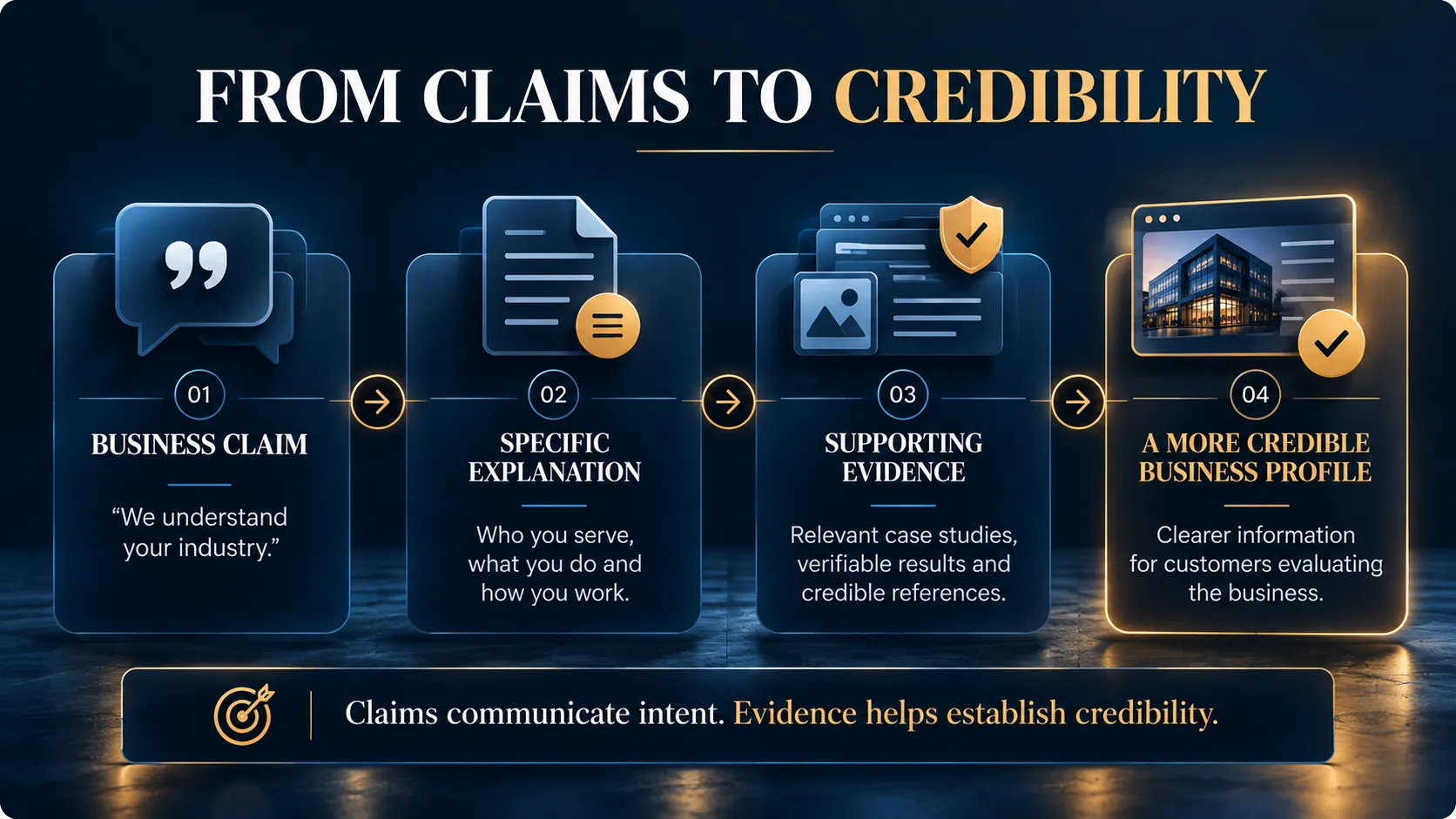
A business’s website tells visitors what the company says about itself. Independent and corroborating sources can provide additional context.
Depending on the business and category, relevant evidence may include:
- Detailed case studies explaining the problem, work and outcome.
- Verifiable customer reviews and testimonials.
- Authoritative industry coverage.
- Professional credentials and genuine affiliations.
- Useful original research or subject-matter expertise.
- Consistent business information on credible third-party platforms.
The objective is not to accumulate mentions indiscriminately. It is to make important claims easier to assess.
If a company claims expertise in a particular industry, relevant case studies and substantive work in that industry provide more context than repeating the industry name across dozens of pages.
If it claims a measurable result, it should explain what was measured and provide support where possible. Results should never be exaggerated to make a business appear more authoritative.
The quality, relevance and reliability of evidence matter more than the volume of unsupported claims.
Build Evidence Around the Claims That Matter
Start with the statements that most influence a customer’s decision.
Does the business claim a particular specialism? Does it describe a distinctive methodology? Does it say it serves a particular kind of company? Does it make claims about the outcomes of its work?
For each claim, ask what evidence a prospective customer would reasonably expect to see.
A detailed case study that explains the context, decisions and results can be more useful than several generic testimonials. A well-maintained company profile can help confirm basic business information. An original article can demonstrate how the business thinks about a problem.
Google’s people-first content guidance similarly emphasises helpful, reliable information rather than content created primarily to manipulate search rankings.
developers.google.com
The point is not that every business must appear in every external publication. It is that claims become more credible when the available evidence supports them.
5. It Needs Accessible, Connected Information
Even well-positioned businesses need to make their information accessible.
Important service descriptions, company details and expertise should be available in readable website content. Core information should not depend entirely on text embedded in images or on content that search systems cannot access.
A practical review should include:
- Whether important pages can be crawled and indexed.
- Whether service pages are reachable through sensible internal links.
- Whether headings and page titles describe the actual content.
- Whether relevant structured data accurately reflects visible information.
- Whether business details are current and consistent.
- Whether related pages reinforce the same clear understanding of the company.
Structured data can provide explicit information about a page’s content. It is not a substitute for useful content, and it should not be treated as a secret shortcut into AI answers.
Google’s published guidance states that existing SEO fundamentals remain relevant to its AI search features and that there are no additional technical requirements specifically for appearing in AI Overviews or AI Mode.
developers.google.com
The practical lesson is to strengthen the fundamentals before investing in speculative technical fixes.
Connect Related Pages Into a Coherent Picture
A business’s website should help people move from a general understanding of the company to a more specific understanding of its services and expertise.
For example, a brand strategy page can link to a relevant explanation of brand positioning. A service page can link to a case study that demonstrates the approach. An article discussing a business problem can direct readers to a relevant service page.
These links are useful because they help readers explore the subject without having to reconstruct the relationship between disconnected pages.
They also make the site’s information architecture clearer.
The goal is not to link every page to every other page. It is to make meaningful relationships between the business’s ideas, services and evidence easy to follow.
A Five-Part Diagnostic for AI Search Visibility
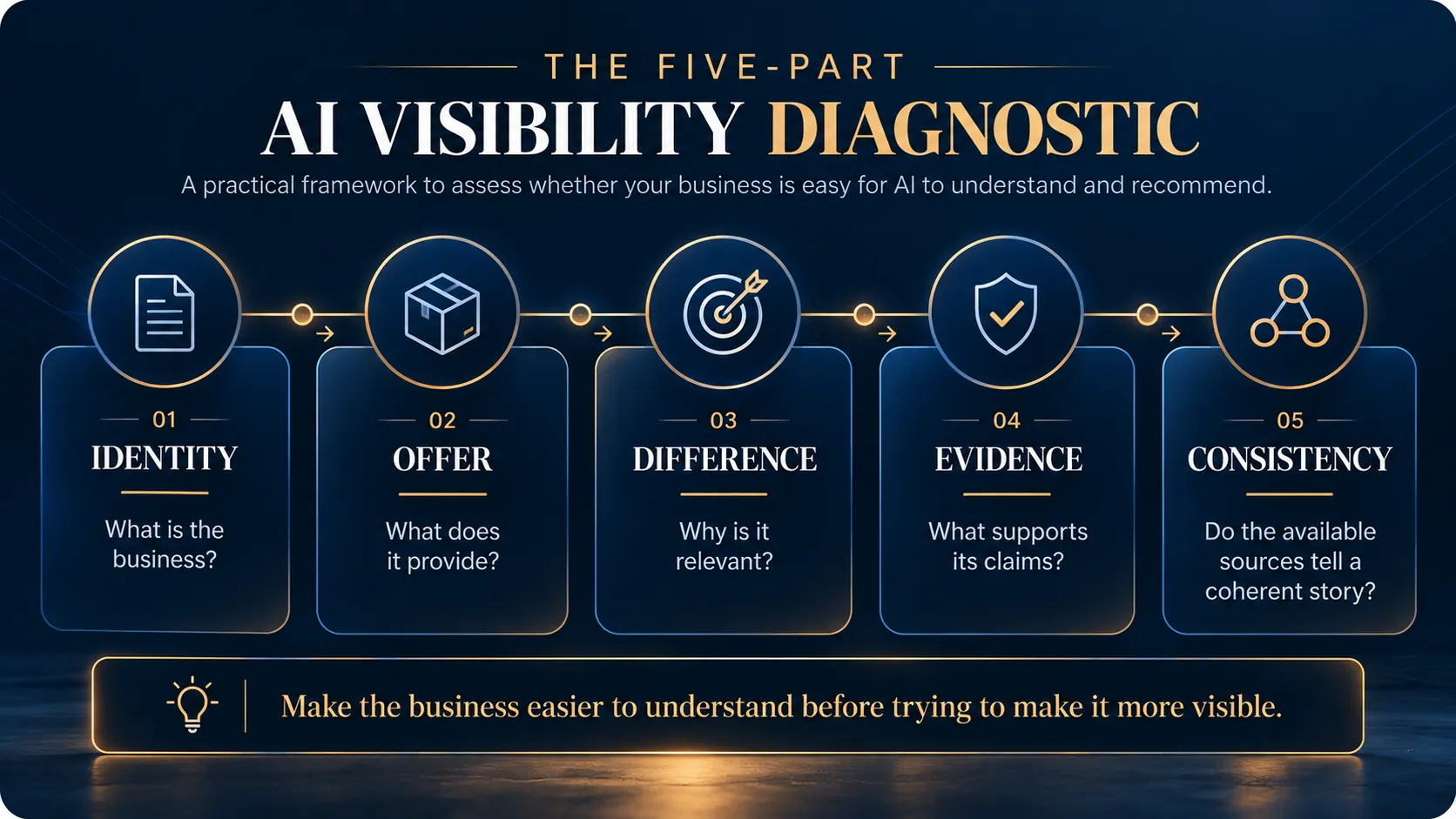
Business owners can use the following framework to assess whether their company is easy to understand and evaluate online.
1. Identity Clarity
Can a new visitor quickly explain what the business is, what category it belongs to and whom it serves?
If the answer depends on interpreting several pages or decoding broad claims, the business description needs attention.
2. Offer Clarity
Are the core services, products, audiences and intended outcomes described specifically?
A visitor should be able to distinguish the company’s main offerings and understand the business problems they address.
3. Differentiation Clarity
Can a buyer identify why the business is relevant instead of seeing only generic claims that competitors could also make?
Look for a clear audience, a meaningful problem, a distinctive approach and evidence that supports the positioning.
4. Evidence Clarity
Are important claims supported by credible, relevant and verifiable information?
Review case studies, testimonials, credentials, original work and other evidence appropriate to the claims being made.
5. Information Consistency
Do the website and other relevant sources communicate a sufficiently coherent picture of the business?
The wording does not need to be identical everywhere. The underlying facts about the business, its offerings and its focus should not conflict unnecessarily.
How to Use the Diagnostic
Use a simple rating for each dimension:
- 0 — Unclear: The information is absent, vague or contradictory.
- 1 — Partial: Some useful information exists, but important gaps remain.
- 2 — Clear: The information is specific, accessible and supported where appropriate.
The resulting score ranges from 0 to 10.
This is a practical internal audit, not a validated AI ranking metric or a predictor of recommendation frequency.
Its value lies in identifying where the business’s public information needs attention.
A low score for differentiation, for example, suggests that the next step may be a positioning exercise—not another round of content production.
A low score for information consistency may instead call for a review of service pages, company profiles and third-party listings.
The diagnosis should determine the intervention.
Why More Content Is Not Always the Answer
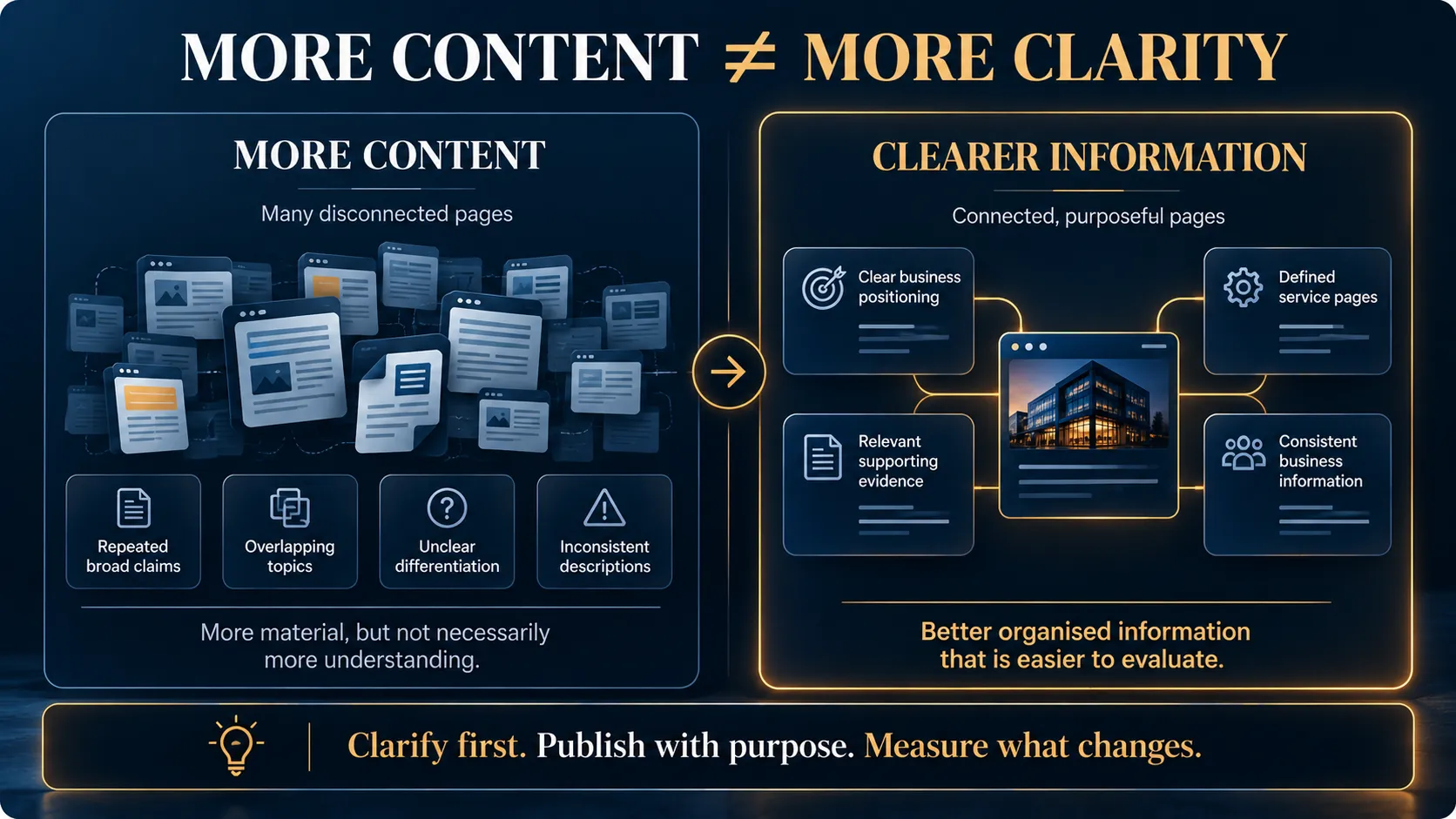
When businesses notice that they are missing from AI-generated recommendations, the immediate response is often to publish more articles, add more FAQs or create pages around additional keywords.
Sometimes new content is necessary. But volume does not automatically resolve unclear positioning or conflicting information. Understanding the difference between content strategy and content marketing helps businesses distinguish the direction behind their content from the activity of producing it.
If a company publishes twenty articles describing its expertise in broad, interchangeable terms, it may simply create more material that communicates the same ambiguity.
A more useful sequence is:
Clarify the business → Organise the information → Support the claims → Publish genuinely useful content → Measure the result.
This sequence begins with the business itself rather than the content calendar.
It also helps distinguish between different problems. A company may be difficult to discover because important pages are not accessible. It may be easy to discover but difficult to distinguish. Or it may be accurately described but absent from a particular recommendation because the query, market or available evidence favours other businesses.
These situations require different responses.
No business can control every AI-generated answer. The goal is to improve the quality of the information and evidence it contributes to the discovery process.
For a deeper look at the distinction between planning content and producing it, see content strategy vs. content marketing.
How to Tell Whether Your Business Is Becoming More Visible
AI search visibility should be measured through repeated, relevant checks rather than a single prompt or screenshot.
Start by defining the questions prospective customers are likely to ask. Include different types of intent, such as finding a provider, comparing alternatives, understanding a service or solving a specific business problem.
Then review how relevant AI platforms respond over time.
Track four things:
- Presence: Does the business appear in relevant answers?
- Accuracy: Is the business described correctly?
- Relevance: Is it presented for the right audience, problem or use case?
- Evidence: Are there citations or sources that support the description?
Where possible, record the platform, exact question, date, answer and cited sources. Repeat the checks consistently, because responses can vary across systems and over time.
Also monitor conventional indicators such as relevant organic impressions, branded searches, referral visits and qualified enquiries. Google explains that traffic from its AI search features is included in the overall Web search performance reporting in Search Console.
developers.google.com
These measures provide complementary evidence, although none alone establishes that AI visibility caused a business outcome.
A brand mention is not necessarily a recommendation. A citation is not necessarily a qualified lead. A recommendation is not necessarily a sale.
The objective is not merely to appear more often. It is to be understood accurately in the situations where the business is genuinely relevant.
The Real Foundation of AI Search Visibility Is Brand Clarity
AI-powered discovery is changing how customers can find and evaluate businesses. But the response should not be to treat every new platform as a separate marketing channel requiring a new set of tricks.
Businesses still need a clear identity, a relevant offer, meaningful differentiation, credible evidence and accessible information.
These are not only search considerations. They are foundations of a coherent brand and a considered business growth strategy.
When those foundations are weak, technical optimisation and additional content may have limited value. When they are strong, the business is better prepared to communicate its relevance across search experiences, websites, directories and other discovery channels.
AI systems will continue to evolve, and no framework can guarantee inclusion in every answer. What businesses can control is how clearly and credibly they explain themselves.
Before asking how to make AI recommend your business, ask a more fundamental question:
Have you given people—and the systems helping them discover you—enough clear, consistent information to understand why your business belongs in the conversation?
If the answer is uncertain, start by reviewing your positioning, service information and evidence. Improving AI search visibility begins with making the business itself easier to understand.