

There is an uncomfortable moment in many founder-led businesses.
The business is bigger.
The team is bigger.
The client base is bigger.
The responsibilities are bigger.
But the way the founder operates has barely changed.
You still approve the important decisions.
You still handle the most sensitive clients.
You still get pulled into problems that other people should be able to solve.
People ask for your view before moving.
The business may have grown around you.
But it may not have grown beyond its dependence on you.
That is a different problem from simply having too much work. A founder bottleneck can emerge when the business grows faster than the way the founder operates.
If founder dependency is already becoming a growth constraint, our earlier look at the founder bottleneck explains that problem in more detail.
A founder bottleneck can appear when the operating model that helped build the business becomes unsuitable for the business’s next stage.
The founder has not necessarily become worse at leading.
The business has simply become different.
And sometimes, the clearest sign that a business has outgrown its founder is not that the founder is struggling.
It is that the company cannot move at full speed unless the founder is involved.
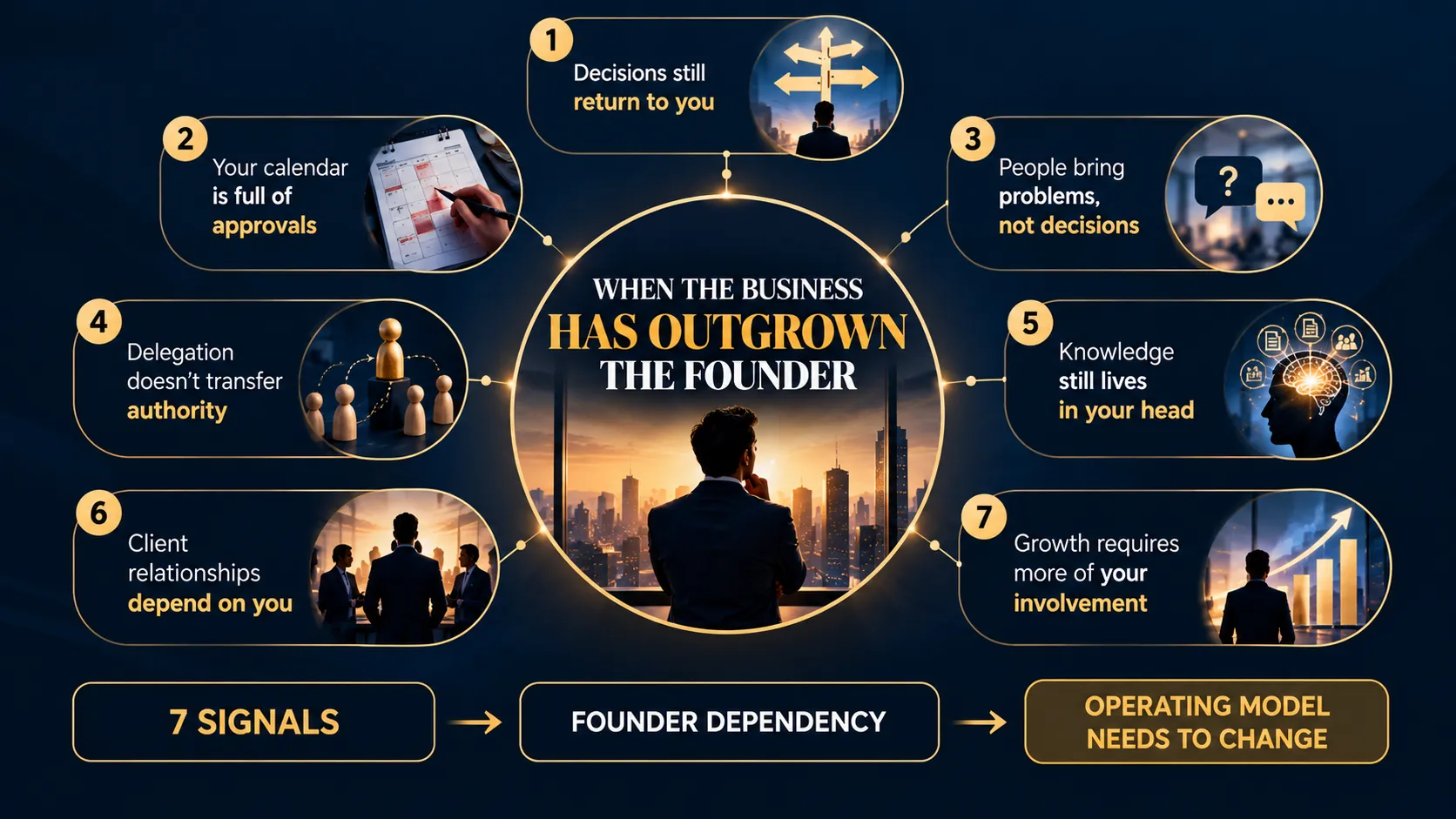
Here are seven signs to look for.
1. Your Team Has Grown, But Your Decision-Making Hasn’t
Hiring people should change more than the number of people on payroll.
It should change where decisions happen.
Yet many founder-led businesses add managers, specialists and senior people while keeping the same decision structure they had when the company was much smaller.
The team grows.
The founder remains the final approval point.
A campaign needs approval.
A pricing exception needs approval.
A difficult client needs approval.
A new hire needs approval.
A significant proposal needs approval.
Eventually, the company has more people capable of making decisions but very few decisions they are actually allowed to make.
That creates an invisible queue.
The problem isn’t necessarily that the team lacks capability.
It may be that authority hasn’t grown with the organisation.
McKinsey’s research on organisational decision-making has similarly highlighted how much executive time can be consumed by ineffective decision processes, and the importance of matching decision-making approaches to the type of decision involved.
Diagnostic question:
If you disappeared for two weeks, which decisions would genuinely stop — and which ones would simply wait because everyone has learned to ask you?
That difference tells you a lot.
2. Your Calendar Is Full of Decisions Only You Are Supposed to Make
A founder’s calendar can reveal more about business maturity than an organisational chart.
Look at the meetings.
Are you spending your time on:
- strategic priorities?
- major commercial decisions?
- important relationships?
- future opportunities?
- leadership?
- market direction?
Or are you spending it on:
- approvals?
- routine reviews?
- internal escalations?
- checking work?
- solving recurring problems?
- sitting in meetings because nobody wants to make the final call?
The distinction matters.
A founder should still be involved in important decisions.
The issue is when importance and dependency become the same thing.
If every difficult decision automatically becomes a founder decision, the organisation hasn’t developed enough decision ownership.
And the founder’s calendar becomes the operating system.
3. People Bring You Problems Instead of Decisions
This is one of the easiest signs to miss.
Someone walks into your office or sends a message:
“We have a problem.”
And you immediately become the person expected to solve it.
Over time, that creates a habit.
The team learns that escalation is safer than judgment.
The founder learns that the team cannot operate without them.
Both sides reinforce the same system.
But there is a significant difference between:
“Here is the problem. What should we do?”
and:
“Here is the problem. We recommend doing X because of Y. Unless you disagree, we’ll proceed.”
The second behaviour demonstrates ownership.
The first demonstrates dependency.
A business that has outgrown the founder needs more people who can interpret situations, make trade-offs and own outcomes.
That is much more valuable than simply having people who can complete tasks.
4. Your Best People Still Need Your Permission to Own Their Work
Delegation is often misunderstood.
A founder gives someone responsibility.
The person takes the work.
But the founder still:
- reviews it
- changes it
- approves it
- makes the difficult decision
- handles the exception
- speaks to the client
- takes responsibility when something goes wrong
Technically, the work has been delegated.
Practically, the authority hasn’t.
This is where many founder-led businesses get stuck.
The founder says:
“I’ve delegated this.”
The employee experiences:
“I still need the founder’s approval.”
That is not ownership.
It is execution under supervision.
Greiner’s organisational growth work is useful here because it treats delegation not simply as a productivity technique but as part of a broader change in how growing organisations are managed.
The question is therefore not:
How much work have I delegated?
It is:
How much meaningful authority have I transferred?
5. Important Knowledge Still Lives Inside Your Head
This is particularly dangerous in founder-led businesses.
You know:
- why certain clients are treated differently
- which opportunities are worth pursuing
- what kind of work the business should avoid
- how pricing decisions are made
- what customers really care about
- which quality standards matter
- what you would never compromise on
The team may be highly capable.
But much of the logic behind your decisions exists only in your experience.
That creates what could be called founder-held operating knowledge.
People can execute the process.
They struggle when the situation changes.
So they come back to you.
This is why documenting a process is not always enough.
A process tells someone:
What to do.
A scalable organisation also needs to make clearer:
How to decide.
That distinction becomes increasingly important as the business becomes more complex.
6. Your Client Relationships Depend More on You Than on the Company
Founder involvement with customers is not automatically a problem.
In fact, founder relationships can be a major competitive advantage.
The problem begins when the relationship belongs to the founder rather than the business.
Ask yourself:
If you stepped away from a key account for six months, would the relationship remain strong?
Would the client still know:
- who to contact
- what the company stands for
- how decisions are made
- what level of service to expect
- who owns the relationship
- why they should continue working with the company?
If the answer is no, you may have built strong customer relationships without building enough institutional relationships.
That matters for growth.
Because a business that can only maintain its most valuable relationships through the founder has effectively put a ceiling on its own capacity.
The founder can only be in so many conversations.
The company needs to become larger than the founder’s personal network.
7. The Business Can Grow Further — But Not With You Operating the Same Way
This is the biggest sign.
The business is not necessarily failing.
It may be doing well.
You may even have more opportunities than before.
But every new opportunity creates more founder involvement.
At this stage, the founder’s changing role needs to sit within a broader business growth strategy – one that defines where the company is going and what the founder should actually own.
More clients.
More decisions.
More people.
More relationships.
More approvals.
More exceptions.
More complexity.
And eventually the founder becomes the limiting variable.
This is the uncomfortable paradox of founder-led growth:
The qualities that helped you build the business can become the qualities that prevent it from scaling.
Your personal judgment created momentum.
Your personal involvement protected quality.
Your personal relationships created trust.
Your personal standards shaped the business.
Those strengths should not disappear.
They should move up the value chain.
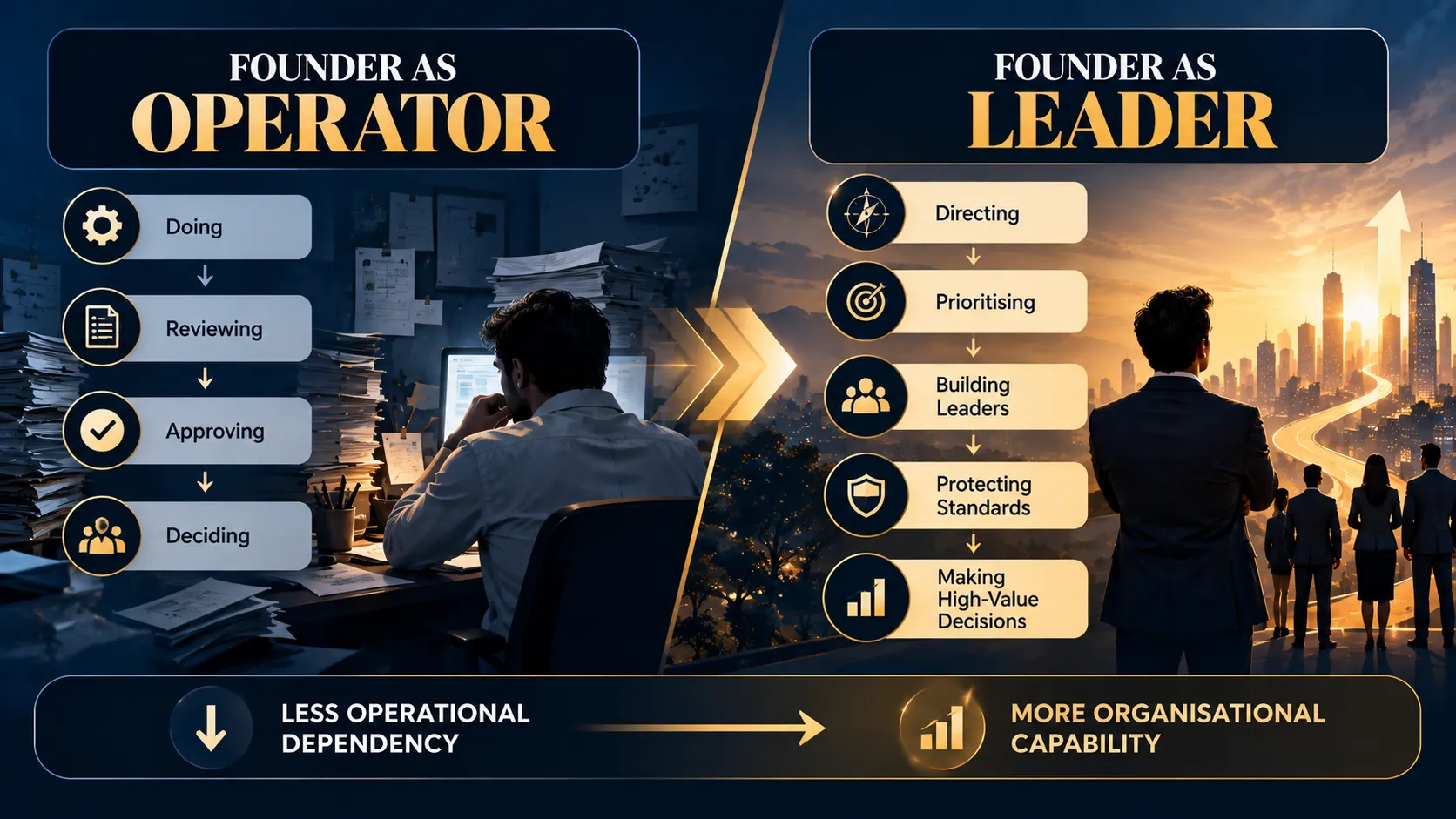
The founder’s role needs to evolve from:
Doing → Reviewing → Approving → Deciding
towards:
Directing → Prioritising → Building leaders → Protecting the standard → Making the decisions only the founder should make.
That is not stepping away from the business.
It is leading at a different level.
The Real Transition: From Founder-Led to Founder-Dependent to Founder-Enabled
It helps to distinguish three states.
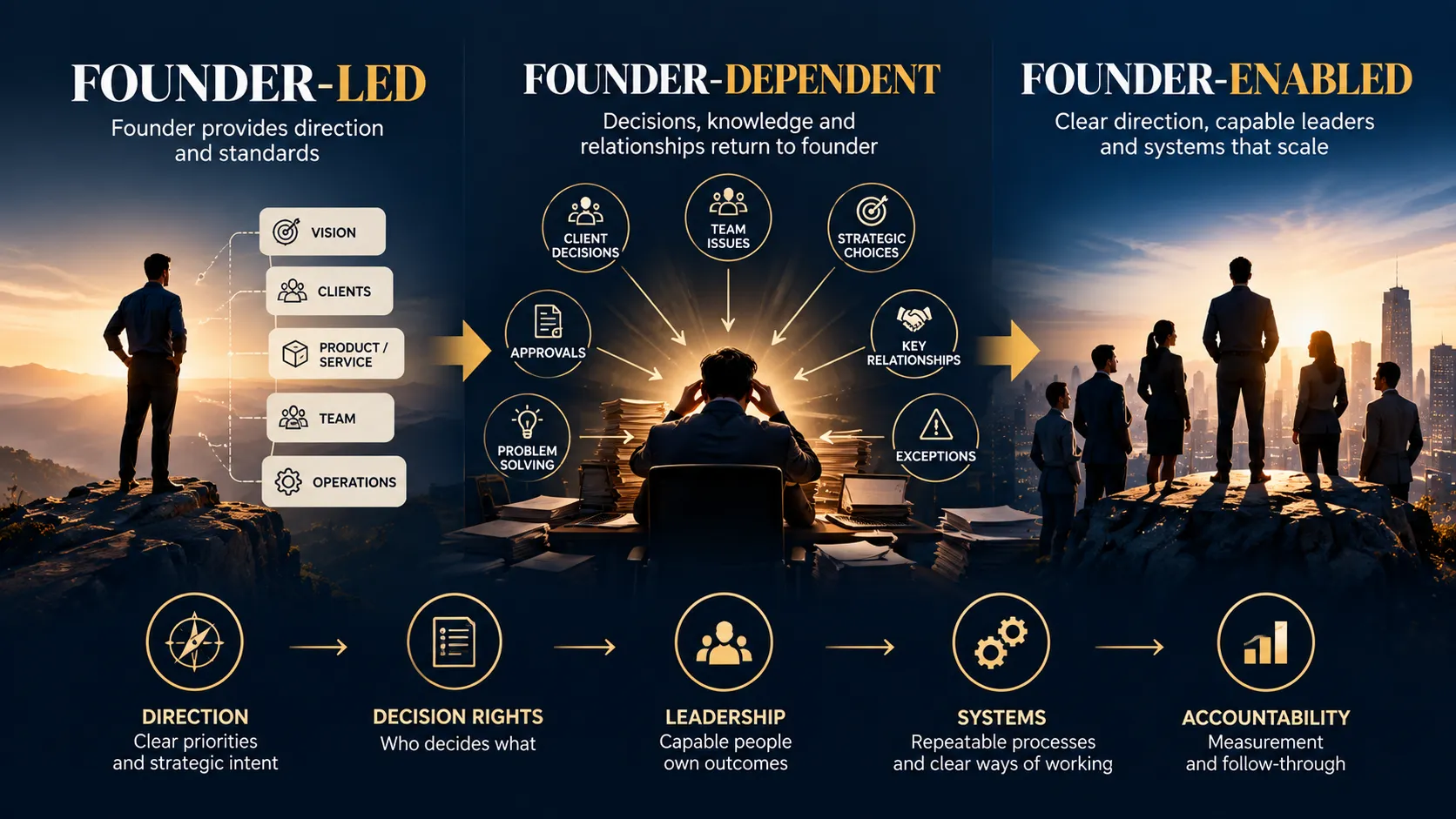
Founder-led
The founder provides direction, standards and strategic judgment.
The organisation can still operate independently within those boundaries.
Founder-dependent
Important decisions, relationships, knowledge and approvals continually return to the founder.
The organisation moves at the founder’s speed.
Founder-enabled
The founder’s thinking has been translated into:
- clear priorities
- capable leaders
- decision rights
- operating principles
- customer ownership
- systems
- accountability
The founder remains important.
But the business no longer requires the founder to personally unlock every part of it.
That is the real goal.
A Simple Founder Maturity Test
Try answering these five questions honestly.
1. If I were unavailable for 30 days, what would genuinely stop?
Not what would become harder.
What would actually stop?
2. Which decisions still require my approval?
Separate decisions that genuinely require founder judgment from decisions that require founder permission simply because that is how the business has always operated.
3. Who owns my most important relationships?
If the answer is mostly “me”, there may be a relationship dependency problem.
4. What knowledge exists only because I know it?
That is founder dependency hiding inside organisational knowledge.
5. Am I still solving problems the business should now be capable of solving?
This is perhaps the most revealing question of all.
If the answer is yes repeatedly, the issue may not be that you need to work less.
The business needs to work differently.
What Should Actually Change?
The answer is not “delegate everything.”
Some decisions should remain with the founder.
The goal is to distinguish between:
Decisions only the founder should make
For example:
- long-term strategic direction
- major capital allocation
- fundamental positioning
- critical leadership decisions
- exceptional commercial commitments
- major changes in the business model
Decisions capable leaders should own
For example:
- functional priorities
- routine commercial decisions
- team management
- client delivery
- operational improvements
- resource allocation within agreed boundaries
Decisions the system should handle
For example:
- repeatable approvals
- standard workflows
- routine reporting
- predictable operating processes
- recurring administrative decisions
This creates a much healthier model:
Founder judgment → Leadership ownership → Systemised execution
Instead of:
Everything → Founder → Everyone else
The Marcom Trends View
The founder bottleneck is often described as a delegation problem.
We think that is too narrow.
The deeper issue is usually a business maturity problem.
That is also why founder dependency can become one of the structural reasons business growth stalls.
A founder builds a business around what works.
Then the business grows.
But the operating model remains attached to the original conditions.
The founder is still the fastest route to an answer.
The safest route to a decision.
The strongest client relationship.
The final quality check.
The keeper of institutional knowledge.
For a while, that works.
Then the business becomes too large for one person’s attention to remain the central mechanism holding it together.
That is when the question changes.
It is no longer:
“How do I get more done?”
It becomes:
“What should still require me to be involved?”
That is a much more important leadership question.
Because the objective of scaling a founder-led business isn’t to make the founder irrelevant.
It is to make the business less fragile because the founder is indispensable.
Final Takeaway
If your business has grown but your role has not changed, you may not have a workload problem.
You may have a founder bottleneck.
The warning signs are not simply long hours.
They are structural:
Your team waits for decisions.
Your calendar is filled with approvals.
Problems keep coming back to you.
Delegation transfers tasks but not authority.
Critical knowledge remains in your head.
Important relationships depend on you.
And the next stage of growth seems to require more of your personal involvement rather than less.
That is the point to pay attention.
Because a business can outgrow its founder’s way of operating long before it outgrows the founder’s value.
The next stage is not about stepping away.
It is about changing what only you should be doing.
If your business has reached a stage where too many decisions, relationships or strategic choices still depend on you, explore how Marcom Trends works with founder-led businesses.