
Festive shopping has always been about more than buying.
There is anticipation. Discovery. Celebration. Comparison. Deals. And increasingly, something else: participation.
That matters because India’s festive commerce window is becoming both larger and more competitive.
Festive advertising is forecast to reach ₹60,000–62,000 crore in 2026, representing roughly 34–35% of India’s annual advertising spend. Commerce advertising is forecast to grow 27%, significantly faster than the overall advertising market.
And the major shopping events are now almost here.
Amazon’s Great Indian Festival starts October 8, while Flipkart’s Big Billion Days opens with early access on October 8.
The interesting question isn’t simply how much consumers will spend.
It is what brands and commerce platforms are doing to earn their attention before they spend.
The festive sale is becoming an experience
The traditional festive formula is familiar:
Campaign → Offer → Sale
But look at how some of the biggest commerce players are approaching the season.
Flipkart’s 2026 Big Billion Days campaign, “Luck Badal Sakta Hai,” is built around an entertainment-led story in which an ordinary man’s day keeps changing through unexpected events and his Flipkart purchases. The company describes the campaign as a relatable, entertaining story rather than simply a product-and-price communication.
Amazon is also expanding the shopping experience around its sale with formats such as Blockbuster Deals, Top 100 Deals, Mega Deals, Exchange Mela and Sample Mania, alongside entertainment through Prime Video. Its 2026 festive proposition also incorporates AI-powered discovery through Rufus, visual search and buying tools.
The common thread isn’t that every brand is becoming an entertainment company.
It’s that commerce is increasingly being packaged as an experience rather than presented only as a transaction.
That makes content strategy part of the commercial journey, not simply a way to fill social feeds.
From watching to participating
This is where festive commerce gets more interesting.
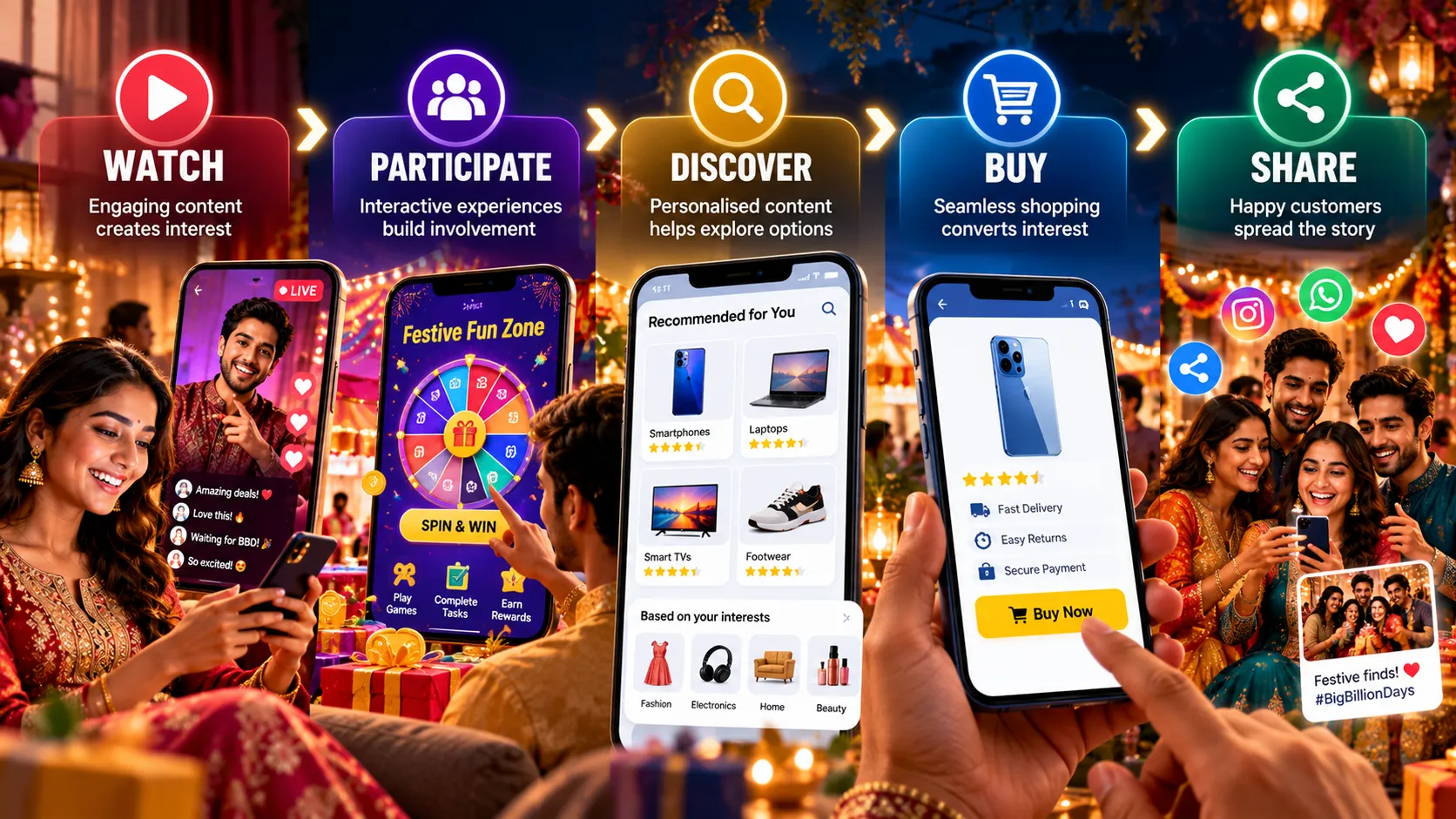
A consumer can now move through a journey like:
WATCH → PARTICIPATE → DISCOVER → BUY → SHARE
Creators are part of that shift.
Festive creator-marketing spend in India is projected to reach ₹900 crore in 2026, with around 7,200 brands expected to activate creators. Diwali remains the biggest individual occasion, but creator activity is increasingly distributed across the wider festive calendar.
That changes the role of the creator too.
They are not necessarily just another media placement.
They can become the host, storyteller, demonstrator or entry point into the commerce experience.
And the consumer is no longer simply receiving the campaign.
They are doing something with it.
Why this matters before the purchase
The timing is important.
JioStar’s 2026 festive research says 68% of consumers start planning more than a month before the purchase, while 49% of category buyers are still researching before choosing a brand. It also expects average festive transaction value to rise from ₹16,500 to ₹24,020.
That means the festive opportunity isn’t confined to the moment someone clicks Buy.
There is a much longer period in which brands can influence discovery, consideration and preference.
Entertainment can create the entry point.
Participation can create involvement.
Commerce then becomes the next step rather than the entire story.
The festive question is changing
This doesn’t mean every brand needs a celebrity, a game or an elaborate interactive campaign.
It means the question is changing.
Instead of asking:
“What festive offer should we promote?”
brands increasingly need to ask:
“What can we create that people actually want to enter, experience or share?”
That is a different marketing problem.
A discount can create urgency.
An experience can create involvement.
The Marcom Trends take
Festive commerce is becoming less about putting an offer in front of consumers and more about creating a reason for them to enter the commercial journey.
The strongest festive campaigns may not initially feel like advertisements.
They may look like entertainment, stories, creator content, games or cultural moments — with commerce built into what happens next.
And as the festive window gets more crowded, that distinction could become increasingly important.
The festive shelf is crowded. The next battle may be for the experience around the shelf.