

There is a point in many founder-led businesses when being deeply involved stops being an advantage.
The business may be growing.
The team may be getting bigger.
Clients may be increasing.
Revenue may be moving in the right direction.
And yet, somehow, almost everything still comes back to the founder.
A major proposal needs the founder’s approval.
A difficult client issue needs the founder.
A new hire needs the founder’s judgment.
The team waits when the founder is unavailable.
Important decisions sit in someone’s inbox because nobody wants to make the wrong call.
The founder’s calendar fills with meetings that were supposed to create leverage but instead create another layer of dependency.
This is the founder bottleneck.
It doesn’t mean the founder is doing a bad job.
Quite often, it means the opposite.
The founder became central because they were the person who understood the market, knew the customers, made good decisions and cared enough to solve problems personally.
Those qualities may have helped build the business.
But the same qualities can eventually become the thing that prevents the business from scaling.
The question is no longer whether the founder can keep carrying the business.
The question is whether the business can keep growing without requiring the founder to carry so much of it personally.
The Founder Is Usually the Reason the Bottleneck Exists
Founder dependency rarely appears because someone deliberately designed a bad organization.
It usually develops naturally.
In the early stages, the founder has to know everything.
They know:
- what customers want
- what the product or service can actually deliver
- which clients matter most
- how pricing decisions are made
- which opportunities are worth pursuing
- what quality looks like
- who on the team can be trusted with what
- what risks the business can afford to take
That concentration of knowledge is useful when the company is small.
Speed matters.
There may not be enough people to create layers of decision-making.
The founder can make a decision in ten minutes that would otherwise require three meetings.
So the company learns a pattern:
When something important happens, ask the founder.
And because the founder usually has the answer, the pattern gets reinforced.
That is where the problem begins.
Growth Changes the Cost of Founder Involvement
The same level of founder involvement that works at five employees can become a serious constraint at twenty-five.
At fifty, it can become structural.
The business now has more customers, more employees, more projects, more financial decisions and more moving parts.
But the founder still has approximately the same number of hours in a day.
This creates a simple constraint:
The organization can grow faster than the founder’s ability to process decisions.
The founder becomes the queue.
One decision waits.
Then another.
Then another.
Eventually, the business doesn’t move at the speed of the team.
It moves at the speed of founder availability.
That is a very different problem from simply being busy.
What the Founder Bottleneck Actually Looks Like
Founder dependency is often difficult to recognize because it can look like leadership.
Here are some of the more obvious signals.
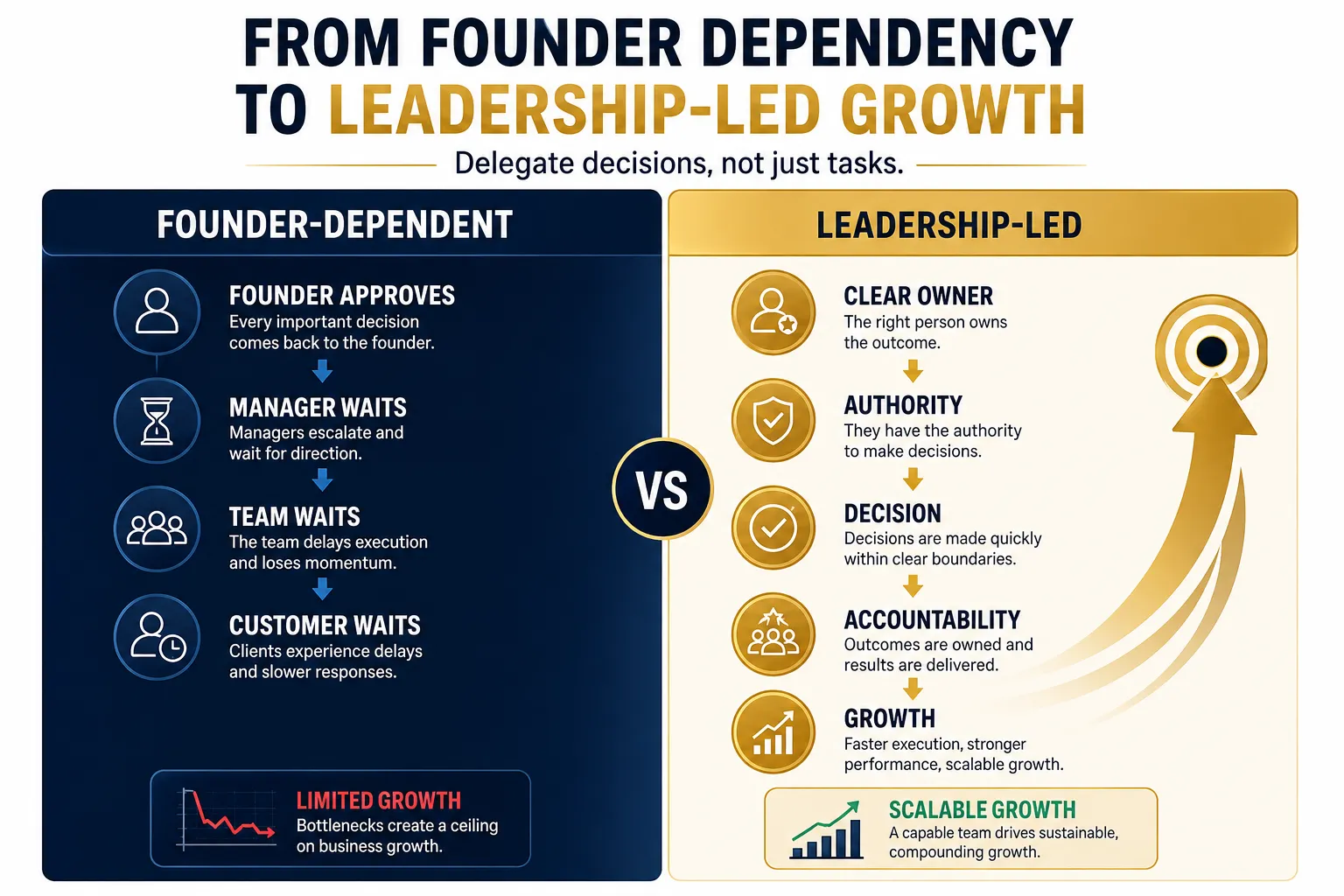
Every Important Decision Comes Back to the Founder
The team may technically have authority, but everyone knows the founder has the final say.
So people wait.
Not because they are incapable.
Because the decision rights aren’t clear.
Managers Escalate Problems Instead of Solving Them
A manager says:
“I just wanted to check with you.”
It sounds harmless.
But if that sentence appears dozens of times every week, the company has a capacity problem.
A manager who constantly needs founder confirmation isn’t really operating with full ownership.
Clients Expect the Founder Personally
This is especially common in professional services and founder-led advisory businesses.
The founder built the relationship.
The founder closed the deal.
The founder became the trusted expert.
Now the client expects the founder to remain involved in everything.
That can create a dangerous commercial dependency.
The business owns the client relationship on paper.
The founder owns it in practice.
The Founder Is the Quality-Control Department
Every proposal.
Every important presentation.
Every campaign.
Every major piece of content.
Every significant hire.
Everything eventually reaches the founder’s desk.
The founder believes they are protecting quality.
The organization experiences it as a bottleneck.
Critical Knowledge Lives in the Founder’s Head
This may be the most serious version.
The business knows how to operate because the founder knows how to operate it.
Processes may exist informally.
Decisions may depend on context nobody else has.
Customer knowledge may not be documented.
The company has employees, but too much organizational intelligence remains concentrated in one person.
That is not scalable knowledge.
It is founder dependency.
The Dangerous Part: The Founder Bottleneck Can Look Like Success
This is why the problem is easy to miss.
The company isn’t necessarily failing.
It may be doing well.
Revenue may be increasing.
Customers may be happy.
The team may be busy.
The founder may even feel indispensable.
That can create a misleading conclusion:
“The business is working because I am deeply involved.”
But another interpretation may be more accurate:
The business is working, but its next stage of growth is constrained by how much the founder can personally absorb.
Recent writing on founder bottlenecks makes a similar distinction: the issue is often not founder effort or commitment, but concentration of decisions, relationships and knowledge around one person.
That distinction matters.
Because the solution isn’t:
Work harder.
It isn’t even:
Delegate everything.
The solution is to change how the organization operates.
Delegating Tasks Is Not the Same as Delegating Authority
This is where many founders get stuck.
They delegate the work.
They don’t delegate the decision.
For example:
“Please prepare the proposal, but send it to me before you send it.”
Or:
“Run the campaign, but I’ll approve every important change.”
Or:
“Handle the client, but call me if they push back.”
The founder has transferred execution.
They have not transferred ownership.
That means the founder remains the bottleneck.
Real Delegation Transfers a Decision
Instead of:
“Prepare this for me.”
It becomes:
“You own this outcome within these boundaries.”
That requires three things:
Responsibility
Who owns the outcome?
Authority
What decisions can that person make without asking?
Boundaries
When must the issue come back to leadership?
Without all three, delegation is incomplete.
The Business Needs a Decision Architecture, Not Just More Employees
Hiring more people does not automatically solve founder dependency.
You can add five managers and still have the founder approving everything.
You can add a COO and still have every important decision return to the founder.
You can build departments and still operate like a founder-led startup.
The organization needs something more deliberate:
Who decides what?
That question sounds basic.
It isn’t.
A growing company should be able to identify:
- which decisions belong to the founder
- which belong to managers
- which belong to functional owners
- which require consultation
- which require escalation
- which should never return to the founder
That is decision architecture.
And it is one of the foundations of scalable leadership.
Five Areas Where Founder Dependency Usually Builds
Not every founder bottleneck looks the same.
1. Decision Dependency
The founder approves too many decisions.
Fix: Establish clear decision rights and thresholds.
2. Relationship Dependency
Customers, partners or suppliers rely primarily on the founder.
Fix: Build broader relationship ownership across the leadership team.
3. Knowledge Dependency
Critical information exists mainly in the founder’s experience.
Fix: Document repeatable knowledge, processes and decision logic.
4. Quality Dependency
The founder is the final quality filter for everything important.
Fix: Define quality standards so others can make decisions against an explicit bar.
5. Commercial Dependency
The founder remains the only person who can confidently sell, price, negotiate or shape important opportunities.
Commercial dependency can become particularly visible when the founder remains the only person shaping the company’s B2B marketing strategy and commercial story.
Fix: Transfer commercial judgment through frameworks, coaching, exposure and accountable ownership.
This five-part view is useful because the same delegation strategy won’t solve every type of dependency. Current founder-bottleneck analysis similarly distinguishes decision, relationship, knowledge, quality and commercial dependency rather than treating all founder involvement as one problem.
The Founder Should Not Disappear From the Business
There is a common overcorrection.
Once founders recognize dependency, they sometimes conclude:
“I need to get out of the business.”
That’s not necessarily the goal.
The founder’s role should evolve.
Early stage:
Founder does
Later stage:
Founder leads
Mature stage:
Founder shapes direction, capital, culture, strategic relationships and the next level of growth
The objective isn’t to make the founder irrelevant.
It is to make the organization less fragile without the founder’s constant intervention.
That is a much better definition of scale.
What the Founder Should Keep
Not every responsibility should be delegated.
The founder may still need to own:
Strategic Direction
Where is the company going?
What markets matter?
What should the company become known for?
Major Capital Decisions
Which investments could materially change the business?
Culture and Leadership Standards
What behaviours and standards are non-negotiable?
Critical Strategic Relationships
Which relationships genuinely require founder-level involvement?
The Next Growth Constraint
The founder’s highest-value role increasingly becomes identifying what the organization needs to solve next.
That is very different from approving every minor decision.
What the Founder Should Start Releasing
The other side of the equation is equally important.
Founders should look for recurring decisions that consume time without requiring founder-level judgment.
For example:
- routine approvals
- operational scheduling
- standard client decisions
- routine hiring steps
- campaign execution
- recurring reporting
- internal coordination
- project-level decisions
- routine supplier decisions
- repeatable customer issues
The first question should not be:
“What can I get someone else to do?”
Ask:
“What decisions am I still making that the organization should be capable of making without me?”
That is the more powerful question.
A Simple Founder Bottleneck Diagnostic
If you want to test whether founder dependency is becoming a growth constraint, ask these questions:
If I disappear for two weeks, what stops?
Not what becomes slightly harder.
What actually stops?
How many decisions are currently waiting for me?
Look at your inbox, Slack/Teams messages, meeting agendas and approval queues.
The number can be revealing.
Which managers can make decisions without checking with me?
Not which managers have responsibility.
Which ones genuinely have authority?
Which customer relationships would weaken if I stepped away?
Those relationships represent commercial dependency.
What does only the founder know?
This identifies knowledge dependency.
Where am I still the final quality filter?
That reveals quality dependency.
What do people bring to me that they could reasonably solve themselves?
Those are potential delegation opportunities.
The First Step Is Not Hiring. It Is Mapping Dependency
A common response to founder overload is to hire.
Sometimes that is exactly right.
But hiring before understanding the bottleneck can simply add another person to a broken decision structure.
Start by mapping where the founder is required.
Create four columns:
| Area | Founder involvement | Why? | Can it transfer? |
|---|---|---|---|
| Sales | High | Key relationships | Partially |
| Marketing | Medium | Final approval | Yes |
| Operations | High | Escalations | Yes |
| Strategy | High | Founder responsibility | Partially |
The point isn’t to remove the founder from every row.
The point is to distinguish founder-value work from founder-dependent work.
Those are not the same thing.
Build the Operating Layer Before You Demand More Growth
Growth creates complexity.
Complexity creates more decisions.
More decisions create more opportunities for founder dependency.
So the operating layer has to mature alongside the business.
That means:
Clear roles
Clear accountability
Clear decision rights
Documented processes
Regular leadership rhythms
Visible priorities
Defined escalation paths
Consistent performance measurement
This is where Marcom Trends’ business growth approach can connect naturally to the broader question of how businesses build the operating capability required for sustainable growth.
The objective is not bureaucracy.
It is reducing unnecessary dependence on one person’s attention.
The Founder Bottleneck Is Ultimately a Growth Design Problem
The founder bottleneck is often described as a leadership problem.
It is bigger than that.
It is a growth design problem.
Because every business has a finite amount of decision-making capacity.
When that capacity becomes concentrated in one person, it can become a growth constraint.
If too much of that capacity sits with one person, growth eventually creates a queue.
And queues create friction.
The team waits.
Customers wait.
Opportunities wait.
Managers stop taking initiative.
The founder becomes increasingly reactive.
The business becomes harder to scale precisely when it should be becoming more capable.
That is the paradox:
The founder’s involvement helped create the growth. Too much founder dependency can eventually limit it.
The Goal Is Not a Founder-Free Business
A founder-free business is not necessarily a better business.
A founder should still bring something the organization cannot easily manufacture:
Vision.
Judgment.
Market perspective.
Conviction.
Strategic relationships.
Long-term thinking.
The goal is to move those strengths up the value chain.
From:
“I need to approve this.”
To:
“I need to decide where we’re going.”
From:
“I need to solve this client issue.”
To:
“I need to build a leadership system that handles issues well.”
From:
“I need to check everything.”
To:
“I need to define the standard and make sure the organization can meet it.”
That’s the transition from founder-dependent growth to leadership-led growth.
Final Takeaway
If your business cannot move without you, the problem may not be that you need to work harder.
It may be that the organization has not yet learned how to operate at the level of growth you are asking it to achieve.
The founder bottleneck is not a character flaw.
It is often the natural consequence of building a successful business through personal ownership, judgment and relationships.
But what worked to create the business cannot always be the operating model that takes it to the next stage.
The goal isn’t to remove the founder.
The goal is to stop making the founder the only mechanism through which the business can move.
If important decisions, customer relationships, knowledge and quality control still depend heavily on one person, that dependency deserves to be treated as a strategic growth issue.
But recognising the bottleneck is only the first step. If the business has already grown beyond the way the founder operates, these seven signs can help identify whether the company’s next stage requires a different founder role.
And the earlier the business identifies it, the easier it is to redesign.
Explore Marcom Trends’ business growth advisory approach.