

How to scale a founder-led business without losing control is one of the hardest transitions for a founder to navigate. What worked when every important decision passed through one person can become the very thing that limits the next stage of growth.
What happens if I stop being involved in everything?
It is a reasonable question.
The founder knows how the business works. They know the customers. They know why certain decisions were made. They know what good work looks like. Often, they are also the person who catches problems before anyone else sees them.
So delegation can feel dangerous.
Give someone else responsibility and quality might fall.
Let someone else handle a customer and the relationship might weaken.
Let someone else make decisions and the business might start moving in a direction the founder never intended.
That is why many founder-led businesses reach an uncomfortable point: they hire people to create capacity, but still keep themselves at the centre of almost every important decision.
The business grows.
The founder’s workload grows with it.
And eventually, the thing that made the business successful starts limiting how far it can go.
The answer is not to stop controlling the business.
It is to control the right things.
Why Scaling Feels Like Losing Control
Early-stage businesses often run on founder judgment.
A customer has a problem. The founder solves it.
A proposal needs changing. The founder changes it.
A team member is unsure what to do. The founder decides.
A new opportunity appears. The founder evaluates it.
This works surprisingly well when the organisation is small.
The founder is close to the work, the customers and the decisions.
But growth changes the equation.
More customers create more decisions. More employees create more coordination. More products or services create more complexity. More opportunities create more trade-offs.
The founder’s personal capacity does not grow at the same rate.
McKinsey’s recent research on founder-led companies identifies building systems that can sustain growth beyond the founder as a critical scaling inflection point. As organisations become larger, it becomes impractical for the founder to remain close to every operational, talent and financial decision.
This is where founders can make a subtle mistake.
They think:
“I need to delegate more.”
The better question is:
“Which decisions should no longer require me?”
That is a very different starting point.
The Problem Is Not Delegation. It Is Founder Dependency
This is where a founder bottleneck becomes a scaling problem.
Delegation is often discussed as if the solution is simply to hand tasks to other people.
That misses the bigger issue.
A founder can delegate a task and remain completely central to the decision behind it.
For example:
A marketing manager creates the campaign.
But the founder approves every headline.
A sales manager handles enquiries.
But the founder still has to approve every important proposal.
An operations manager runs delivery.
But the founder is still the only person who can resolve customer complaints.
A finance team prepares reports.
But the founder remains the only person who can decide what the numbers mean.
Technically, work has been delegated.
Operationally, the founder is still the system.
That is founder dependency.
The organisation appears to have a team, but important knowledge, judgment and decision rights remain concentrated in one person.
What starts as a strength can eventually become a growth constraint.
Research on organisational decision-making has identified a related problem: decisions that are supposedly delegated can repeatedly return to senior leaders when employees are unclear about their authority or expect senior leaders to reopen decisions they disagree with.
So real delegation is not:
“You can do this.”
It is:
“You own this decision within these boundaries.”
What Should the Founder Actually Keep Control Of?
The goal is not to remove the founder from the business.
A founder’s strategic involvement remains valuable.
The question is where that involvement creates the most leverage.
There are four areas founders should generally remain close to.
Strategic direction
The founder should still help determine:
- where the business is going
- which markets matter
- what the business should become known for
- what opportunities fit the strategy
- what the business will deliberately not pursue
These are not routine operating decisions.
They shape the future of the company.
Brand and quality standards
Delegation does not mean lowering standards.
The founder should define what good looks like.
That could include:
- customer experience
- brand behaviour
- quality thresholds
- service standards
- communication principles
- important commercial boundaries
Once those standards are clear, other people can operate within them.
High-consequence decisions
Some decisions genuinely deserve founder involvement.
A major strategic partnership may.
A fundamental change in the business model may.
A significant financial commitment may.
A decision that could materially change the brand may.
The objective is not to delegate everything.
It is to identify the decisions where founder judgment actually matters.
Key relationships and exceptions
There will always be situations where the founder’s involvement creates disproportionate value.
The largest customer.
A sensitive strategic relationship.
A serious reputation issue.
A major negotiation.
A business-threatening exception.
The founder should be available for these situations without becoming the default destination for every ordinary problem.
How to Scale a Founder-Led Business: The Founder Control Shift
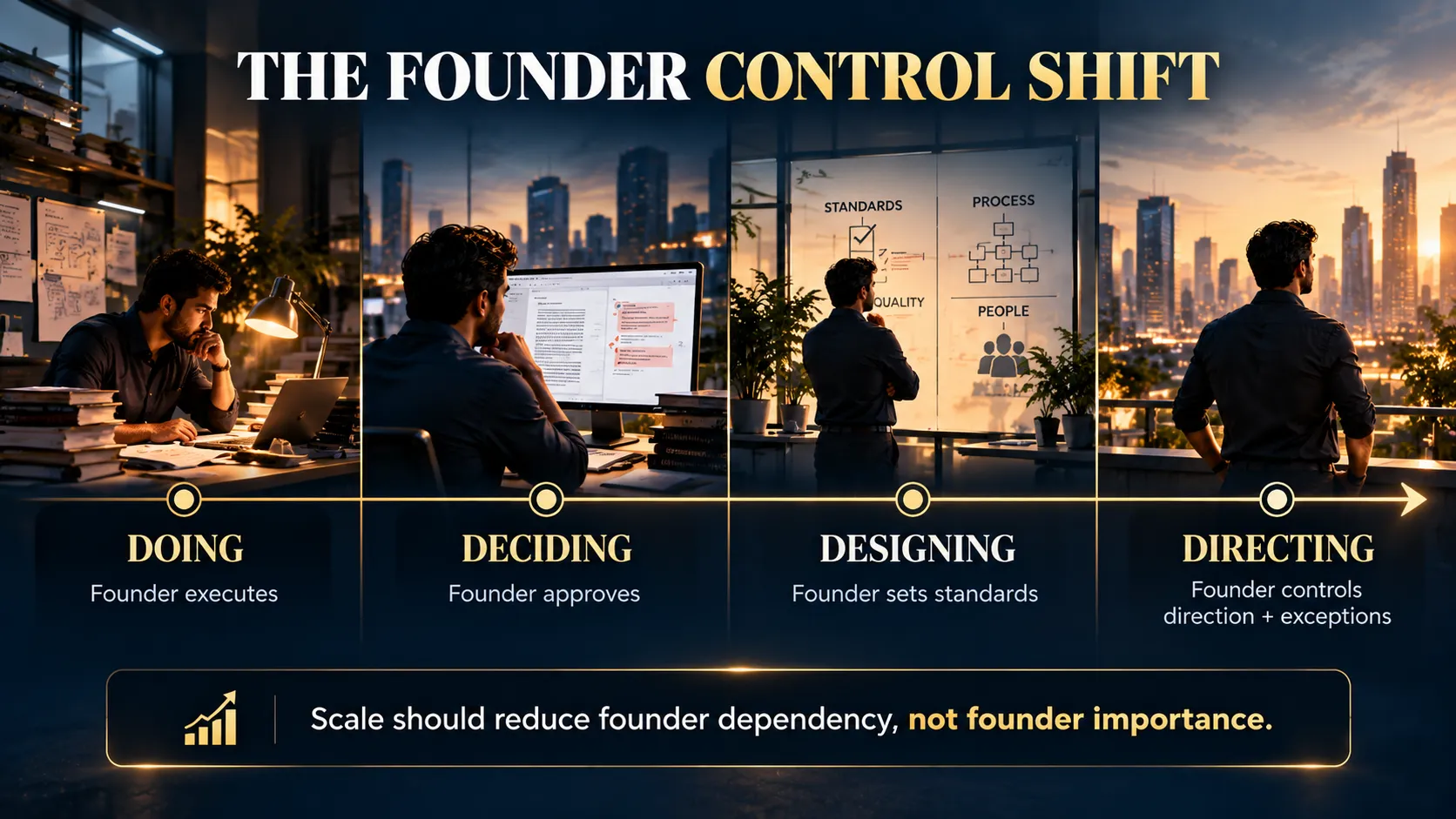
This is where scaling becomes more practical.
Instead of asking how to remove the founder from the business, ask how to redesign the founder’s role.
1. Define the decision
Start with recurring decisions.
Who decides pricing exceptions?
Who approves new suppliers?
Who decides whether a customer complaint requires compensation?
Who approves campaign budgets?
Who can hire?
Who can make an offer to a client?
If the answer to most questions is still “the founder”, the business has a decision-rights problem.
McKinsey recommends explicitly identifying recurring decisions, assessing whether they are reversible, whether someone else has the capability to make them, and whether that person can be held accountable for the outcome.
2. Set the guardrail
Delegation without boundaries creates anxiety.
A team member may technically have authority but still wonder:
“How far can I go?”
Define the limits.
For example:
Customer service can resolve complaints up to an agreed threshold without founder approval.
Or:
The marketing lead can change campaign creative and targeting within the approved strategy and budget.
The specific numbers will vary by business.
The principle does not.
People need boundaries to make decisions confidently.
3. Transfer ownership
This is the step founders often skip.
If a founder says:
“Handle this, but send it to me before anything goes out.”
The decision has not really moved.
The team member is executing.
The founder is still deciding.
True ownership means the person has authority to act within the agreed guardrails.
4. Create visibility
Control does not require constant intervention.
It requires visibility.
Dashboards, reporting routines, quality checks, customer feedback and defined performance indicators can give founders the information they need without requiring them to personally inspect every activity.
The founder should be able to ask:
“Is the system working?”
rather than:
“Let me check everything myself.”
5. Escalate by exception
This is perhaps the biggest shift.
Routine decisions should stay with the people responsible for them.
Exceptions should move upward.
That creates a healthier pattern:
Routine → Team
Exception → Manager
Strategic exception → Founder
The founder remains important.
But the founder is no longer the traffic controller for the entire organisation.
The First Step Is Not Hiring More People
A common scaling response is to hire.
More work comes in, so hire someone.
More customers arrive, so hire another person.
The founder becomes overwhelmed, so hire an operations manager.
But hiring alone does not remove founder dependency.
You can build a larger team around the same dysfunctional decision structure.
The result?
More people waiting for the founder.
Before hiring, map where founder dependency actually exists.
The first step is not hiring more people. It is mapping where the founder is still required across decisions, relationships, knowledge, quality and commercial activity, including customer acquisition, sales decisions or B2B marketing strategy.
Look at:
Decisions
What still requires founder approval?
Relationships
Which customers, suppliers or partners only trust the founder?
Knowledge
What does the founder know that nobody else can easily access?
Quality
Which standards exist only inside the founder’s head?
Commercial activity
Which proposals, pricing decisions or negotiations still depend on the founder?
This creates a much clearer picture of what actually needs to change.
Build Systems Around Repeatable Decisions
A system is not necessarily a complicated process document.
Sometimes it is simply a repeatable way of making a decision.
For example:
A founder may personally know which clients are a good fit.
Instead of approving every lead, the business can define the criteria.
A founder may personally know what makes a good proposal.
Instead of rewriting every proposal, the business can define the structure and quality standards.
A founder may personally know when a customer problem is serious.
Instead of handling every complaint, the business can define escalation thresholds.
This is how founder knowledge becomes organisational capability.
McKinsey’s research on scaling founder-led organisations similarly emphasises the need for clear roles, decision rights, operating systems and guardrails as complexity increases.
The objective is not bureaucracy.
It is transferability.
If the business can only operate properly when the founder is present, it has not really scaled.
It has simply become busier.
How to Know Whether You Are Actually Scaling
Revenue going up does not automatically mean the business is scaling well.
Ask five questions.
1. Can important decisions happen without the founder?
If not, decision capacity may still be concentrated.
2. Can customers receive consistent service without the founder?
If not, the customer relationship may still belong to the founder rather than the business.
3. Can new employees learn how the business operates without sitting beside the founder?
If not, too much knowledge may still be informal.
4. Can the founder take several days away without everything slowing down?
This is one of the simplest practical tests.
If the answer is no, the business may still be founder-dependent.
5. Is the founder spending more time on high-leverage decisions?
This is the real test.
Scaling should gradually move founder attention from:
doing → reviewing → designing → directing
The founder does not become less important.
The founder becomes more valuable because their time is being used where it has the greatest impact.
Scaling Should Reduce Founder Dependency, Not Founder Importance
The fear of losing control is understandable.
But there is a difference between control and involvement.
Control means knowing where the business is going, what standards matter, who owns which decisions, what the important numbers are and when something needs escalation.
Involvement means personally touching the work.
A founder can reduce involvement without losing control.
In fact, that is often the point of scaling.
The strongest founder-led businesses do not necessarily become founderless.
They become less founder-dependent.
The founder still shapes direction.
Still protects the brand.
Still makes consequential decisions.
Still understands the customer.
But the organisation no longer needs the founder to approve every move before it can operate.
That is a much healthier definition of scale.
The goal is not to build a business where the founder does less because they matter less.
It is to build a business where the founder can do more of what only the founder should be doing.
If important decisions, customer relationships, knowledge and quality control still depend heavily on one person, that dependency deserves to be treated as a strategic growth issue.
Our business growth advisory approach can help you identify where founder dependency is slowing growth and build a clearer path toward system-led scale.
FAQs
How do you scale a founder-led business without losing control?
Start by separating founder involvement from founder control. Keep strategic direction, major decisions, standards and important exceptions with the founder, while transferring repeatable decisions and execution to clearly defined owners with appropriate guardrails.
What is founder dependency?
Founder dependency occurs when important decisions, relationships, knowledge or operating processes remain concentrated in the founder, making the business dependent on the founder’s availability.
Does delegation mean losing control?
No. Good delegation can increase control by clarifying decision rights, standards, accountability and escalation. The founder loses control when authority becomes unclear, not simply because decisions move to other people.
What should a founder delegate first?
Start with repeatable decisions and activities that others can perform to a defined standard. Routine operational decisions are generally better candidates than strategic choices that require the founder’s unique judgment.
How do you know if a business is too dependent on its founder?
Look at what happens when the founder is unavailable. If routine decisions stop, customers wait, employees seek approval or important work cannot proceed, the business likely has significant founder dependency.
What systems help a founder scale a business?
Useful systems include clear decision rights, documented processes, quality standards, reporting routines, performance measures and escalation rules. The appropriate level of process depends on the business and its complexity.