

Measuring customer perception of your brand starts with understanding whether customers see the business the way you intend them to. A company may have a carefully written positioning statement, a consistent visual identity, a clear value proposition and a marketing message that explains why it is different.
But there is a question that internal brand discussions cannot answer:
Do customers actually perceive the business that way?
A company may describe itself as a strategic partner while customers see it as a service provider. It may communicate quality while buyers primarily compare it on price. It may believe its customer service is a strength, yet customers may remember slow responses or inconsistent support.
These differences matter because customers make decisions based on the brand they experience and understand, not simply the brand a business intends to communicate.
That is why measuring customer perception of your brand should be more than an occasional satisfaction survey or a review-rating exercise. Businesses need a clearer understanding of what customers associate with them, what influences those associations and whether those perceptions support the direction in which the business wants to grow.
What Customer Perception Really Tells You
Customer perception is the collection of beliefs, impressions, expectations and associations people develop about a business through their interactions with it.
It can include how customers judge:
- The quality and reliability of the product or service.
- The expertise and credibility of the business.
- The value they receive relative to the price.
- The company’s ability to understand their needs.
- The experience of dealing with its people and processes.
- The reasons they would choose it over an alternative.
These impressions are not formed through advertising alone.
A customer may first discover a business through its website, develop an expectation during a sales conversation, evaluate its reliability during delivery and form a longer-term opinion through after-sales support.
Each interaction contributes to the overall picture.
Research on brand experience also shows that customers respond to brands through sensory, emotional, intellectual and behavioural experiences, not simply through the messages businesses communicate.
This is why brand perception cannot be measured by looking only at marketing communications. The promise a business makes and the experience it delivers both influence what customers believe.
It is also important to distinguish perception from satisfaction. Satisfaction usually evaluates a particular experience or relationship. Brand perception is broader. It concerns what the customer believes the business represents and what they expect from it.
It is equally important to distinguish whether customers simply recognise a business or actively prefer it. The difference between brand awareness and brand preference helps explain why visibility alone does not establish a strong customer relationship.
A customer can be satisfied with one transaction but still see the business as interchangeable with competitors. Another customer may value the company’s expertise and reliability even when a particular experience has not been perfect.
Both situations deserve attention, but they point to different business questions.
Why Businesses Often Misread Their Brand Perception
The most common problem is that internal understanding gets mistaken for external understanding.
Leadership knows the company’s history, capabilities, expertise and ambitions. Employees may understand the full range of services. The marketing team may have spent months refining the brand message.
Customers do not necessarily share that context.
They may know only the product they purchased, the person they spoke to or the information they found online. They may judge the business through a small number of interactions and compare it with alternatives using criteria the company has not considered.
This creates several common blind spots.
1. Confusing intended positioning with actual perception
A business may want to be known for expertise, but customers may associate it primarily with affordability or convenience. The intended message is not evidence that the market has accepted it.
2. Listening only to positive feedback
Compliments can be reassuring, but they rarely explain why customers choose the business, what makes them hesitate or what they find difficult to understand.
3. Treating every customer as one audience
Different customer groups may hold different opinions. Long-standing customers may understand the business’s strengths, while first-time buyers may have a narrower impression.
4. Relying on internal assumptions
Employees and leaders are close to the business. That familiarity can make it difficult to recognise what is unclear, inconsistent or unconvincing to someone encountering the brand for the first time.
When the market does not understand what makes a business relevant or different, the resulting positioning weakness can also affect marketing effectiveness and increase the effort required to win customer attention. Read more about how weak brand positioning can increase marketing costs.
5. Looking at results without understanding the reasons
A decline in enquiries, repeat purchases or referrals may indicate a problem, but these figures do not explain what customers think or why their behaviour has changed.
The answer is not to collect more feedback indiscriminately. It is to gather evidence that helps explain customer judgement and behaviour.
Five Sources of Evidence That Reveal Customer Perception
No single method provides a complete picture. A useful assessment combines direct feedback with evidence from real customer interactions.
Customer experience research highlights that perceptions develop across multiple interactions and stages of the customer journey, rather than through one isolated encounter.
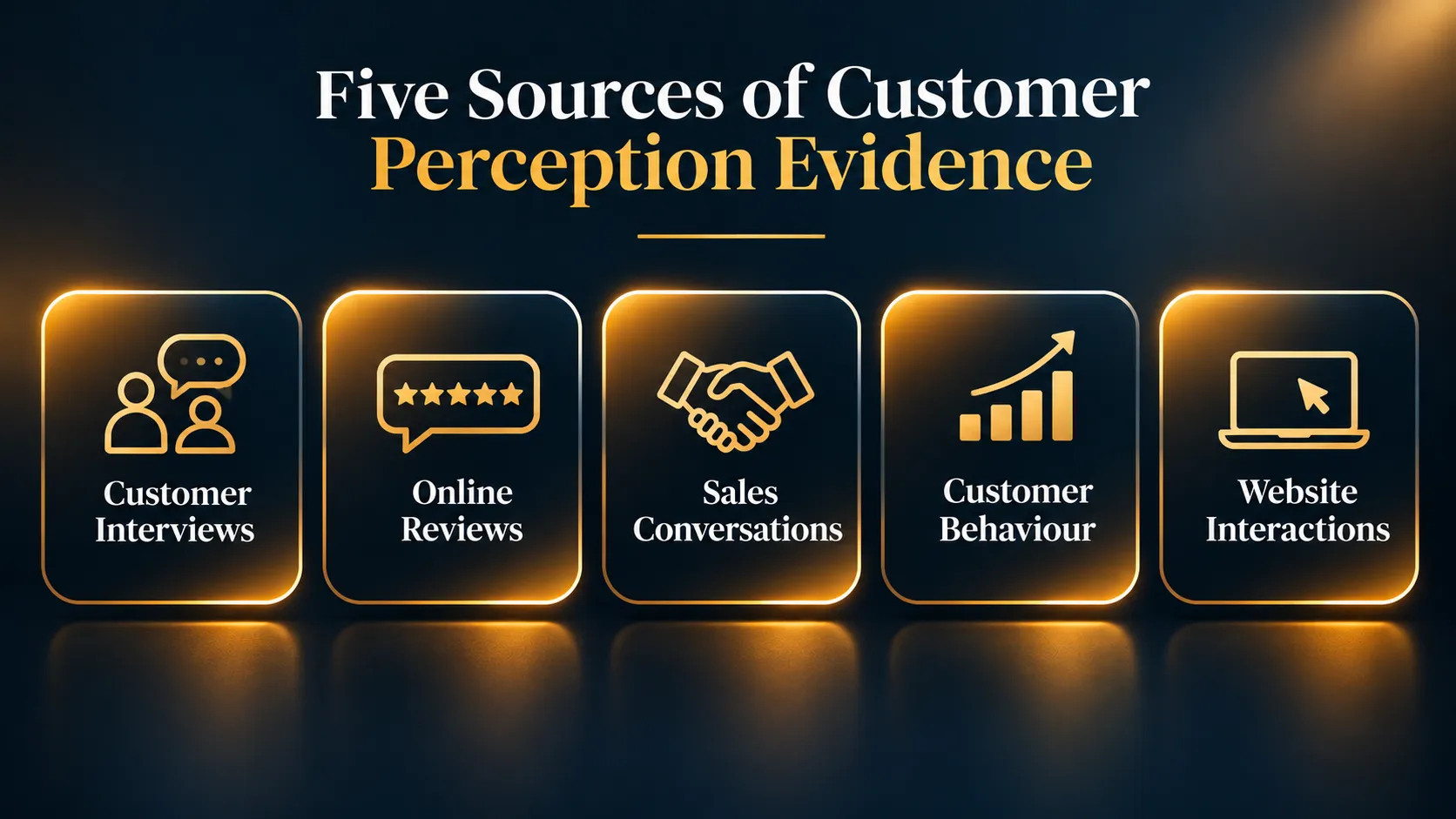
1. Customer interviews and conversations
Direct conversations can reveal how customers describe the business in their own words.
Ask questions that encourage explanation rather than simply requesting a rating:
- What made you consider this business?
- What alternatives did you consider?
- What did you expect before buying?
- What has stood out about your experience?
- What would you tell someone considering this business?
- What do you think this company does particularly well?
Avoid leading questions such as, “Did you find our service reliable?” They encourage a yes-or-no response and may influence the answer.
Instead, ask customers to describe a specific experience. Their language can reveal what they value, what they misunderstand and which aspects of the business they remember.
2. Reviews and public customer comments
Online reviews provide a visible record of customer experiences. They can reveal recurring themes around quality, service, responsiveness, reliability, value and trust.
Do not focus only on the average rating.
Read the actual comments. Group them by recurring subject. Look for differences between positive and negative experiences, and pay attention to the words customers repeatedly use.
For example, a business may believe its main strength is technical expertise. But reviews may repeatedly praise its responsiveness and ability to explain complex issues clearly.
That pattern may reveal a strength the company has not communicated effectively.
Review analysis also has limits. Customers who post publicly are not necessarily representative of the entire customer base. Reviews should be treated as one evidence source, not as a complete measurement of brand perception.
Research published in PLOS ONE demonstrates how customer reviews can be analysed to identify brand sentiment patterns, while also highlighting the challenges involved in interpreting review data accurately.
3. Sales conversations and lost-deal feedback
Sales conversations are particularly useful because they reveal how potential customers interpret the brand before becoming clients.
Listen for recurring questions:
- What does the company actually specialise in?
- How is it different from other providers?
- Why does it cost more?
- Can it handle a particular type of requirement?
- What evidence supports its claims?
These questions can expose gaps in understanding, perceived value or credibility.
Lost-deal feedback is equally important. When a prospect chooses another provider, the reason may be price, timing, capability, trust, familiarity or a clearer offer from a competitor.
Do not assume every lost opportunity reflects weak brand perception. But repeated reasons across different prospects can reveal a pattern worth investigating.
4. Customer behaviour and relationship patterns
What customers do can sometimes reveal more than what they say.
Look at:
- Repeat purchase and renewal patterns.
- Referral activity.
- Customer retention and churn.
- Enquiry-to-conversion rates.
- The services customers actually choose.
- Requests for discounts or repeated price comparisons.
- The points at which customers abandon a buying process.
These measures do not explain perception by themselves. A customer may not return because of budget, changing requirements or a new decision-maker.
However, when behavioural patterns are considered alongside customer conversations and experience data, they can help explain whether the brand is building trust, communicating value and meeting expectations.
5. Website and digital interaction data
A website is often one of the first places where customers test whether a business is relevant to them.
Look at the pages customers visit, the information they search for, the questions they submit and the points where they leave.
Pay particular attention to whether visitors can quickly understand:
- What the business does.
- Which customers it serves.
- What problems it solves.
- Why its approach is different.
- What evidence supports its claims.
- What the next step should be.
Analytics can show where people interact or disengage. They cannot reliably tell you what every visitor thinks. Use behavioural data to identify questions, then investigate the reasons through interviews, feedback and usability conversations.
The Customer Perception Evidence Framework
Collecting feedback is only useful when it leads to a clearer interpretation. A business needs a consistent way to organise the evidence.
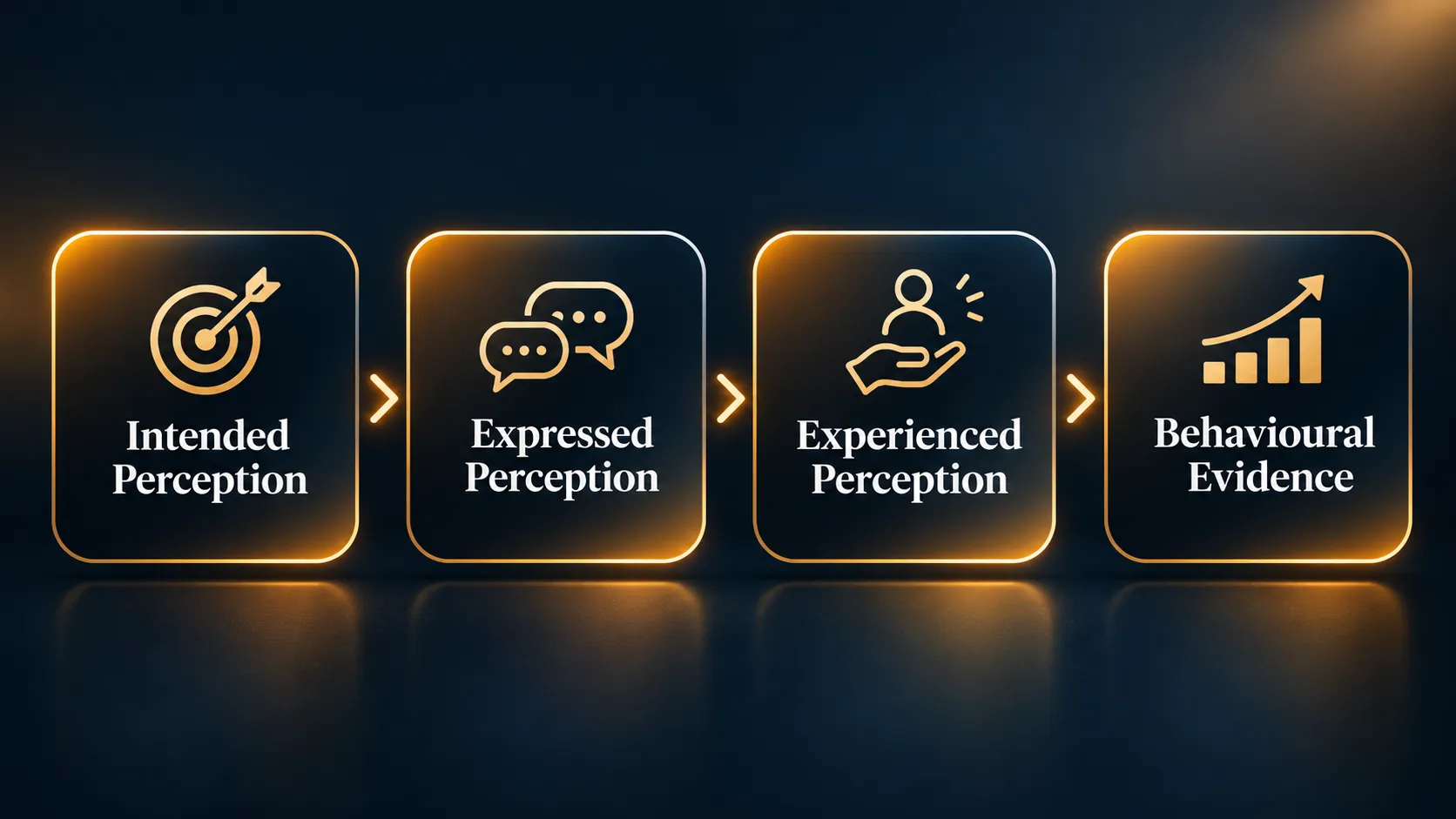
The Customer Perception Evidence Framework uses four stages.
Stage 1: Intended perception
Start with what the business wants customers to believe.
Identify the intended associations around expertise, quality, reliability, service, value and differentiation.
Be specific. “We want to be seen as a trusted brand” is too broad to measure.
A more useful statement might be: “We want mid-sized businesses to see us as a strategic partner that connects brand, marketing and business growth.”
Stage 2: Expressed perception
Examine what customers actually say.
Review interview notes, testimonials, reviews, sales conversations, support requests and lost-deal feedback.
Look for repeated language and recurring themes. Record positive, negative and neutral observations.
Do not rewrite customer comments to make them fit the company’s preferred positioning. The original language is often the most useful evidence.
Stage 3: Experienced perception
Compare customer expectations with the experience the business delivers.
A company may communicate responsiveness, but customers may experience delayed replies. It may promise a consultative approach, but its sales process may feel transactional.
Examine the important touchpoints across discovery, evaluation, purchase, delivery and ongoing support.
The objective is to identify where the experience reinforces the intended perception and where it contradicts it.
Stage 4: Behavioural evidence
Finally, examine whether customer behaviour supports the picture emerging from the feedback.
Are customers returning? Are they referring others? Do they understand the value well enough to progress without repeated price negotiation? Are enquiries coming from the type of customer the business wants to attract?
Behaviour does not prove what a customer believes. It provides another perspective that can confirm, challenge or complicate what customers say.
The four stages should be read together. A recurring difference between intended perception, expressed feedback, actual experience and customer behaviour is a signal to investigate.
How to Interpret What Customers Are Telling You
Not every comment deserves a strategic response. A single complaint may describe an isolated incident. A recurring theme across different customers may indicate a wider issue.
Use three questions to interpret the evidence.
Is the pattern repeated?
Look for similar comments across different customers, channels and interactions. Repetition makes a finding more useful, although the size and representativeness of the sample still matter.
Does the evidence come from the right customers?
Feedback from an ideal customer may carry different strategic importance from feedback from someone who was never a strong fit for the business.
Segment evidence where possible by customer type, service, purchase stage and relationship duration.
Does the feedback connect to behaviour or experience?
If customers repeatedly describe the business as difficult to understand, examine enquiry quality, sales questions and website behaviour. If they praise service reliability, compare those comments with delivery and support records.
The goal is not to turn every opinion into a business decision. It is to identify which perceptions matter, where they come from and what the business can reasonably change.
Turning Customer Perception Into Better Business Decisions
Once the evidence has been interpreted, the next step is to decide what needs attention.
Different findings require different responses.
If customers do not understand the offer, the business may need clearer communication.
If customers understand the promise but experience inconsistent delivery, the issue may sit in operations or service processes.
If customers value the service but struggle to justify the price, the business may need to explain its value more clearly or review whether the offer delivers enough distinctive benefit.
This matters because customers do not evaluate a business in isolation. Their perceptions influence whether they see meaningful differences between available alternatives and how brand differentiation influences customer choice.
If customers consistently associate the company with a capability it wants to expand, that perception may provide a useful foundation for future growth.
These responses are not interchangeable. Changing the visual identity will not fix an inconsistent service experience. Increasing advertising will not automatically resolve an unclear offer. A new positioning statement will not create evidence of expertise that the business has not demonstrated.
The right decision depends on what the evidence reveals.
This is particularly important when the way customers perceive a business no longer reflects its current strengths, capabilities or direction. Understanding when your brand positioning stops matching your business can help leaders recognise when a deeper positioning review is needed.
This is also where customer perception connects with brand strategy. A business should not change its positioning simply because one customer has a different opinion. It should examine whether the pattern is significant, whether it concerns the customers it wants to serve and whether the current brand promise still reflects the business’s strengths.
Once customer evidence is clear, businesses can use those insights to build a brand positioning strategy that reflects their strengths, customer expectations and intended market position.
For a deeper look at the relationship between business reality and market understanding, see When Your Brand Positioning Stops Matching Your Business.
Common Mistakes When Measuring Brand Perception
A measurement exercise can create more confusion if the evidence is collected or interpreted poorly.
Avoid these common mistakes:
- Using satisfaction as a substitute for perception. A satisfied customer does not necessarily see the brand as distinctive or relevant.
- Depending entirely on surveys. Surveys can structure feedback, but they may miss the language and context that emerge in open conversations.
- Treating online reviews as representative. Public reviewers are a self-selecting group.
- Combining different customer groups. A single average can hide important differences between segments.
- Confusing correlation with explanation. A change in sales or retention may occur alongside a change in perception without proving that one caused the other.
- Collecting data without acting on it. Feedback that does not influence a decision becomes an administrative exercise.
- Measuring once and assuming the result will remain true. Customer expectations, competitive alternatives and business experiences change over time.
A good measurement process should be proportionate to the decision being made. A small business may begin with structured customer conversations, review analysis and a basic examination of sales patterns. A larger organisation may need formal research, segmented surveys and ongoing brand tracking.
The method should fit the business question, not the other way around.
Questions Business Leaders Should Ask
Before making changes to brand communication, customer experience or marketing strategy, leaders should be able to answer:
- What do customers currently associate with our business?
- Which of those associations are supported by repeated evidence?
- Do different customer groups perceive us differently?
- What do customers value most about working with us?
- Where does the experience contradict the promise we communicate?
- What reasons do prospects give for choosing us or choosing an alternative?
- Which perceptions support the direction in which we want to grow?
- What should we change, and what evidence would show that the change worked?
These questions shift the discussion from what the company wants to communicate to what the market actually understands and experiences.
Conclusion: Measure the Brand Customers Experience
A brand is shaped by more than its name, identity and marketing message. It is also shaped by what customers experience, remember, discuss and expect.
That makes customer perception an important source of business intelligence.
The objective is not to make every customer think the same way or to react to every piece of feedback. It is to understand the perceptions that influence customer choice, identify where they come from and decide which ones the business should strengthen or address.
When customer conversations, reviews, experience and behaviour are examined together, leaders gain a more grounded view of how the brand is understood.
That understanding can inform better decisions about communication, customer experience, brand strategy and business priorities.
Before deciding what your brand should say next, establish what customers already believe.
If your business is finding it difficult to connect its market perception with its growth priorities, Marcom Trends can help examine the underlying business, brand and marketing challenges.
Explore the Business Growth Diagnostic.