

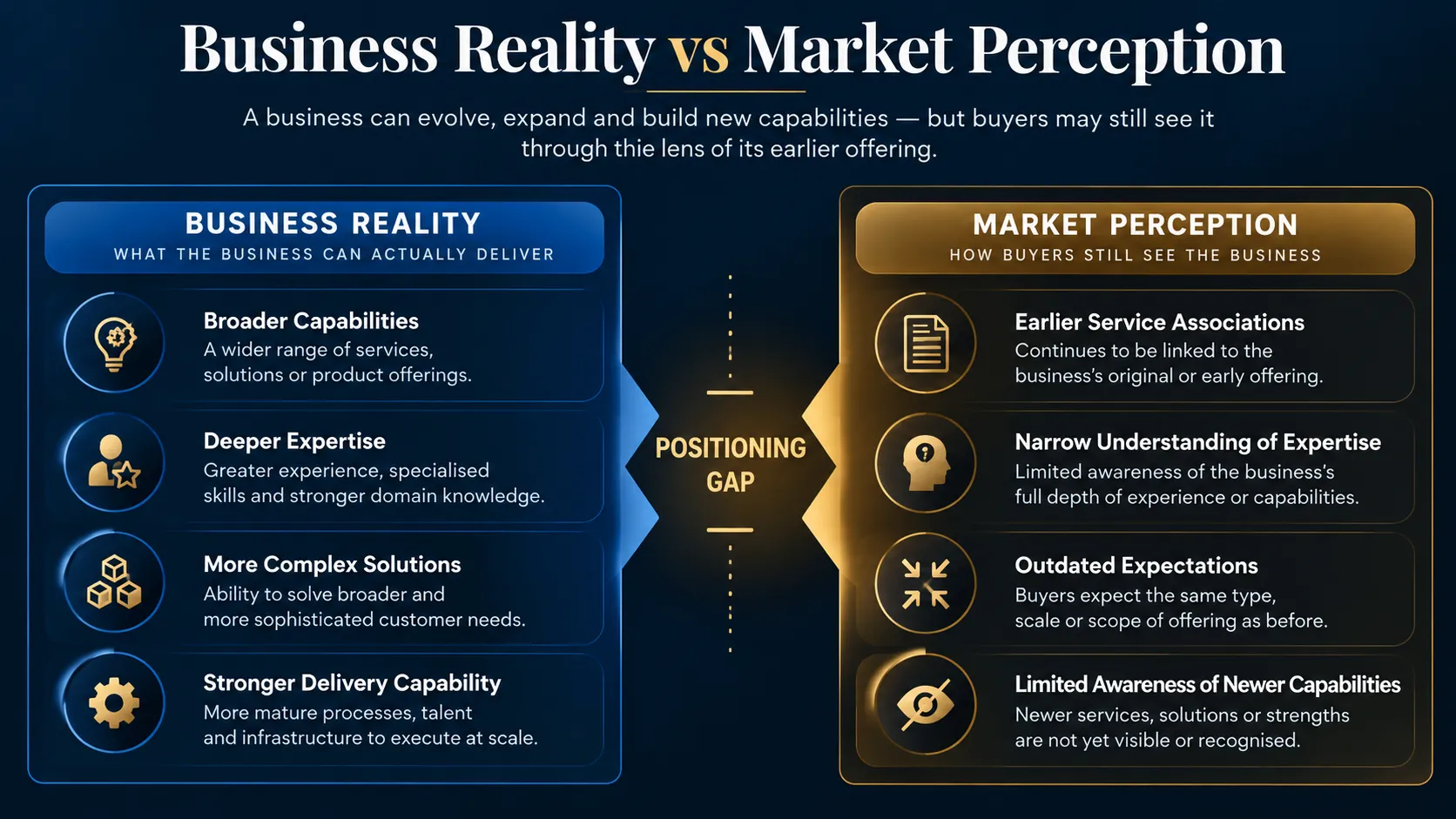
A business can become more capable, serve more valuable customers and develop a stronger offer without changing what the market believes it does.
The company has moved forward. Its positioning has not.
Perhaps the business began by serving smaller clients but now handles more complex engagements. Perhaps it started with one service and developed a broader, more integrated offer. Or perhaps years of experience have given the company a deeper understanding of customer problems than its original messaging can communicate.
Internally, these changes are obvious. Externally, they may be almost invisible.
The website still describes the original service. Prospects continue to compare the business with providers it has outgrown. Referral partners introduce the company using language that no longer reflects its strengths. Sales conversations repeatedly begin by explaining what the business has become rather than why it is the right choice.
It is tempting to treat these symptoms as marketing execution problems. A new website, a more sophisticated campaign or an increased content budget may seem like the logical response.
But when the business has evolved and the market has not caught up, the underlying issue may be positioning.
An effective brand positioning strategy helps the right customers understand what a business does best, why its value matters to them and why the company deserves consideration over alternatives. When the position no longer reflects the business’s capabilities, direction or customer value, it can constrain the opportunities the company attracts.
The challenge is not necessarily to reinvent the brand. It is to close the gap between what the business has become and what the market has reason to believe.
Why business growth does not automatically update brand positioning
Business owners experience their company’s evolution from the inside. They know which capabilities have improved, which customer problems they can now solve and what the team has learned through experience.
The market sees only the signals available to it.
A prospect might discover the business through an old service page. A referral partner might still describe it using the category it occupied years ago. An existing customer might continue to associate the company with the work it originally provided.
These perceptions can persist even when the business has changed substantially.
This is the difference between business evolution and market perception. The first happens through decisions, investments, experience and delivery. The second changes when customers encounter credible evidence that gives them a reason to update their understanding.
The two processes do not necessarily move at the same pace.
This is why understanding the relationship between brand positioning and business growth requires looking at how the market understands a business alongside the capabilities it has developed.
Consider a professional services firm that began by offering individual specialist services. Over time, it developed the ability to solve broader business problems by combining those capabilities. Its value shifted from completing individual assignments to helping clients make better decisions across a connected set of challenges.
If its website still presents a list of separate services, prospects may continue to evaluate each one independently. They may never recognise the broader value the firm can now provide.
The firm has changed its capabilities, but it has not changed the way those capabilities are understood.
This is a positioning lag.
It matters because customers make decisions based on what they can understand and evaluate—not on everything a company knows about itself. A capability that remains hidden from the market cannot reliably influence customer choice.
The five signs your positioning is falling behind
1. Your strongest capabilities are missing from your market story
A business may now be particularly good at solving complex or valuable problems, yet its communication continues to emphasise the services that first brought in customers.
That creates a mismatch between actual capability and visible value.
The company may keep attracting opportunities that fit its past because its own presentation directs attention toward those opportunities. Prospects cannot consider capabilities they never discover, and they cannot value a difference that has not been made clear.
The question is not whether the old services still matter. They may remain important revenue sources. The question is whether they should continue to define the business’s overall position.
2. You repeatedly attract enquiries that no longer fit
Enquiries can reveal what the market believes a company does.
If prospects consistently request low-value work, outdated services or projects that no longer match the business’s direction, the issue may not be lead generation alone. Customers and referral partners may be using an outdated understanding of the company to decide when to contact it.
One unsuitable enquiry proves very little. A persistent pattern is more informative.
Review where the enquiries come from, what prospects believe they are buying, why they contacted the business and how closely those expectations match the work the company wants to win.
If the same mismatch appears across several channels, examine the positioning before assuming the answer is more traffic or more leads.
3. Sales repeatedly has to correct the website
Some explanation is normal, particularly in complex business-to-business sales. Repeatedly correcting the same misconception is different.
If prospects regularly misunderstand the company’s offer, intended audience or level of expertise, the market-facing story may be creating inaccurate expectations before a sales conversation begins.
This creates avoidable work. The sales team must first correct the picture of the business and only then establish relevance, explain value and discuss the potential engagement.
The website does not need to answer every possible question. It should, however, establish the right foundation for the conversation.
4. Your differentiation belongs to an earlier stage of the business
A point of difference that once helped the company stand out may have become common across the category. Alternatively, the business may have developed stronger capabilities without making them central to its positioning.
Both situations create a similar problem: the company risks being evaluated using a comparison that no longer reflects its strongest value.
Being experienced, responsive, innovative or customer-focused may be true. But if competitors make the same claims, those qualities may not provide a sufficiently distinctive reason to choose the business.
The company needs to identify which differences matter to the intended customer, which are credible and which remain distinctive enough to influence a decision.
5. Leadership describes the business inconsistently
The founder leads with business outcomes. Sales emphasises a list of services. The website still reflects the original offer. Each explanation may contain some truth, but together they can leave prospects without a coherent understanding of what the company should be chosen for.
This becomes more consequential as a business grows beyond its founder’s direct involvement.
When the strategic story exists mainly in the founder’s head, employees, partners and external collaborators must interpret it independently. The company may then communicate several slightly different versions of its value.
The solution is not identical wording everywhere. It is a shared strategic position that guides those different explanations.
The hidden commercial cost of positioning lag
An outdated position does not automatically cause every sales or growth problem. Pricing, product-market fit, demand, service quality, capacity and sales execution can all play a role.
However, positioning lag can make those other activities less effective by shaping which customers consider the business and how they evaluate it.
Marketing may amplify an outdated story
More content and more campaigns can increase exposure to the company’s existing message. If that message reflects an earlier version of the business, additional activity may reinforce the wrong associations rather than correct them.
The issue is not that marketing should stop. It is that the strategic direction should be examined before the business invests further in distributing it.
Sales may spend time establishing relevance
When prospects arrive with an incomplete understanding, salespeople must explain what the company does, what has changed and why the offer deserves consideration.
That effort may be necessary in a complex sale. But if the same misunderstanding appears repeatedly, it is worth examining whether the website, referral language and sales materials are helping the market understand the business consistently.
The company may compete on the wrong criteria
When customers cannot see the business’s most relevant difference, they may compare it on easier-to-understand factors such as price, availability or a narrow list of deliverables.
Those factors can be legitimate considerations. The problem arises when they dominate because the business has failed to communicate the value that should distinguish it.
Expansion can make the brand harder to understand
Adding services, customer segments or markets increases the number of things a company can say about itself. Without a coherent position, the brand can become a collection of disconnected promises.
The task of positioning is not to hide the business’s complexity. It is to make that complexity understandable without reducing the company to an inaccurate or overly broad claim.
The Brand Positioning Strategy Gap Diagnostic
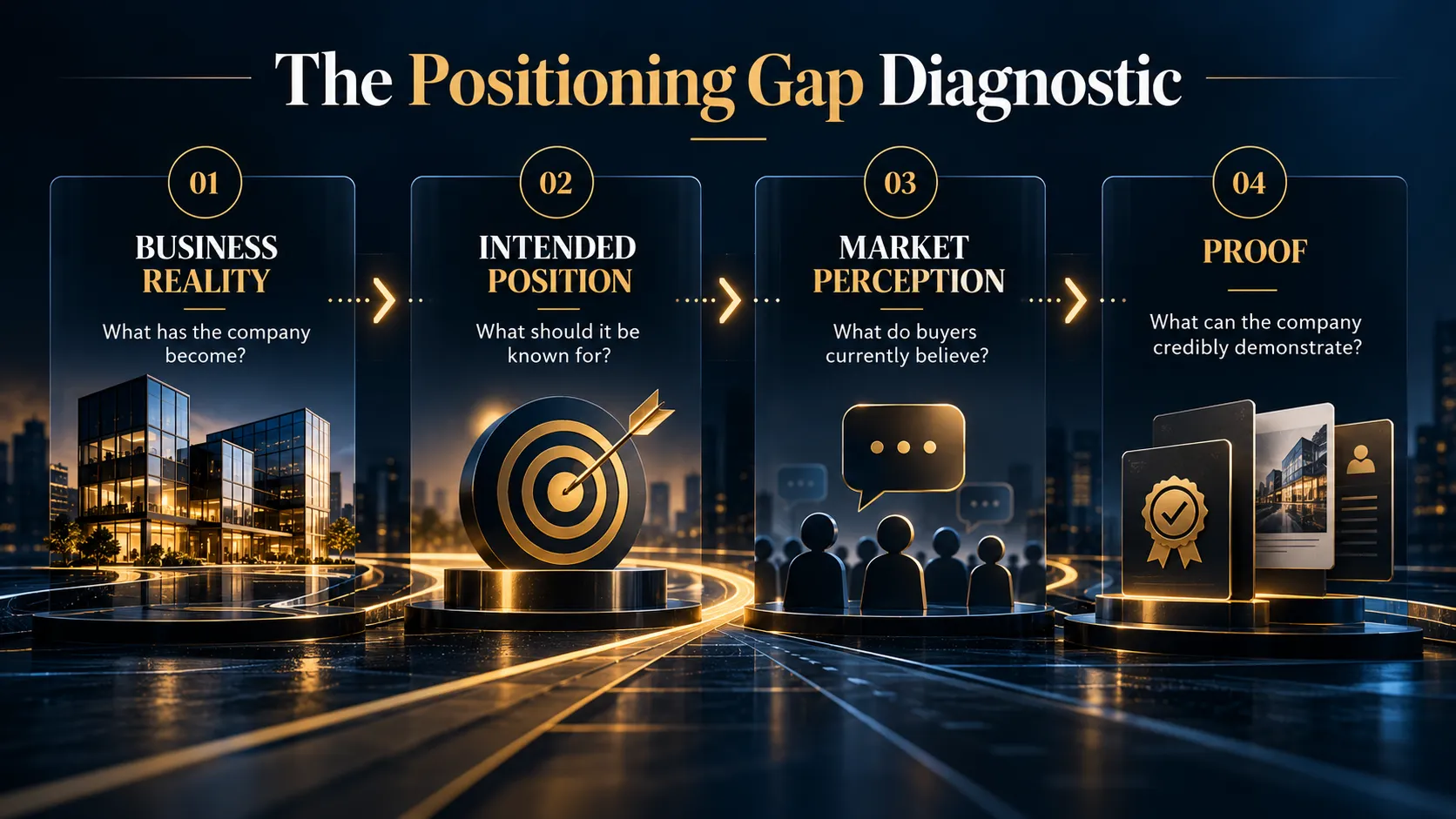
A business that has outgrown its positioning does not automatically need a complete rebrand. The right response depends on what has changed, what the market misunderstands and what the company can credibly demonstrate.
The Marcom Trends Positioning Gap Diagnostic examines four dimensions.
1. Business reality: what has the company become?
Start with observable changes rather than aspirations.
Consider the customer problems the business now solves, the capabilities it has developed, the types of engagements it can deliver, the customers it serves most effectively and the direction in which its commercial priorities are moving.
Ask:
- Which capabilities have materially improved or expanded?
- What work does the business now do particularly well?
- Which customers receive the greatest value from the current offer?
- What has changed in the business model, delivery approach or strategic direction?
- Which earlier assumptions about the company are no longer accurate?
The objective is to establish what has genuinely changed. A new ambition is not the same as an established capability, and a longer service list does not automatically mean the business has a stronger market position.
2. Intended position: what should the business be known for?
The company must decide which aspects of its current reality matter most to the customers and opportunities it wants to attract.
Not every capability needs to become a headline message. Some capabilities support the offer without defining the reason to choose the business.
Ask:
- Which customer group matters most to the next stage of growth?
- Which problem does the business want to be recognised for solving?
- What makes its approach relevant to that group?
- Which alternatives will customers consider?
- What is the most meaningful difference the company can credibly claim?
This is a strategic choice, not a copywriting exercise. The intended position should help leadership decide where to focus, which opportunities to pursue and what the business should communicate consistently.
3. Market perception: what do buyers currently believe?
Leadership cannot establish market perception simply by agreeing on a new positioning statement.
The market’s understanding must be investigated through evidence. Useful inputs include customer interviews, prospect questions, lost-deal feedback, referral introductions, sales-call notes, website enquiries and the language customers use when describing the business.
Ask:
- What do customers think the company does particularly well?
- Which services or capabilities do prospects mention first?
- What assumptions do buyers make before speaking to sales?
- Why do referral partners recommend the company?
- Which misconceptions recur across different conversations?
Different stakeholders may hold different perceptions. Long-standing customers might understand the company’s wider capabilities, while new prospects know only the original offer. Referral partners might rely on an outdated description even when direct customers have updated their understanding.
That variation matters. A positioning gap may be concentrated in one audience or channel rather than shared by the entire market.
4. Proof: what can the company credibly demonstrate?
The intended position must be supported by real capability and evidence.
A business may want to move toward more complex engagements, a more specialised customer group or a higher-value proposition. But if it lacks the relevant experience, delivery capability or evidence, stronger messaging alone will not make the position credible.
Ask:
- What relevant experience supports the intended position?
- Which customer outcomes, examples or demonstrations can substantiate it?
- Can the business consistently deliver what the new promise implies?
- Are its service structure, team and operating model aligned with the intended offer?
- What must improve before the company can credibly make a stronger claim?
This fourth dimension prevents repositioning from becoming an exercise in making the business sound more advanced than it is.
The diagnostic is most useful when the four dimensions are examined together. Business reality reveals what has changed. Intended position clarifies what matters next. Market perception exposes the gap. Proof determines which changes the business can credibly make.
How to interpret the gap—and decide what to change
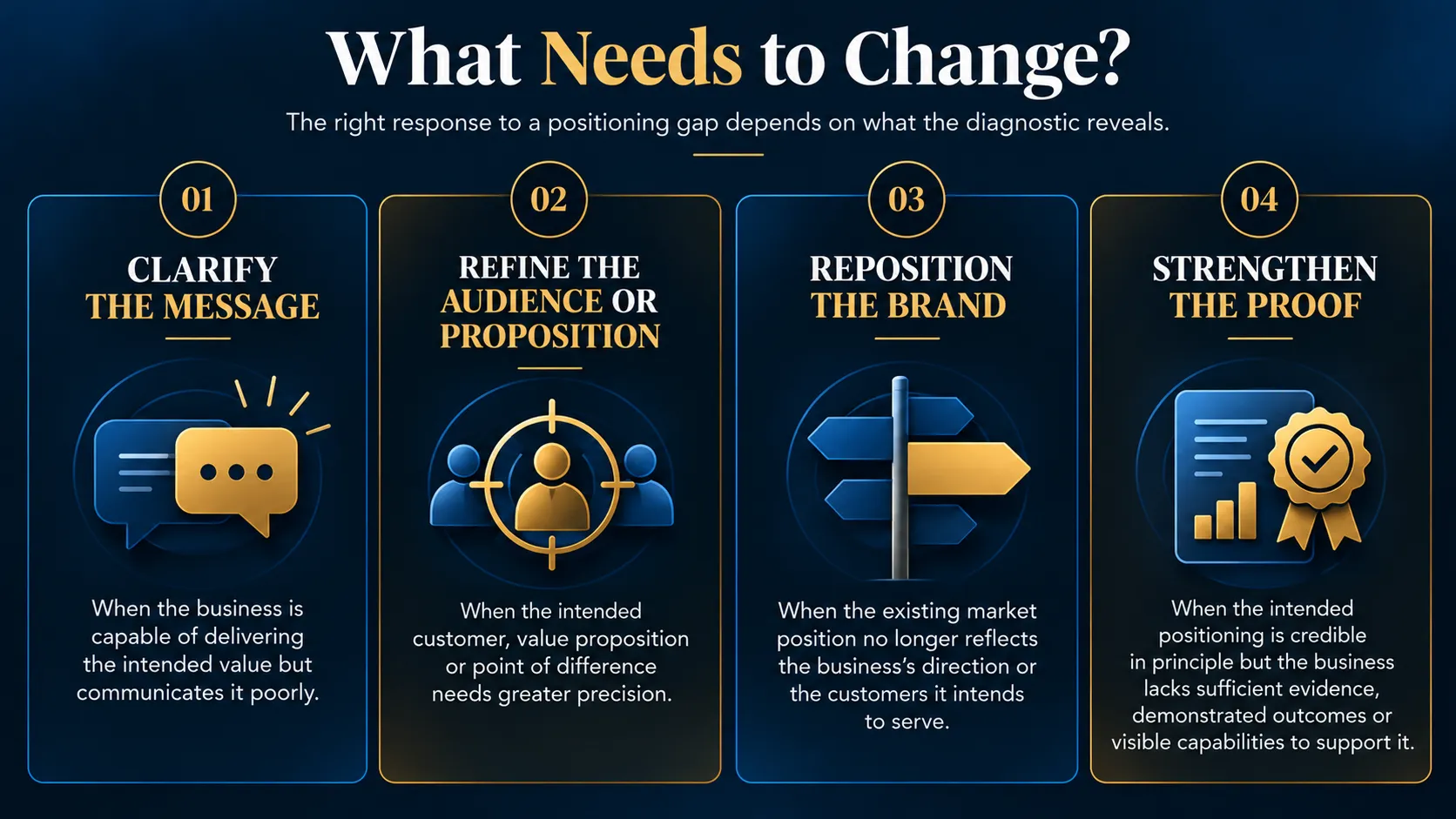
The diagnostic should lead to a decision, not simply a list of observations.
If the evidence points to a more fundamental change, review the signs your business may need to rethink its positioning before deciding how far that change should go.
When the business has evolved but the intended position is still right: the priority may be clearer communication. Update outdated descriptions, service pages, sales materials and referral language so that they reflect the current offer.
When the intended audience or value proposition has changed: the business may need to refine its positioning. This could involve a clearer target audience, a more relevant customer problem, a different competitive frame or a stronger reason to choose the company.
When market perception differs across audiences: the business may need to address the touchpoints through which those audiences encounter it. The website, existing customer communications and partner introductions may require different emphasis while supporting the same strategic position.
When the intended position exceeds the available proof: strengthen the capability before making the claim. This may mean improving delivery, building relevant experience, gathering customer evidence or refining the offer itself.
When the business reality is not yet clear: pause before changing the brand. Leadership may need to resolve strategic questions about customers, services, priorities or growth direction first.
These distinctions matter because not every positioning gap requires the same intervention. A messaging update, a more focused proposition, a change in target audience and a full repositioning are different responses to different problems.
Evolve the position without discarding what already works
Repositioning can create a second problem if the company abandons useful brand associations in an attempt to attract new opportunities.
Customers may value the business for its reliability, specialist knowledge, personal service or established expertise. Those associations can remain valuable even as the company moves into a different segment or offers more complex solutions.
Harvard Business School Online’s guidance on repositioning emphasises the need to reassess the value proposition and the story surrounding it, including the audience, promise or competitive frame. Kellogg Insight’s analysis of repositioning similarly warns that changing an established position can confuse customers or weaken associations that still provide value.
The practical implication is to determine what should be preserved, what should be strengthened and what no longer reflects the business’s direction.
A company can evolve its position while retaining credible elements of its history. It can communicate broader capabilities without pretending its earlier work never mattered. It can serve a more focused audience without making existing customers feel that the company no longer understands them.
The change should be grounded in a clear business reason and supported by the experience customers encounter.
Once the position is clear, align the touchpoints that shape market understanding: website messaging, service descriptions, sales presentations, case evidence, leadership introductions and referral language. The objective is not to repeat identical wording everywhere. It is to create a coherent explanation of the business that customers can recognise and believe.
A practical positioning-gap exercise for leadership teams
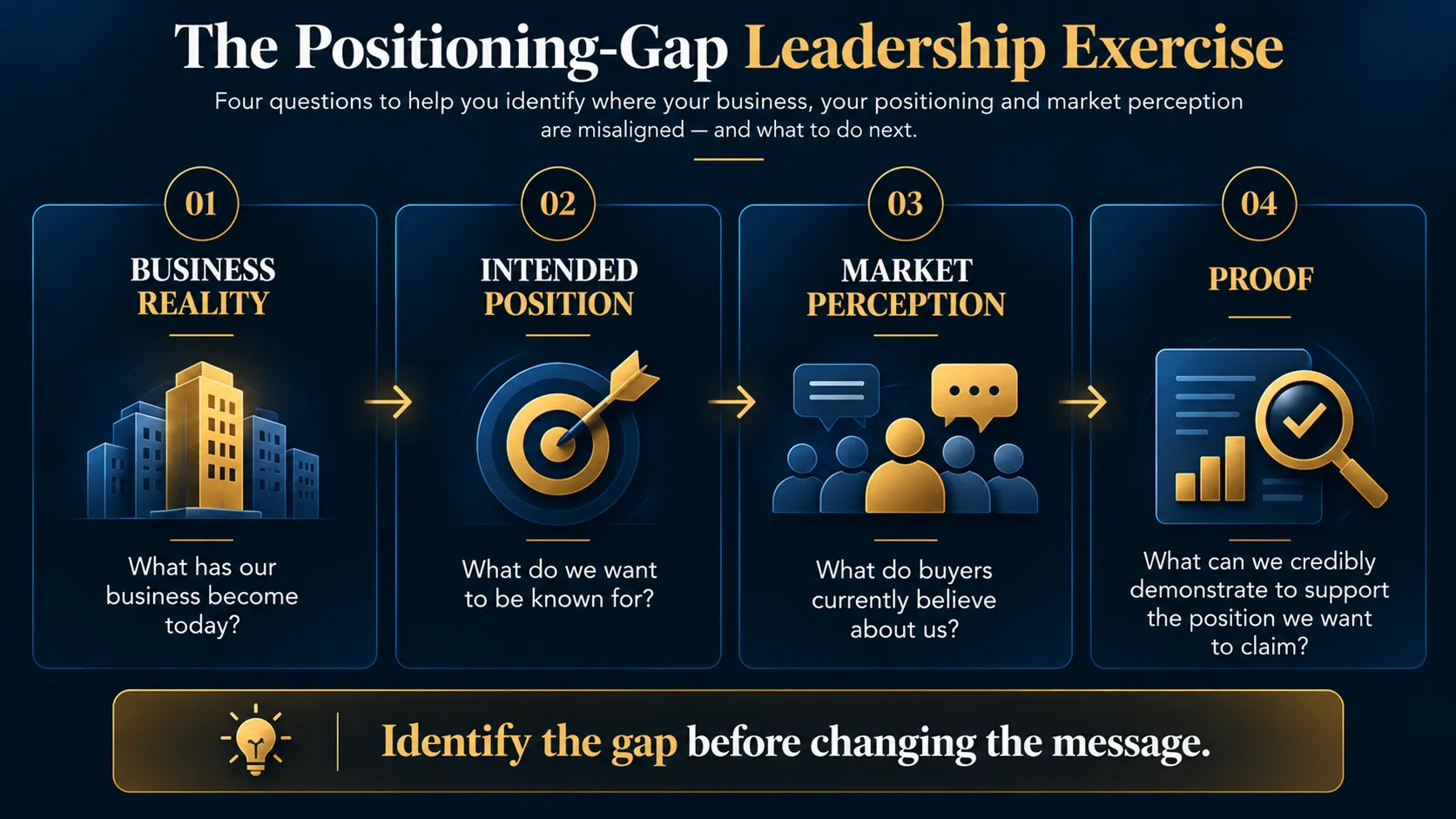
Complete these four statements independently before discussing them as a group:
- We used to be known for: the work, audience or value that defined the earlier business.
- We are now strongest at: the capabilities and customer problems the business can credibly address today.
- We want to be chosen for: the specific value that should guide future customer choice.
- The market still sees us as: the position suggested by customer conversations and other market evidence.
Compare the answers. Disagreement can be revealing: leadership may not have a shared view of the business’s direction, or different teams may be working from different assumptions.
Then test the proposed answers against evidence. Review the reasons prospects contact the company, the language used in sales conversations, the work existing customers value, the patterns in unsuitable enquiries and the reasons opportunities are won or lost.
Do not treat one comment as conclusive proof. Look for recurring patterns and distinguish perception problems from offer, pricing or delivery problems.
Finally, agree on three decisions:
- What must the market understand differently? Identify the most important misconception or missing association.
- What evidence will support that understanding? Select credible capabilities, examples, customer outcomes or demonstrations.
- Which touchpoints need to change first? Prioritise the places where the current story most directly affects customer choice.
This turns positioning from an abstract branding discussion into a practical business decision.
The real test is whether the market can recognise the business it has become
A brand positioning strategy is not a statement that remains correct forever. It is a strategic choice that should continue to reflect the business, the customers it intends to serve and the value it can credibly deliver.
When positioning lags behind business reality, the company may keep attracting opportunities that fit its past, spend time correcting misunderstandings and struggle to communicate why its strongest capabilities matter. These symptoms deserve investigation, but they should not be mistaken for proof that positioning is the only issue.
The goal is to understand what has changed, what the market believes and what evidence can bridge the gap.
Positioning should ultimately inform a practical business growth strategy, rather than remain an isolated branding exercise.
If your business has evolved further than its market-facing story suggests, start with that diagnosis before investing in another round of marketing activity. Decide what needs to change, what is worth preserving and which capabilities or proof points must be strengthened.
The goal is not to make the brand look like a newer business. It is to help the market recognise the business it has already become.
If the gap is affecting the customers you attract or the opportunities you win, the next step is a structured assessment of where the friction sits. The Business Growth Diagnostic examines business, brand, marketing and sales factors to identify clarity gaps and growth barriers—helping you determine whether positioning is the issue, part of the issue or a symptom of something deeper.