

India’s digital advertising market is expanding rapidly. According to the ET Brand Equity–Ipsos State of Digital Marketing in India 2025–26 report, digital advertising accounted for ₹49,000 crore in spending during FY2025, representing 44% of India’s total advertising market. It grew 20% year on year.
But greater investment in digital advertising does not automatically translate into better business outcomes.
A campaign can generate thousands of clicks, consume its budget and produce an impressive performance report—yet deliver few qualified enquiries or paying customers.
The problem may not be the cost per click. It may be the distance between a click and a customer.
The Journey That Advertising Reports Can Hide
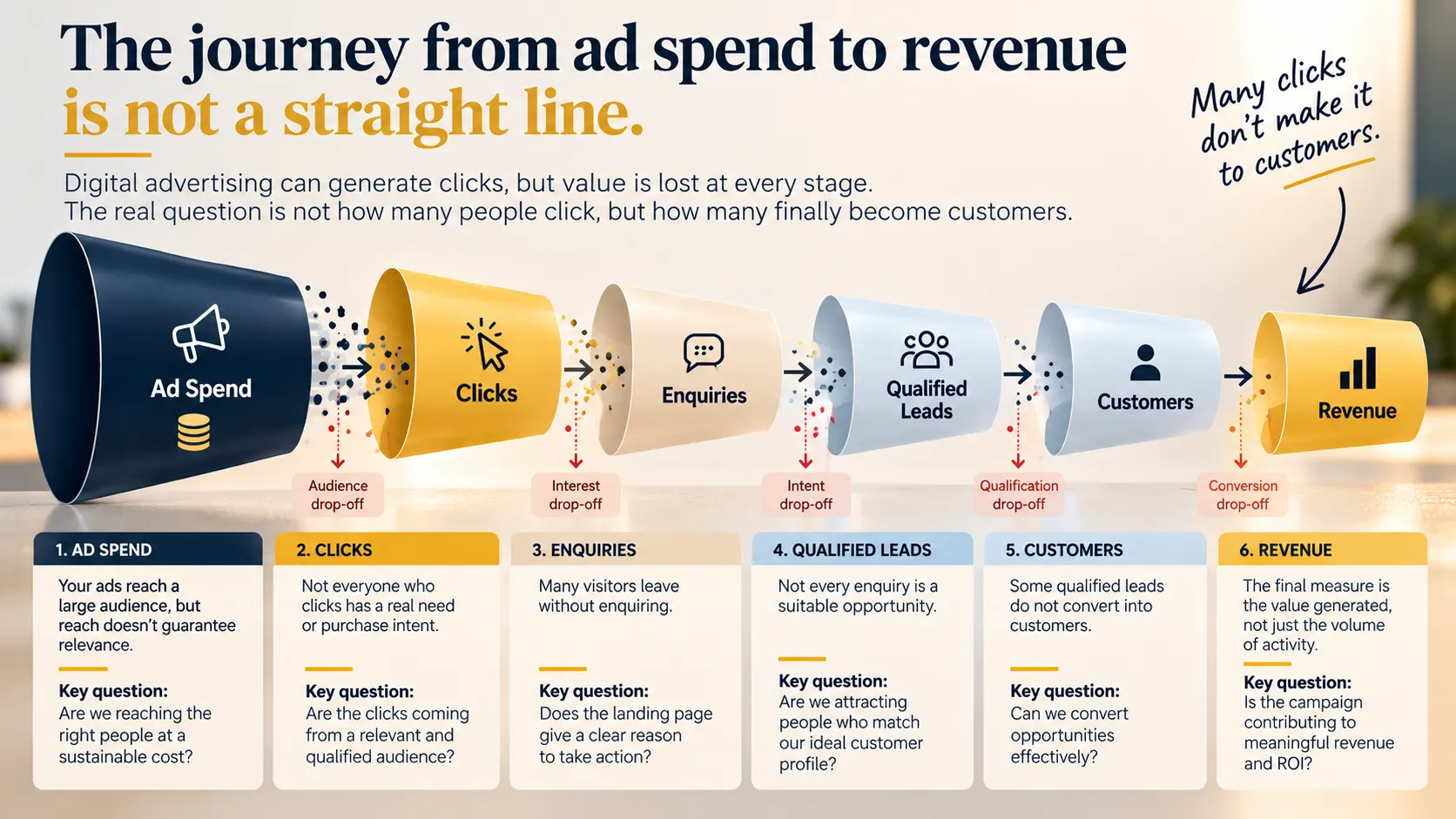
Digital advertising performance is often discussed through metrics such as impressions, click-through rates and cost per click. These numbers are useful, but they represent only part of the commercial picture.
Consider the complete journey:
Spend → Click → Enquiry → Qualified Lead → Customer → Revenue
Every stage asks a different question.
- Spend to click: Is the campaign attracting relevant attention at a sustainable cost?
- Click to enquiry: Does the landing page give visitors a compelling reason to act?
- Enquiry to qualified lead: Are the people responding actually suitable customers?
- Qualified lead to customer: Can the business convert genuine opportunities?
- Customer to revenue: Are those customers generating commercially meaningful returns?
If a business measures only the first two stages, it may mistake activity for progress.
Why Clicks May Not Become Customers
There is no single explanation for weak conversion. Several problems can produce similar symptoms.
1. The campaign attracts the wrong audience
Broad targeting, generic messaging or poorly matched search terms can attract people who are curious but unlikely to buy.
The advertisement may be doing its job by generating clicks. The strategic problem is that it is reaching people with limited purchase intent—or people whose needs do not match the offer.
When the right customers do not recognise why a business is relevant to them, the problem may extend beyond targeting to brand positioning itself.
2. The landing page fails to deliver on the promise
An advertisement creates an expectation. The destination page must fulfil it.
If the message changes, the offer is unclear, important information is missing or the next step is difficult, potential customers may leave without enquiring.
Increasing traffic will not necessarily solve this problem. It may simply send more visitors into the same weak experience.
3. Enquiries are mistaken for qualified demand
A form submission is not automatically a sales opportunity.
Some enquiries may come from people outside the target market, with insufficient budgets, unsuitable requirements or no immediate intention to purchase.
Counting every enquiry equally can make a campaign appear successful while sales teams struggle to convert the pipeline.
This is why businesses need to distinguish between generating more enquiries and improving lead quality before deciding whether an advertising campaign is delivering value.
4. The business cannot convert the opportunities it generates
Sometimes the advertising is attracting the right people, but slow follow-up, weak sales conversations, pricing concerns or an unclear value proposition prevent conversion.
The problem then extends beyond media buying.
Google Ads guidance identifies several possible causes of high traffic with low conversion, including website usability, broad keywords and mismatched advertising messages. It also recommends measuring qualified and converted leads rather than relying solely on basic traffic metrics.
Don’t Confuse Poor Conversion With Invalid Traffic
Low conversion rates do not, by themselves, prove that a campaign is receiving fraudulent clicks.
Google distinguishes invalid traffic—including bots and accidental clicks—from legitimate visits that fail to convert. Its systems filter detected invalid activity, but advertisers still need to assess what happens after a visitor reaches their website.
That distinction matters. Businesses should investigate tracking accuracy, audience relevance, landing-page performance and lead quality before assuming that every disappointing campaign result is caused by click fraud.
The Metrics That Deserve More Attention
Instead of asking only how many clicks a campaign generated, examine the full conversion journey.
| Metric | What it helps reveal |
|---|---|
| Cost per qualified lead | What it costs to attract a suitable prospect |
| Lead-to-customer conversion rate | How effectively enquiries become customers |
| Customer acquisition cost | What it costs to acquire a paying customer |
| Revenue attributed to campaigns | Whether advertising contributes to commercial outcomes |
| Return on advertising spend | How much attributed revenue is generated per unit of ad spend |
These measures need reliable tracking and appropriate attribution. Revenue attributed to advertising is not necessarily revenue caused entirely by advertising, particularly when customers encounter multiple channels before purchasing.
For businesses with longer sales cycles, connecting advertising data with CRM records and offline sales outcomes can reveal performance that basic campaign dashboards miss.
Before Increasing the Advertising Budget, Find the Leak
When campaigns underperform, increasing spend may amplify the existing problem.
A more useful approach is to identify the weakest stage of the journey first.
If relevant visitors are not enquiring, review the offer and landing page. If enquiries are poor quality, examine targeting, messaging and qualification. If qualified leads are not becoming customers, investigate sales conversion and the strength of the proposition.
Only then can the business make a better-informed decision about whether to optimise, reallocate or increase its advertising investment.
The Marcom Trends Perspective
Digital advertising is not simply a traffic-generation activity. It is one part of a broader business growth strategy connecting brand positioning, customer relevance, marketing execution and sales performance.
The commercial question is not whether a campaign generated clicks.
It is whether those clicks created a credible path to customers and sustainable business value.
Before spending more to attract attention, find out where the attention you already pay for is being lost.