

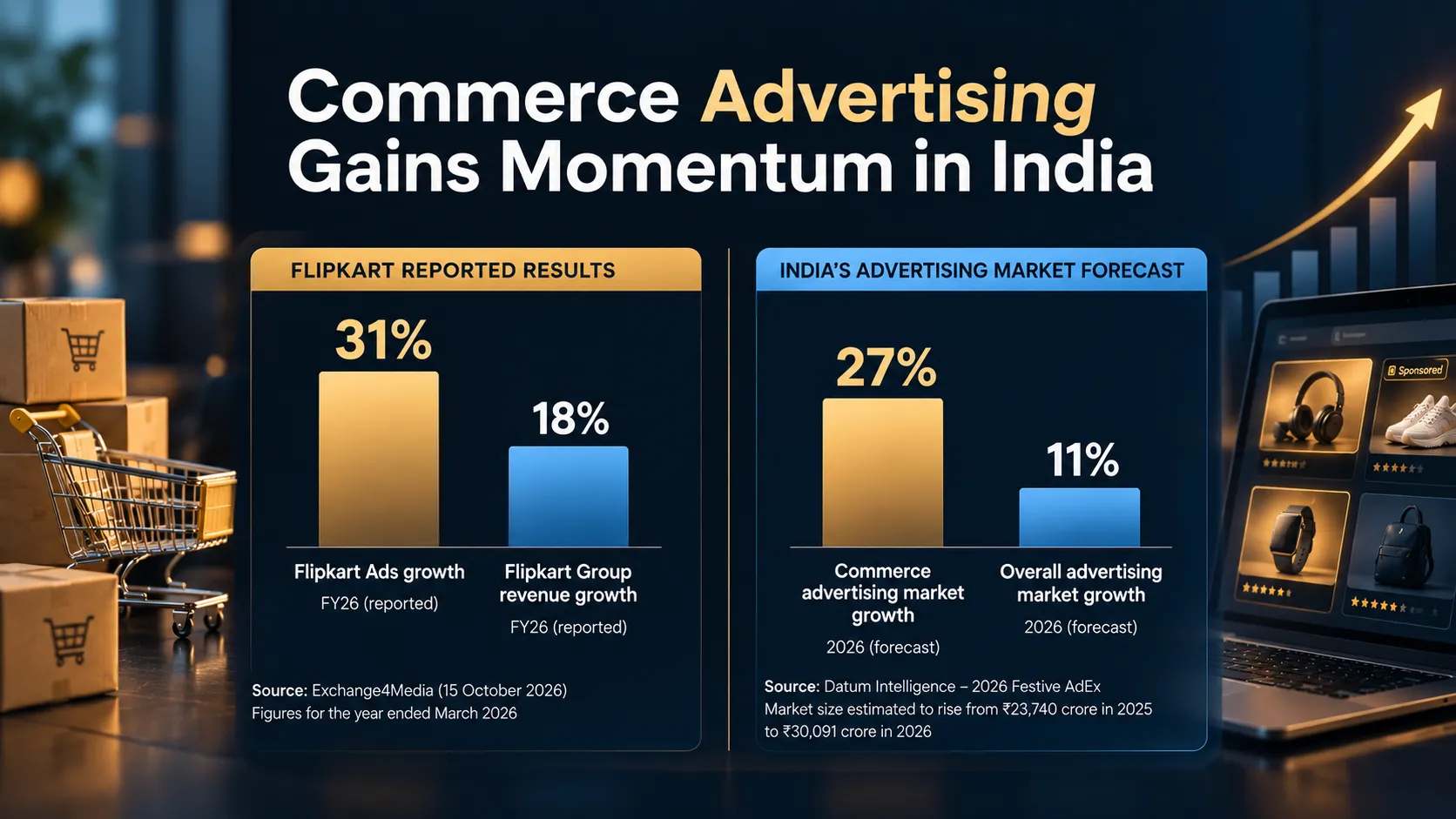
Flipkart Ads growth reached 31% year-on-year in FY26, according to a report published by Exchange4Media on 15 October 2026. The development comes as India’s commerce advertising market is forecast to expand faster than the overall advertising market, reflecting the growing importance of advertising within e-commerce and shopping platforms.
The figures offer a useful view of how advertising is evolving in India. However, the growth of a platform’s advertising business and the effectiveness of the advertising purchased on that platform are two different measures.
Flipkart Ads Growth Outpaces the Group’s Revenue Expansion
Exchange4Media reported that Flipkart Ads grew 31% year-on-year in the financial year ended March 2026. Flipkart Group’s revenue from operations reached ₹1,45,880 crore, representing 18% growth over the previous financial year.
The group’s wider financial results provide important context. Its net loss narrowed by ₹178 crore, from ₹8,646 crore in FY25 to ₹8,468 crore in FY26. Adjusted operating losses also narrowed by approximately ₹1,600 crore, while total expenses increased 16% to ₹1,54,781 crore.
These figures show why advertising growth should be considered alongside the broader business. Flipkart Ads’ reported 31% expansion indicates growth in its advertising business, but the group’s financial results do not independently establish the advertising segment’s profitability.
There is also a reporting-period distinction worth noting. Although the Exchange4Media headline refers to Q2 FY27, its body reports the group’s revenue figure and financial performance for FY26. The 18% revenue growth should therefore not be presented as a verified Q2 FY27 growth figure.
India’s Commerce Advertising Market Is Forecast to Grow 27%
Flipkart’s reported performance sits within a wider market shift.
Datum Intelligence’s 2026 Festive AdEx report estimates that India’s commerce advertising market will increase from ₹23,740 crore in 2025 to ₹30,091 crore in 2026. That represents forecast growth of 27%, compared with 11% for the overall advertising market.
The report also estimates India’s total advertising expenditure at ₹1,75,782 crore in 2026. Its figures are forecasts, not final audited expenditure totals.
Commerce advertising includes advertising sold through shopping and commerce platforms, such as sponsored product placements and other formats distributed across search, display, social and video environments. These placements can connect a brand’s message with a consumer who is already researching or considering a purchase.
This relationship helps explain the sector’s appeal. Traditional advertising often measures exposure, reach or engagement, while commerce platforms can connect advertising activity with shopping and transaction data. That creates an opportunity to examine the relationship between advertising and sales more closely.
However, the market estimate should not be interpreted as evidence that every commerce advertising format is equally effective. The overall category includes different platforms, placements, audiences and measurement approaches.
Commerce advertising is one part of a wider digital marketing landscape in which content and channel choices need to serve a clear purpose.
The Measurement Question Behind Retail Media Growth
As commerce advertising expands, the ability to demonstrate business impact becomes increasingly important.
Retail media and commerce platforms can provide advertisers with metrics such as impressions, clicks, attributed purchases and return on ad spend. These measures are useful, but they do not all answer the same question.
For example, a platform may attribute a purchase to an advertisement because the shopper clicked a sponsored listing before buying. That does not necessarily prove the advertisement created an additional sale. The shopper might have purchased the product anyway.
This is the distinction between attribution and incrementality. Attribution identifies the touchpoints credited with a purchase; incrementality examines whether advertising generated outcomes that would not otherwise have occurred.
In its July 2026 analysis, NielsenIQ identifies incrementality measurement as a central challenge for retail media. Its August analysis also argues that return on ad spend alone cannot establish how much additional growth advertising created.
As more advertising expenditure moves into commerce environments, the quality and comparability of measurement will matter alongside the scale of platform advertising businesses.
What the Latest Figures Signal
The available evidence points to two connected developments: Flipkart Ads reported 31% growth in FY26, while India’s commerce advertising market is forecast to grow 27% in 2026.
Together, these figures underline the increasing commercial importance of advertising within digital shopping environments. They do not, however, establish that all advertisers are receiving stronger returns or that platform growth translates directly into incremental sales.
The next phase of commerce advertising will depend not only on how much spending these platforms attract, but also on how clearly advertisers can connect that spending with measurable business outcomes.