

A business can have a polished logo, an impressive website, consistent colours and a professional visual system – and still have a branding problem.
Not because the design is bad.
Because the market may still be unclear about why it should choose that business.
This is where the difference between brand positioning vs brand identity becomes important.
The two are connected, but they do different jobs.
Brand positioning defines the place a business wants to occupy in the market.
Brand identity gives that position a recognisable expression.
The American Marketing Association similarly distinguishes brand identity as the visual and symbolic elements that represent a brand, while brand positioning concerns the position a business establishes relative to competitors and its target audience.
That distinction sounds simple.
But businesses often get the sequence wrong.
They redesign the logo when the real problem is positioning.
They rewrite the website when the real problem is differentiation.
They change the colour palette when customers still don’t understand why the business is different.
And that can become an expensive way of avoiding a strategic decision.
Brand Positioning vs Brand Identity: The Difference
The simplest distinction is this:
Positioning decides what you want to mean.
Identity decides how that meaning becomes recognisable.
Think of positioning as the strategic decision behind the brand.
Identity is the system that expresses that decision.
| Brand Positioning | Brand Identity |
|---|---|
| Defines the market position | Expresses the position |
| Focuses on relevance and differentiation | Focuses on recognition and expression |
| Asks “Why should customers choose us?” | Asks “How should customers recognise us?” |
| Considers customers and competitors | Considers visual and verbal expression |
| Guides strategic communication | Creates consistency across touchpoints |
| Determines what the brand should stand for | Makes that meaning visible |
Neither is optional.
But they should not be treated as the same project.
What Is Brand Positioning?
Brand positioning is the strategic decision about how a business wants to be understood in relation to its customers, competitors and market.
It asks questions such as:
- Who are we trying to be relevant to?
- What problem do we want to be known for solving?
- What makes our approach meaningfully different?
- What should customers remember about us?
- Why should someone choose us instead of the alternatives?
- What should we deliberately avoid competing on?
This is why positioning is much more than a tagline.
Saying:
“We deliver innovative solutions.”
doesn’t necessarily create a position.
Neither does:
“We are customer-focused.”
Or:
“We provide high-quality service.”
Competitors can make the same claims.
A stronger positioning decision creates a clearer relationship between customer, problem, difference and choice.
For example, a business may move from:
“We help businesses grow.”
to a more specific strategic territory such as:
“We help founder-led businesses remove the strategic bottlenecks that prevent their next stage of growth.”
The second statement begins to tell the market something more useful.
It starts defining:
who → problem → relevance → difference
That gives marketing something meaningful to communicate.
What Is Brand Identity?
Brand identity is how the brand looks, sounds and expresses itself.
It can include:
- Logo
- Colours
- Typography
- Photography
- Graphic elements
- Packaging
- Tone of voice
- Messaging
- Layout systems
- Brand templates
- Other visual and verbal cues
The American Marketing Association describes brand identity in terms of visual and symbolic elements such as a brand’s name, logo, colour scheme, typography and design elements.
Identity therefore answers a different question:
How should our brand express itself so people can recognise it and connect it with the meaning we want to create?
That makes identity important.
But identity works best when it has a clear strategic job.
If the business hasn’t decided what it wants to mean, the identity project can easily become an exercise in aesthetics.
And aesthetics alone don’t create positioning.
Positioning Should Give Identity a Job to Do
Imagine a business decides that it wants to be perceived as:
A strategic growth partner for established founder-led businesses.
That positioning has implications.
The business may need to communicate:
- strategic depth
- commercial thinking
- confidence
- experience
- clarity
- maturity
Now the identity has a purpose.
The typography, photography, colour system, website structure, messaging and overall visual language can be developed to reinforce those qualities.
The design brief becomes:
“How should we visually and verbally express our strategic position?”
instead of:
“Can you make the brand look more modern?”
That difference matters.
A modern-looking brand is not automatically a well-positioned brand.
Why Businesses Often Start With Identity?
Identity is easier to see.
You can compare two logos.
You can review a colour palette.
You can approve a website design.
You can put a new business card on the table.
Positioning is harder because it requires choices.
You have to decide:
- who matters most
- who doesn’t
- what you are actually different at
- what you want to be known for
- what you won’t compete on
- what customers should remember
- which opportunities don’t fit
Design creates visible deliverables.
Positioning creates strategic decisions.
That is one reason businesses sometimes commission a rebrand when what they really need is clarity.
The result can look better without becoming meaningfully different.
A New Identity Cannot Automatically Fix Weak Positioning
Suppose a business has:
- a beautiful website
- a distinctive logo
- consistent social media
- professional photography
- polished sales presentations
Now ask a potential customer:
“Why should I choose this business instead of its competitors?”
If the answer sounds almost identical to five alternatives, the problem probably isn’t the logo.
A new identity might improve recognition.
It might improve consistency.
It might modernise the brand.
But it cannot automatically decide:
- who the business should prioritise
- what problem it should own
- what makes it meaningfully different
- why the right customer should choose it
That is positioning work.
This distinction becomes especially important because unclear positioning can create problems further down the business system. Marcom Trends’ existing work on positioning connects unclear market meaning with marketing, sales, pricing and growth problems.
So before asking:
“Do we need a new logo?”
sometimes the more useful question is:
“Do we have a clear reason for the market to choose us?”
What Happens When Positioning Is Weak?
A positioning problem rarely announces itself as:
“Your positioning is weak.”
Instead, it appears through symptoms.
Marketing Starts Sounding Generic
The company keeps producing content and campaigns, but the overall message could belong to almost any competitor.
Every individual post may be reasonable.
The accumulated brand impression is the problem.
People see activity but don’t develop a clear understanding of what makes the business different.
Sales Teams Explain the Business Differently
Ask five people inside the company:
“What does this business actually stand for, and why should a customer choose it?”
If you get five different answers, there may be a strategic clarity problem.
This becomes particularly important as founder-led businesses grow.
The founder may understand the business instinctively because they have lived through its evolution.
Customers and employees don’t have that context.
Prospects Keep Comparing You on Price
Price comparison isn’t automatically a positioning problem.
But when buyers cannot see meaningful differences between providers, price becomes an easier comparison mechanism.
If every competitor appears to offer similar expertise, quality and service, the buyer has fewer reasons to evaluate the businesses differently.
The Website Explains What You Do but Not Why You Matter
A website can clearly list:
- services
- capabilities
- features
- industries
- experience
and still leave a visitor wondering:
“Why this company?”
That is an important distinction.
Information explains the business.
Positioning helps create preference.
Your Competitors Sound Interchangeable
Try a simple test.
Take your homepage copy and remove your company name.
Could a competitor use most of it?
If yes, the issue may be deeper than copywriting.
What Happens When Identity Is Weak?
The reverse problem also exists.
A business can have a strong position but express it poorly.
Imagine the strategic position is clear:
Premium, specialised and commercially focused.
But then:
- the website feels generic
- the sales presentation looks outdated
- social content uses a different visual language
- proposals communicate something else
- different teams use different messaging
The positioning may be sound.
The identity is simply failing to carry it consistently.
That is where identity becomes valuable.
It gives the strategic idea recognisable form.
The customer might encounter the business through a website today, a LinkedIn post next week and a proposal a month later.
The expressions don’t need to be identical.
But they should feel like the same brand.
Positioning Creates Meaning. Identity Creates Recognition.
This is perhaps the easiest way to remember the difference.
Positioning asks:
Why this brand?
Identity asks:
Is this the same brand I encountered before?
Positioning helps establish:
- relevance
- difference
- preference
- strategic direction
Identity helps establish:
- recognition
- consistency
- expression
- familiarity
They work together.
But one should not be used as a substitute for the other.
When Should You Work on Positioning?
Positioning deserves attention when the business is experiencing problems such as:
- Customers don’t understand what makes you different.
- Competitors sound almost identical.
- Your marketing keeps becoming generic.
- Your business is attracting the wrong customers.
- Sales conversations are becoming heavily price-driven.
- Your offer has changed significantly.
- You have entered a new market.
- Your ideal customer has changed.
- Different teams describe the business differently.
- The founder is still the primary person explaining what the company actually does.
If several of these sound familiar, a design refresh may not be the first place to look.
It may be time to revisit the strategic position.
For businesses that have already evolved beyond their original market position, the issue may be repositioning rather than simply refining the existing identity. Marcom Trends explores this distinction in its article on when a brand stops supporting growth.
When Does a Business Need a New Brand Identity?
Identity work may be appropriate when:
- the existing identity is inconsistent
- the brand is difficult to recognise
- the business has materially changed
- the current expression no longer reflects the intended position
- different touchpoints look like different businesses
- the identity is outdated or difficult to apply
- the brand has expanded into new markets
- the existing identity system cannot scale
But one question should come first:
What should the new identity express?
If that answer is unclear, redesigning the identity can simply produce a more attractive version of the same strategic confusion.
A Simple Diagnostic: Do You Have a Positioning Problem or an Identity Problem?
Before investing in a branding project, ask these five questions.
1. Can We Clearly Define Who We Are For?
If not, start with strategy.
2. Can We Explain Why Those Customers Should Choose Us?
If not, investigate positioning.
3. Can Our Team Explain Our Difference Consistently?
If not, the strategic foundation may need work.
4. Once the Strategy Is Clear, Does the Current Brand Express It?
If not, identity may be the problem.
5. Do Our Customer Touchpoints Feel Like One Brand?
If the website, social media, sales material and customer communications feel disconnected, the identity system may need strengthening.
This creates a useful sequence:
Don’t use design to solve a strategy problem.
The Right Sequence: Position → Identity → Expression → Experience
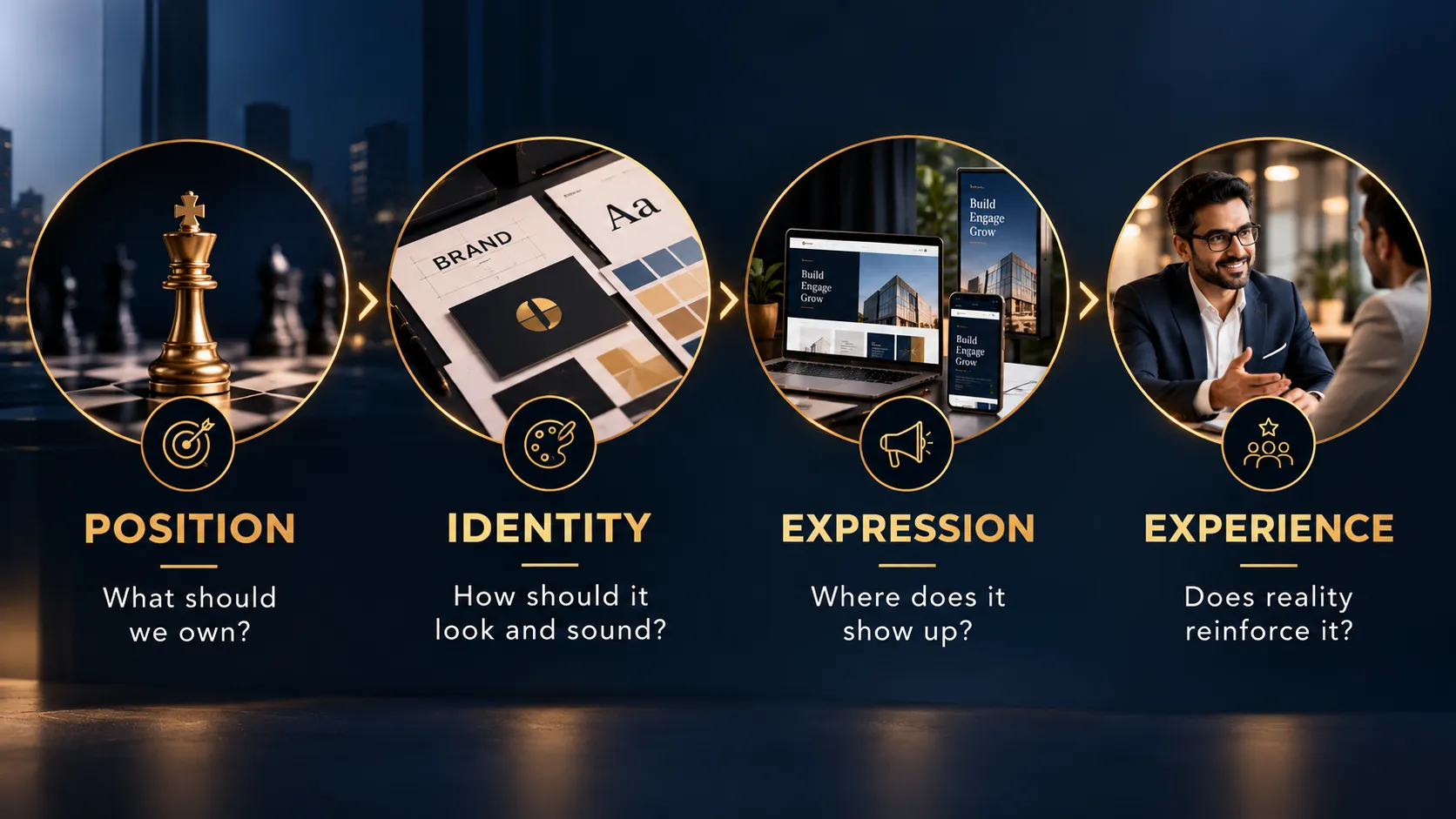
A useful way to think about the relationship is:
POSITION
What should we own?
↓
IDENTITY
How should that position look and sound?
↓
EXPRESSION
How does it appear across marketing and communication?
↓
EXPERIENCE
Does the actual customer experience reinforce the promise?
That final step matters.
A brand can have excellent positioning and a strong identity, but if the actual experience contradicts both, the gap eventually becomes visible.
A premium position followed by poor service creates a credibility problem.
A position built around simplicity followed by complicated processes creates friction.
A position built around expertise followed by generic communication creates doubt.
Brand strategy therefore cannot stop at the logo.
Positioning Is Also a Business Decision
This is why brand positioning shouldn’t be isolated inside the marketing department.
A clear position influences decisions about:
- customers
- offers
- pricing
- sales
- marketing
- partnerships
- content
- customer experience
- growth priorities
Marcom Trends’ existing Business Growth Strategy article similarly treats positioning as part of the wider business system rather than an isolated marketing activity.
That is an important distinction.
If positioning only appears in a brand document, it remains a document.
If it influences business decisions, it becomes strategy.
What Strong Brand Positioning Should Actually Do
Strong positioning doesn’t need to sound clever.
It needs to be useful.
Make the Right Customer Recognise Themselves
The right prospect should be able to think:
“This is for a business like mine.”
That is more valuable than trying to sound relevant to everyone.
Give the Market a Reason to Choose You
The difference needs to matter.
Being different for the sake of being different doesn’t create preference.
The difference needs to be relevant, credible and defensible.
Give Marketing and Sales One Direction
Positioning should reduce the amount of interpretation required downstream.
Marketing shouldn’t have to reinvent the company’s story every month.
Sales shouldn’t have to create a completely different explanation on every call.
The website shouldn’t tell a different story from the sales presentation.
Make Growth Easier to Understand
As a business expands, complexity increases.
More products.
More customers.
More capabilities.
More markets.
More people communicating the brand.
A strong position gives that complexity a centre of gravity.
The Bigger Mistake: Confusing a Visible Brand With a Differentiated Brand
A business can be highly visible and still be difficult to choose.
It can have:
- a recognisable logo
- thousands of followers
- frequent advertising
- a professional website
- strong content production
and still fail to answer:
“Why you?”
Visibility and differentiation are different problems.
Identity can help people recognise you.
Positioning helps them understand why you matter.
That distinction becomes particularly important when marketing performance is being diagnosed. If the underlying strategic problem is unclear positioning, simply changing channels or increasing activity may not solve it. Marcom Trends’ current marketing-strategy analysis makes the same broader diagnostic point: businesses need to identify the underlying constraint before changing tactics.
Final Takeaway
Brand positioning and brand identity are not competing concepts.
You need both.
But they do different jobs.
Brand positioning defines the strategic territory you want to occupy.
Brand identity gives that position a recognisable form.
Positioning asks:
Why should the right customer choose us?
Identity asks:
How should that choice become visible and recognisable?
If the first question hasn’t been answered, starting with the second can create an attractive distraction.
So before asking:
“Do we need a new logo?”
ask:
“Are we clear about what we want our brand to mean, who we want it to matter to, and why those customers should choose us?”
If the answer isn’t clear, the next project may not be a design project.
It may be a positioning project.
Frequently Asked Questions:
Is brand positioning the same as brand identity?
No. Brand positioning defines the strategic position a business wants to occupy in relation to its customers and competitors. Brand identity is the visual and symbolic system used to represent the brand.
What comes first, brand positioning or brand identity?
Positioning should generally come first because it gives the identity a strategic direction. The identity then helps express that position consistently.
Is a logo part of brand positioning?
No. A logo is normally part of brand identity. It can support recognition, but a logo alone does not establish a differentiated market position.
Can a new brand identity fix weak positioning?
Not by itself. A new identity can improve recognition and consistency, but it cannot determine who the business should serve, what it should be known for or why customers should choose it.
Why is brand positioning important before rebranding?
Because rebranding changes how the brand is expressed. If the underlying position remains unclear, the business may simply create a new visual identity without solving the strategic problem.
Can a business have strong positioning but weak brand identity?
Yes. A business can know exactly what it wants to be known for while communicating that idea inconsistently through its website, sales materials, social media and other customer touchpoints.
How do I know whether my business needs positioning or rebranding?
Start with the strategic questions. If your audience, differentiation and reason for choice are unclear, investigate positioning first. If those are clear but your visual and verbal expression no longer represents them, identity or rebranding may be the more relevant project.