

Why business growth stalls is rarely as simple as saying the company is doing something wrong. A business can have a good product, capable people, loyal customers and a marketing team that never seems to stop.
And still struggle to grow.
That is one of the more frustrating positions a founder can find themselves in.
The business isn’t broken. There is no obvious crisis. Customers are still buying. The team is working. Marketing campaigns are running. Sales conversations are happening.
But growth has become harder.
Revenue moves sideways. New customers take longer to win. Existing customers buy less frequently. Marketing produces activity without enough commercial momentum. The founder starts asking whether the business needs more leads, more advertising, more salespeople or simply more effort.
Sometimes it does.
But often, that isn’t the real problem.
Growth can stall when the business keeps executing yesterday’s growth model in a market that has already moved on.
That distinction matters.
McKinsey’s recent research makes a similar point from a broader business perspective: many leaders want sustained growth, but far fewer have aligned their teams, resources and execution around the bets required to achieve it.
So the question isn’t always:
What are we doing wrong?
A better question is:
What has changed that our current way of growing no longer accounts for?
Why Business Growth Stalls Without the Business Being Broken
A growth plateau is easy to misread.
When revenue slows, businesses tend to look for an obvious failure:
- Marketing isn’t generating enough leads.
- Sales isn’t closing enough opportunities.
- The website isn’t converting.
- The team needs to work harder.
- The brand needs a refresh.
- We need to spend more on advertising.
Those things can certainly matter.
But they are often symptoms rather than the constraint.
A company may have a competent sales team selling an offer that has become harder to differentiate.
A marketing team may be producing good content for an audience whose priorities have changed.
A website may be technically strong but communicate the business in exactly the same language as five competitors.
A founder may have built a successful business around a customer segment that is no longer growing fast enough.
The execution can therefore be good while the growth model becomes weaker.
That’s why simply adding more activity can produce disappointing results.
More campaigns do not automatically create more demand.
More sales calls do not automatically create more preference.
More content does not automatically create more authority.
More traffic does not automatically create more revenue.
Growth depends on the quality of the system connecting market demand, positioning, offer, acquisition, conversion and retention.
The Market May Have Changed While Your Business Stayed the Same
One of the most overlooked causes of stalled growth is market movement.
Your business does not operate in the market it entered five years ago.
Customers change.
Competitors change.
Technology changes.
Buying behaviour changes.
Pricing expectations change.
New alternatives appear.
And sometimes an entire category becomes harder to explain or defend.
A proposition that once felt distinctive can gradually become standard.
A service that once had obvious value can become difficult to compare.
A company that was once early to a market can find itself surrounded by competitors using almost identical language.
This is where founders can get trapped by their own history.
They remember what worked.
So they keep doing more of it.
But the question isn’t whether the old strategy worked.
The question is whether the conditions that made it work still exist.
That is a very different question.
Your Business May Have Outgrown Its Original Position
This is one of the most interesting growth problems because success itself can create it.
A company starts with a clear proposition.
It finds a profitable customer group.
It builds reputation.
It adds services.
It enters new markets.
It hires people.
It develops new capabilities.
Eventually, the business becomes much broader than the company it originally positioned.
But the positioning doesn’t evolve with it.
Now the website says one thing.
The sales team explains another.
The founder describes the business differently.
Customers refer to the company in yet another way.
The result is not necessarily a bad brand.
It is a less decisive brand.
And when buyers cannot quickly understand why your business is particularly relevant to them, growth becomes more expensive.
This is why clear brand positioning matters beyond brand communication. It influences who notices you, what they remember, how they compare you and whether they understand your value quickly.
For businesses facing this problem, Marcom Trends’ business growth solutions can provide the next strategic step.
More Marketing Cannot Fix an Unclear Growth Model
There is a common pattern in stalled businesses.
Revenue slows.
Marketing gets more pressure.
The company produces more content.
Runs more campaigns.
Posts more frequently.
Adds another channel.
Tries paid advertising.
Then wonders why the results aren’t proportional to the effort.
The uncomfortable possibility is that marketing is being asked to solve a strategic problem.
If the market does not understand the offer, marketing amplifies confusion.
If the proposition isn’t differentiated, marketing makes the similarity more visible.
If the wrong customers are being targeted, better lead generation simply produces more of the wrong leads.
If the sales process is disconnected from the positioning, more traffic creates more opportunities for prospects to become confused.
This doesn’t mean marketing is unimportant.
It means marketing performs best when the underlying business decisions are clear.
Google’s own guidance for search content makes a related point: useful content should provide original value for people rather than being produced simply to attract search traffic.
The same principle applies commercially.
Activity is not the same thing as progress.
Your Customers May Still Like You Without Giving You More Growth
This is another uncomfortable distinction.
Customer satisfaction does not automatically equal customer expansion.
A customer can be perfectly happy with your company and still:
- buy the same amount every year
- never consider additional services
- never refer you
- switch when a cheaper alternative appears
- see you as interchangeable with competitors
That means retention alone isn’t enough.
You need to understand whether the relationship is becoming more valuable.
Look at what your strongest customers actually do.
Do they buy more?
Do they ask for additional capabilities?
Do they introduce you to others?
Do they involve you earlier in decisions?
Do they treat you as a strategic partner or simply as a vendor?
Those differences reveal whether the business has genuine room to grow inside its existing customer base.
The Real Constraint May Be Where You Are Competing
Sometimes the problem isn’t execution.
It is the market itself.
A business can be extremely well managed and still struggle if it is competing in a low-growth, overcrowded or increasingly commoditized segment.
This is why growth strategy has to include a serious look at where the business is competing, not just how well it executes.
McKinsey has repeatedly highlighted this distinction: growth can become difficult when companies remain concentrated in mature or less attractive areas, even when operational execution remains strong.
For a founder, that creates a difficult but valuable question:
Are we trying to become better at competing in the same market, or are we becoming more relevant to a better opportunity?
Those are not the same strategy.
Five Signs Your Growth Model Is Starting to Break
A stalled business rarely announces the problem clearly.
Instead, watch for patterns.
1. Revenue Is Growing, But Effort Is Growing Faster
You are technically growing, but every additional unit of revenue requires significantly more:
- sales effort
- marketing spend
- founder involvement
- discounts
- operational complexity
That can indicate that the existing growth engine is becoming less efficient.
2. Your Sales Team Needs Longer Explanations
When prospects increasingly ask:
So what exactly do you do?
or
How are you different from them?
the problem may sit upstream of sales.
A strong sales team cannot permanently compensate for unclear positioning.
3. Marketing Produces Activity but Not Enough Commercial Movement
Traffic is up.
Engagement is up.
Content output is up.
But qualified opportunities aren’t moving proportionally.
That is a signal to examine the connection between attention and commercial relevance.
4. Your Best Customers Are Becoming Less Representative of the Market
If the customers who once drove your growth now represent a shrinking part of the opportunity, the business may need to redefine its target market.
5. Every New Growth Idea Sounds Like More of the Same
Another campaign.
Another salesperson.
Another channel.
Another discount.
Another social platform.
Another service.
When every proposed solution is an additional activity rather than a change in strategic direction, the organization may be treating a structural problem as an execution problem.
What to Diagnose Before You Spend More Money
Before increasing marketing spend or adding another growth initiative, look at five areas.
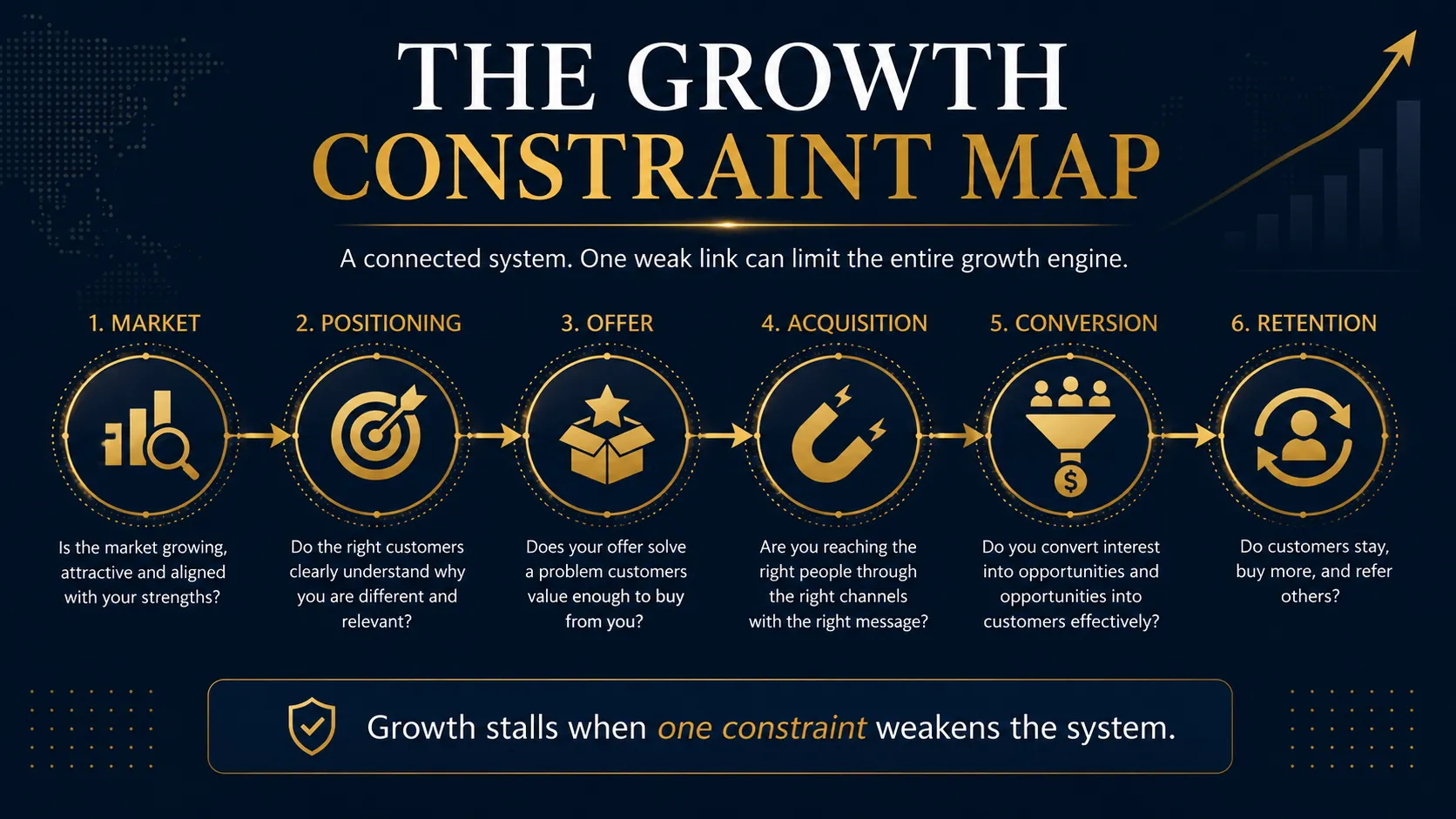
1. Market
Has the size, attractiveness or behaviour of the market changed?
2. Positioning
Can the right customer immediately understand why your business is relevant and different?
3. Offer
Does what you sell still reflect what customers increasingly value?
4. Acquisition
Are you reaching the right people, through the right channels, with a message that creates commercial interest?
5. Conversion and Retention
Once people engage, do they have a compelling reason to buy, stay, expand and refer?
These five areas should be examined together.
Otherwise, teams tend to optimize whichever metric they can see most easily.
Marketing optimizes traffic.
Sales optimizes meetings.
Operations optimizes efficiency.
Finance optimizes margin.
But nobody owns the complete growth system.
That is where the growth ceiling often hides.
The Next Stage of Growth Usually Requires a Different Level of Clarity
The answer to stalled growth is not always a dramatic pivot.
Sometimes the business needs a sharper market position.
Sometimes it needs to narrow its audience.
Sometimes an existing service needs to be packaged differently.
Sometimes the company needs to move into a more attractive segment.
Sometimes the customer experience needs to become the growth engine.
And sometimes the business simply needs to stop doing five things that no longer deserve resources.
The important point is that growth requires choices.
McKinsey’s 2026 research emphasizes this execution gap: leaders may have strong growth ambitions, but sustainable growth requires deliberate resource allocation, clear bets and disciplined execution.
That is why the next growth stage should not begin with:
What else should we do?
It should begin with:
What has changed, what is constraining growth now, and what should we choose to do differently?
That question creates a much better starting point.
Growth Stalls When the Business Keeps Solving Yesterday’s Problem
A mature business doesn’t necessarily need more ideas.
It often needs a better diagnosis.
The business may have done everything right for the stage it was in.
The problem is that the stage changed.
The customers changed.
The competitive environment changed.
The economics changed.
The expectations changed.
And the growth model that once produced momentum may no longer be enough.
That is not failure.
It is a signal.
The businesses that respond well are usually the ones willing to examine their assumptions before adding more activity.
They ask:
- Where is demand actually moving?
- Which customers are becoming more valuable?
- What do we want to be known for now?
- Where are competitors becoming interchangeable?
- What part of our growth engine is losing efficiency?
- What should we stop doing?
- What new growth opportunity deserves a deliberate bet?
That is where sustainable growth strategy begins.
Final Takeaway
A business can do almost everything right and still stall if its growth model no longer fits the market.
The answer isn’t automatically more marketing, more salespeople or more content.
First diagnose the constraint.
Look at the market, positioning, offer, acquisition, conversion and retention together.
Then make deliberate choices about where the business should compete and how it should create preference.
Because the next stage of growth rarely comes from simply doing more.
It comes from becoming more relevant, more differentiated and more deliberate about where the business is going.
If your business has reached that point, Business Growth Diagnostic™ is the logical next step. It is designed to uncover what is working, what is creating friction and where the highest-priority growth opportunities sit.