

A business can be capable, experienced and genuinely good at what it does—and still struggle to explain why a customer should choose it over a competitor.
Ask the business what makes it different, and the answers may come quickly: better service, higher quality, a more personal approach, greater flexibility or a commitment to results.
Ask its competitors the same question, and many will say something similar.
The problem is not necessarily that these businesses lack differences. It is that the differences they describe may not give customers a clear, meaningful reason to choose one over another.
This is where brand differentiation becomes a business problem rather than a copywriting exercise.
A business may have a distinctive capability without communicating it clearly. It may communicate a difference that customers do not value. It may offer something relevant but fail to provide a convincing reason to believe its claims.
These are different problems, and they require different responses.
The first task is therefore not to invent a stronger slogan. It is to understand where the connection between what the business believes makes it different and what customers have a reason to choose is breaking down.
Why capable businesses become difficult to distinguish
Many companies describe their value from the inside out.
They begin with what they have: experienced people, technical expertise, a broad service offering, established processes, strong customer relationships or a commitment to quality.
These may be genuine strengths. But customers do not automatically interpret them as distinctive reasons to choose the business.
Consider two B2B consultancies. Both have experienced teams, offer strategic advice and promise measurable business outcomes. One believes its strength lies in senior-level involvement. The other believes its strength lies in diagnosing the commercial problem before recommending marketing activity.
The second consultancy may have a meaningful distinction. Yet if both websites lead with strategy, expertise, tailored solutions and results, a prospective customer may struggle to recognise the difference.
The distinction exists inside the businesses, but the communication makes the offers look similar.
This gap can persist even when the marketing is professionally executed. A polished website, consistent visual identity and regular content cannot compensate for an unclear reason to choose the business.
The issue may sit in the strategy itself: the company has not decided which difference matters most, which customer should care about it, or what evidence would make it credible.
That is why differentiation should not begin with the question, “How can we look different?”
It should begin with a more demanding question: “What is meaningfully different about the value we offer, and why should the right customer care?”
The gap between being different and being chosen
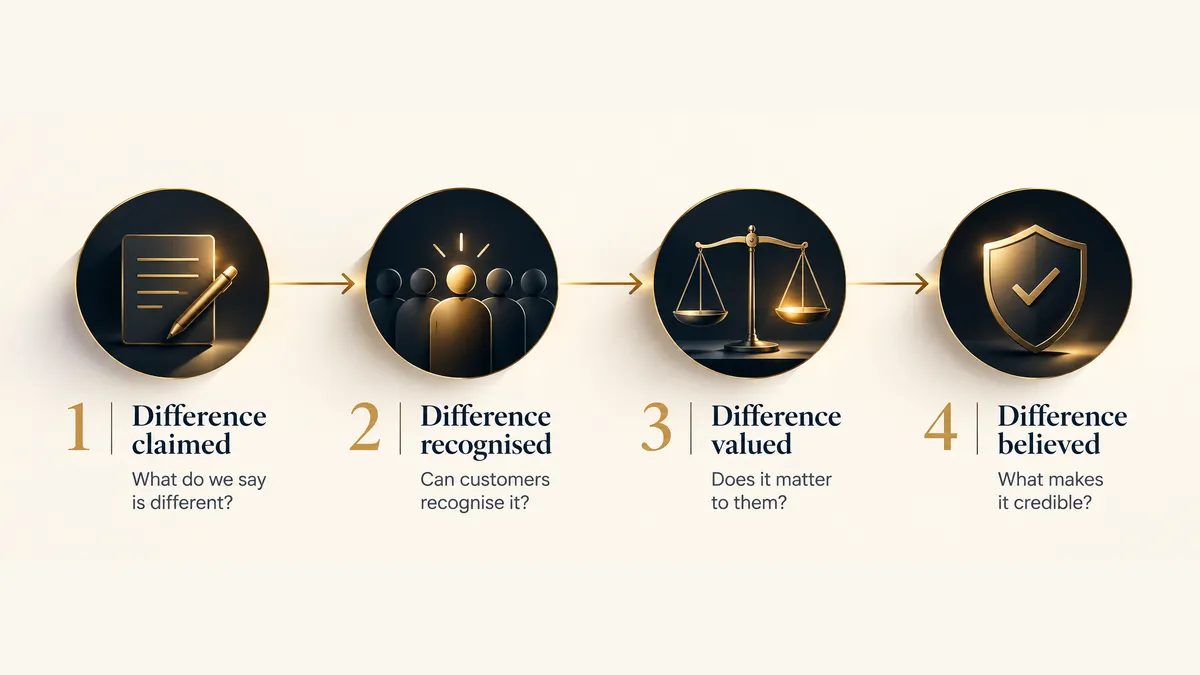
A useful way to diagnose differentiation is to separate four stages: the difference the business claims, the difference customers recognise, the difference customers value and the difference customers believe.
Brand differentiation works within a category of alternatives: customers need to understand what a business has in common with other options, as well as what makes it meaningfully different. This is why points of difference and points of parity need to work together rather than in isolation.
Marcom Trends uses these stages as a practical diagnostic framework. They are not a validated scientific scale; their purpose is to help business leaders identify where a claimed distinction loses its ability to influence customer consideration.
1. The difference the business claims
Start with the company’s own explanation.
What does it say it does differently? Is the distinction based on specialist expertise, a particular method, the way work is delivered, a distinctive combination of capabilities or an outcome it is especially equipped to support?
The answer needs to be specific enough to examine.
“We provide personalised solutions” is difficult to evaluate. It might mean that the business adapts its process to each customer’s circumstances. It might mean that clients receive direct access to senior specialists. Or it might simply mean that the team responds promptly to requests.
Those are different propositions, with different implications for the customer.
A useful claim identifies the actual capability or approach rather than relying on an adjective that almost any competitor could use.
Ask: Could the business describe its difference without using broad terms such as quality, innovation, flexibility or customer focus as the entire explanation?
If not, the first problem may be strategic clarity. The business has not yet defined the distinction it wants the market to understand.
2. The difference customers recognise
A genuine difference can remain invisible.
The company may have a specialist method, but its website lists only standard services. Its sales presentations may emphasise credentials shared by every competitor. Its content may discuss industry trends without revealing how the business approaches the underlying problem differently.
The customer sees the category, but not the distinction.
Imagine a consultancy that begins each engagement by identifying the commercial constraint before recommending marketing activity. That approach could separate it from providers that start with channels, campaigns or execution.
But if the consultancy communicates only that it offers strategy, digital marketing, content and campaign management, the distinctive approach remains buried.
The solution is not necessarily a more dramatic headline. The business may need to show how its approach changes the sequence of decisions, the recommendations it makes or the evidence it uses.
Ask: After encountering the website or speaking to the business, could a suitable customer explain what is meaningfully different about its approach?
If not, the difference may be unclear, invisible or hidden beneath generic category language.
3. The difference customers value
Not every difference matters to the person making the buying decision.
A company may use a proprietary process, offer an unusual reporting format or provide a feature competitors lack. Those distinctions may be real, but they are not automatically commercially meaningful.
A rapid response time may matter greatly to a customer dealing with an urgent operational problem. It may matter less to a buyer who is primarily concerned with specialist expertise, risk reduction or long-term continuity.
The importance of a difference depends on the customer’s situation, priorities and alternatives.
This is also why being unusual is not the same as being preferable. A business can stand out for a feature that has little influence on the decision.
Ask: What customer problem, concern or desired outcome makes this difference worth considering?
If the business cannot answer, it may be emphasising an internal strength without establishing its relevance to the customer.
4. The difference customers believe
Even a relevant, recognisable difference may fail if the claim lacks credibility.
Customers hear claims about expertise, innovation, quality and results from many providers. Repeating those claims does not make them more convincing.
A company that promises specialist expertise should be able to show what that expertise enables it to do. A business that claims a distinctive process should explain or demonstrate the process. A company that promises an outcome should present appropriate evidence without implying that every customer will receive identical results.
Proof can take several forms: relevant case studies, demonstrations, transparent methodology, documented experience, credible testimonials or a clear explanation of how the work is delivered.
The proof must match the claim.
If a business says it helps customers make better strategic decisions, a list of software platforms it uses may not establish that capability. A clear explanation of how it diagnoses a problem, evaluates alternatives and reaches a recommendation may be more relevant.
Ask: What would a sceptical but suitable customer need to see before accepting this difference as credible?
If the answer is unclear, the business may have a proof problem rather than a messaging problem.
Why common differentiation claims fail
Some common claims are not necessarily false. They are simply too weak to establish a useful distinction on their own.
“We deliver quality.” Quality is often an expectation rather than a reason to prefer one provider. The business needs to explain what quality means in its category and how customers can evaluate it.
“We put customers first.” Many competitors will say the same. A stronger explanation shows which decisions, behaviours or service commitments demonstrate that priority.
“We provide customised solutions.” Customisation becomes meaningful when customers understand what is adapted, why the adaptation matters and how it improves the fit of the offer.
“We are innovative.” Innovation is an aspiration unless it is connected to a relevant capability, a better way of solving a problem or a demonstrable benefit.
“We are results-driven.” Customers need to understand which results matter, how the business works towards them and what evidence supports the promise.
The answer is not to ban these phrases. They may describe genuine expectations or values. But they rarely provide enough information to distinguish a business by themselves.
A useful differentiation claim connects a specific capability or approach to a customer-relevant reason to consider the business—and gives the customer a way to believe it.
There is another important qualification. A business does not need to be different on every dimension. Established brand-positioning thinking distinguishes between points of difference that help a brand stand out and points of parity that allow it to be considered a legitimate option in the category.
A provider may need to meet basic expectations around reliability, competence or service before its distinctive strength can influence the decision. Difference does not automatically compensate for failing at something the customer considers essential.
Research examining brand-differentiating messages and advertising effectiveness found relationships between differentiation-focused advertising and outcomes across the brand funnel, although the findings should be interpreted within the study’s specific research design. Read the study in the Journal of the Academy of Marketing Science.
Diagnose the differentiation gap before rewriting the message
Before changing the website, developing a new brand promise or commissioning another campaign, identify which stage is failing.
| Diagnostic stage | What to examine | Warning sign |
|---|---|---|
| Claimed | The capability, method or value the business says distinguishes it | The claim relies on generic adjectives |
| Recognised | Website, sales material, content and customer explanations | Customers cannot describe the distinction |
| Valued | Customer priorities, buying criteria and reasons for choosing | The difference does not influence consideration |
| Believed | Evidence, demonstrations, examples and delivery experience | The claim sounds relevant but unsupported |
This diagnosis should use evidence rather than internal agreement alone.
Review recent sales conversations. What do prospects ask about? Which differences do they mention without prompting? What reasons do successful customers give for choosing the business? What objections recur? Which claims generate interest but fail to move the conversation forward?
Where possible, speak directly with suitable customers and prospects. Ask what they understood about the offer, which alternatives they considered, what influenced their decision and what made the business credible.
Avoid asking only, “Do you think our brand is different?” That invites a general opinion. Ask for concrete examples and decision evidence instead.
Compare what the business intends to communicate with what customers actually say. The gap between the two can reveal whether the problem lies in the claimed distinction, its visibility, its relevance or its credibility.
The aim is not to collect positive comments about the brand. It is to understand how customers interpret the offer when making a real decision.
What to change when the difference is not working
The right response depends on the diagnosis.
If the claimed difference is vague, return to the business itself. Identify which capabilities genuinely distinguish the offer and which customer problems the business is particularly well equipped to address. Do not invent a difference simply because marketing needs a stronger headline.
If the difference is not recognised, improve how it is expressed and demonstrated. Review the website’s central message, service descriptions, sales narrative and content. Make the distinction easier to understand without relying on unsupported superlatives.
If the difference is not valued, investigate the customer decision. The business may be emphasising a feature that customers consider secondary. It may need to focus on a different benefit, serve a more suitable audience or explain the commercial significance of its capability more clearly.
If the difference is not believed, strengthen the evidence. Show how the approach works, use relevant examples, explain the process and make the limits of the promise clear. Stronger language cannot compensate for weak proof.
These responses should not be treated as interchangeable. A vague claim does not necessarily need a new visual identity. An irrelevant feature does not necessarily need a more persuasive headline. An evidence gap cannot be solved by repeating the claim more frequently.
The diagnosis should determine the intervention.
It is also important to distinguish differentiation from broader positioning. If the business cannot explain which customers it is prioritising, which alternatives it competes against or why its offer matters, the problem may extend beyond the way a particular difference is communicated. That is a broader strategic decision, not simply a copywriting adjustment.
The real test of brand differentiation
A meaningful difference is not merely something the business can say about itself. It is a distinction the intended customer can recognise, connect to a relevant need and believe for a credible reason.
That does not guarantee a sale. Customer choice also depends on price, availability, timing, relationships, risk and other considerations. Differentiation is one part of the decision, not a substitute for a competitive offer or a good customer experience.
But it gives a business a more useful standard than asking whether it looks different from competitors.
Start with four questions:
- What do we claim is different about our business?
- Can the right customers recognise that difference?
- Does it matter to the decisions they are trying to make?
- What gives them a reason to believe it?
If those questions produce clear, evidence-based answers, the business has a stronger foundation for communicating its value.
If they do not, another slogan or campaign is unlikely to resolve the underlying problem.
The strategic task is to close the gap between what the business believes makes it different and what customers have a reason to choose.
The question is not simply whether your business is different. It is whether the right customer can see why that difference matters—and has a reason to believe you.
If customers struggle to explain why they should choose your business, another campaign may not be the answer. The first step is to understand whether your difference is unclear, irrelevant to the customer or insufficiently supported by evidence.
Marcom Trends helps businesses examine the strategic choices behind their positioning, marketing direction and growth priorities. If the underlying constraint is unclear, explore the relevant advisory or diagnostic support to identify what deserves attention first.