

A strong cultural marketing strategy does more than borrow a popular trend. It translates cultural interest into a product or experience that feels relevant to the audience. McDonald’s India’s Korean-inspired Gochujang Butter Sauce campaign offers a useful example of how cultural influence can shape product adaptation and brand communication.
McDonald’s India North and East is applying this approach through its Asia Chicken Campaign, introducing menu options featuring Korean-inspired Gochujang Butter Sauce alongside a campaign featuring G-DRAGON. The collaboration connects a global fast-food brand with Korean food culture, music and popular culture.
The marketing question is not simply whether Korean culture is popular. It is how a brand can translate cultural relevance into a product experience that feels accessible to its existing customers.
From a cultural trend to a product experience
At the centre of the campaign is Gochujang Butter Sauce, developed by McDonald’s Korea. For its North and East India launch, McDonald’s introduced four menu offerings—McSpicy Paneer, McSpicy Chicken, Veg Surprise and Chicken Delite—as part of its Korean-inspired Gochujang Butter Sauce campaign, according to MediaNews4U’s report on the India launch. The local menu adapts the Korean-inspired flavour concept to familiar McDonald’s products.
This is a strategic choice worth examining. Instead of asking customers to embrace an entirely unfamiliar food format, the campaign introduces a new flavour through products they may already know.
The approach creates a bridge between discovery and familiarity. Korean-inspired flavour provides the new element; the existing menu provides a recognisable starting point.
For marketers, this illustrates how cultural relevance can inform product presentation and innovation. A trend becomes more useful when a brand can translate it into an experience that makes sense within its own category, capabilities and audience.
Why the collaboration extends beyond the food
The campaign is not limited to the menu. It also features G-DRAGON in digital campaign content, while limited-period G-DRAGON Cards are available with McSpicy Chicken and McSpicy Paneer Meals. The wider collaboration spans 13 Asian markets, with individual markets adapting menu offerings to local preferences.
When the product, celebrity collaboration and campaign content reinforce the same central idea, they create a more coherent brand experience. A brand messaging framework can help marketers keep these different touchpoints consistent without making every execution identical.
These elements give the campaign several connected points of entry: the flavour, the celebrity and the collectible experience.
Each serves a different potential role. The menu gives customers a product to explore. The celebrity association connects the launch to music and popular culture. The cards offer an additional campaign-related element for interested customers.
This creates more than a product announcement. It gives the brand multiple ways to communicate the same campaign idea across food, content and customer experience.
However, the presence of a celebrity or collectible does not automatically translate into purchase or loyalty. Those outcomes would need to be assessed through campaign performance data.
The positioning lesson: make cultural relevance fit the brand
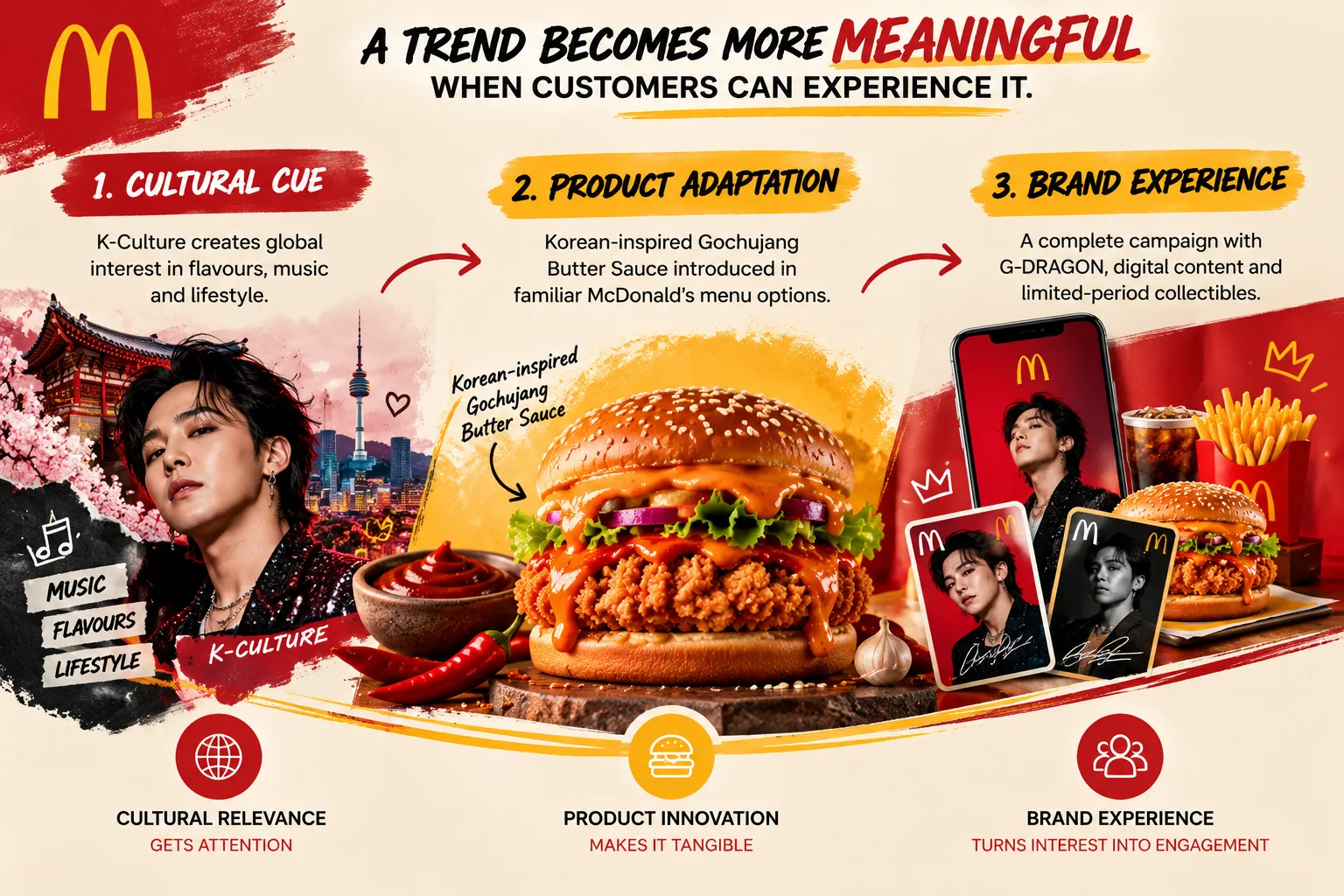
An effective cultural marketing strategy connects the trend to the brand’s identity instead of using cultural references simply to attract attention.
Cultural references can attract attention, but attention alone is not a positioning strategy. A campaign needs a credible connection between the cultural idea, the product being offered and the brand experience.
The key is to make cultural relevance fit the brand rather than adopting a trend simply because it is popular. A clear brand positioning helps marketers decide which cultural cues fit the brand’s identity and which may feel disconnected from it.
McDonald’s approach provides three useful considerations for marketers.
First, make the trend tangible. Rather than relying only on references to Korean culture, the campaign introduces a specific flavour through menu items.
Second, preserve familiarity while offering something new. Adapting the sauce to established menu options gives customers a recognisable way to explore the concept.
Third, connect every activation to one central idea. The menu, G-DRAGON content and collectible cards all sit within the same campaign, helping the different elements reinforce one another rather than operate as unrelated promotions.
The broader lesson is that cultural relevance works best when it is translated into something the brand can credibly deliver—not simply added to a campaign because it is attracting attention elsewhere.
What marketers should take away
Before building a campaign around a cultural trend, brands can ask three questions:
These questions help marketers assess whether a cultural marketing strategy can translate audience interest into a relevant product and a coherent brand experience.
- Is the trend relevant to the audience? Popularity alone is not enough; the connection should make sense for the intended customer.
- Can the brand turn it into a real product or experience? The cultural reference should lead to something concrete rather than remain a decorative message.
- Does the activation strengthen the brand’s positioning? The idea should make the offer more meaningful without obscuring what the brand stands for. A clear brand positioning strategy helps marketers assess whether a trend-led campaign reinforces the brand’s intended identity.
McDonald’s India’s Korean-inspired menu campaign is a useful example of connecting cultural influence with product adaptation and a coordinated campaign experience. Whether it ultimately improves sales or brand preference requires evidence beyond the launch announcement.
The takeaway: Cultural relevance may earn a brand a moment of attention. A meaningful product experience gives that attention something concrete to connect with.