

Today, it arrives across the entire business.
Media teams are planning earlier. Commerce platforms are selling advertising. Creators are becoming discovery channels. Quick-commerce platforms are turning regional occasions into shopping moments. Retailers and manufacturers are building inventory ahead of expected demand.
The interesting change isn’t simply that Indians are spending more during the festive season.
Festive commerce is beginning to behave less like a campaign and more like an operating system.
India’s 2026 festive advertising market is forecast to reach ₹60,000–62,000 crore, with digital expected to account for 67.8% of festive advertising. Commerce and retail media alone are forecast at ₹11,500 crore, while quick-commerce advertising is estimated at about ₹2,200 crore.
That changes what “festive marketing” actually means.
From campaign thinking to system thinking
The traditional festive model was relatively straightforward:
Campaign → Sale → Discount → Conversion
The emerging model looks more like:
Demand → Discovery → Media → Creator → Commerce → Fulfilment → Data → Retention
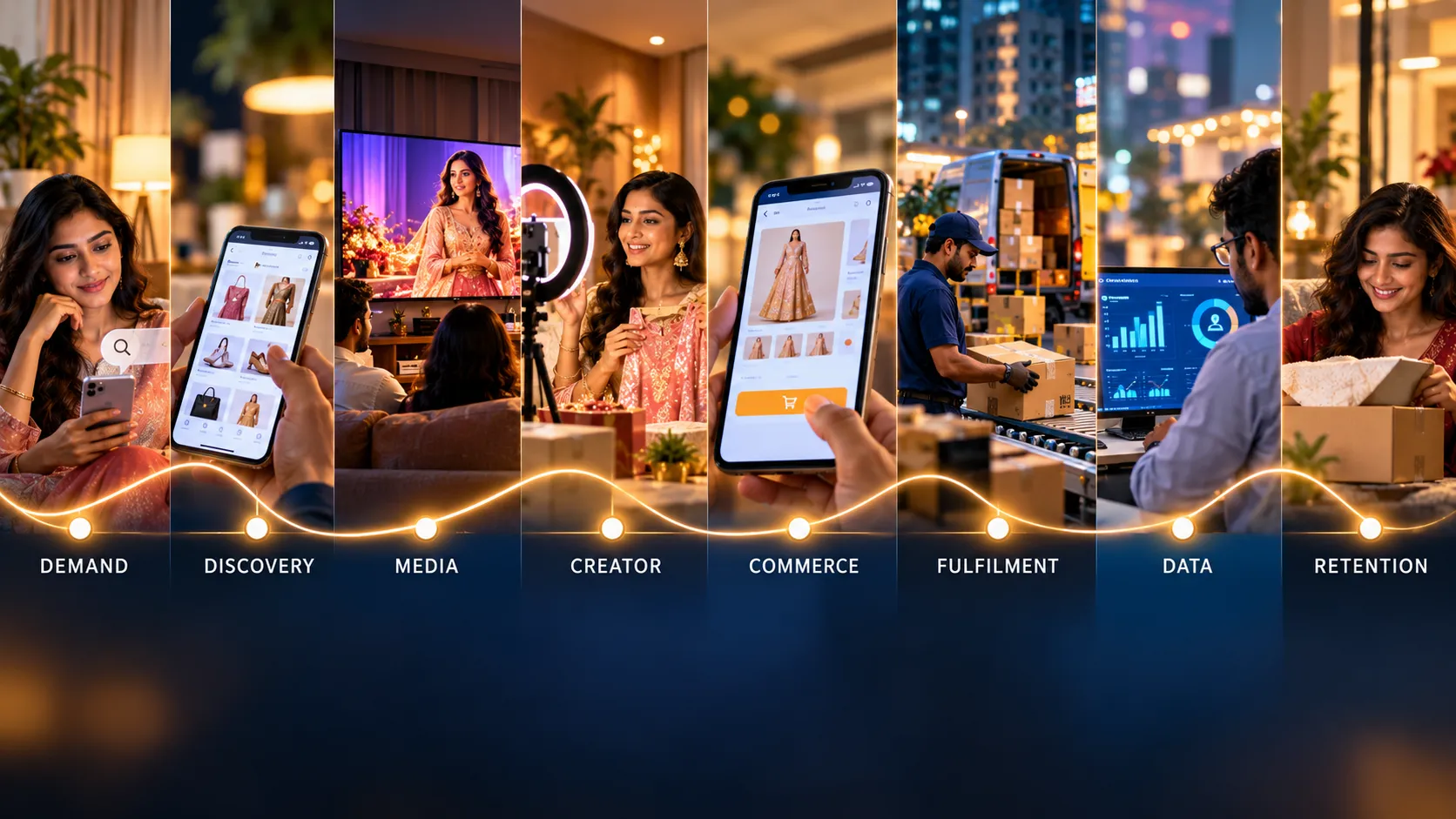
The difference is important.
A festive campaign can be owned by marketing.
A festive system cannot.
It touches merchandising, inventory, media, content, creators, marketplaces, logistics, customer experience and increasingly the data generated by every transaction.
That is why some of the most interesting festive developments in India are happening outside conventional advertising.
Commerce is becoming part of the media plan
One of the biggest shifts is that the platforms where consumers discover and buy products are increasingly becoming advertising environments themselves. This is also changing how brands compete on the digital shelf.
Datum Intelligence estimates commerce and retail media will form the largest single pool within India’s digital festive advertising ecosystem in 2026.
That creates a different question for brands.
It is no longer simply:
Where should we advertise?
It becomes:
Where does the consumer move from attention to purchase — and how much of that journey can we influence?
Amazon, marketplaces, quick-commerce platforms and other commerce environments increasingly sit much closer to the transaction.
The media decision and the commerce decision are beginning to overlap.
Quick commerce is stretching the meaning of “festive”
Festive commerce is also becoming less dependent on one large shopping event.
This matters because India does not have one festive consumer. It has thousands of local occasions, habits and purchase triggers. Quick commerce is increasingly giving brands a real-time environment in which to test these changing consumer behaviours. The 2026 festive period itself is unusually extended, running from Onam to Chhath.
This matters because India does not have one festive consumer.
It has thousands of local occasions, habits and purchase triggers.
A national campaign can create awareness.
But increasingly, local relevance can create the transaction.
That makes geography, occasion and inventory part of marketing execution.
Creators are moving closer to commerce
Creator marketing is following a similar trajectory.
India’s festive creator marketing spend is projected to reach ₹900 crore in 2026, with around 7,200 brands expected to activate creators. Nano and micro creators accounted for 75% of festive creator participation last season.
The significance isn’t simply that creator budgets are increasing.
Creators are increasingly being used within the discovery-to-purchase system. The journey can begin much earlier, as entertainment and participation become part of the path to purchase.
A creator can introduce a product.
A commerce platform can surface it.
A consumer can compare it.
A marketplace can convert the intent.
And the transaction generates data that can influence the next marketing decision.
The creator is therefore no longer necessarily just a media placement.
In some categories, the creator is becoming part of the commerce infrastructure.
The real competitive advantage may be coordination
This is where the festive season becomes more interesting for marketers.
The strongest brand may not necessarily be the one with the biggest festive campaign.
It may be the one that coordinates more of the system.
The right product.
The right inventory.
The right creator.
The right audience.
The right commerce environment.
The right regional context.
The right moment.
Recent business signals reinforce this. Companies have been building inventory ahead of expected festive demand, while festive-linked sectors such as e-commerce, quick commerce and logistics are also seeing increased hiring.
That is not simply a marketing story.
It is a business coordination story.
Festive commerce is becoming a test of the whole brand
This may be the bigger lesson.
A brand can have strong advertising and still lose because the product is unavailable.
It can have great creators and weak conversion.
It can generate demand and fail at fulfilment.
It can win attention nationally and miss the local context.
And it can generate transactions without creating a reason to come back.
That is why festive commerce increasingly needs to be viewed as a connected system rather than a collection of campaigns.
The old question was: “How do we win Diwali?”
The better question may be:
“How well does our entire business work when consumer demand accelerates?”
Because when festive commerce becomes an operating system, marketing is no longer sitting outside the business trying to create demand.
Marketing, commerce and growth start operating as one system.