

Brand awareness vs brand preference sounds like a small distinction. In practice, it can explain why customers know your brand, recognise it and still choose someone else.
Customers know the brand.
They recognise the name. They may remember the advertising. They may follow the company on social media. They may even visit the website.
But when it is time to make a decision, they choose someone else.
That creates an uncomfortable question:
If people already know us, why aren’t they choosing us?
The instinctive response is often to invest in more awareness.
More advertising.
More reach.
More content.
More visibility.
But awareness and preference are not the same thing.
Brand awareness tells you whether people recognise or recall a brand. Research has long treated awareness as an important part of how brands enter consumers’ consideration sets, but recognition alone does not guarantee final choice.
That distinction matters.
Because if your customers already know your brand, the next growth question may not be:
How do we become more known?
It may be:
Why aren’t we becoming the brand they prefer when the decision arrives?
Being Known Is Not the Same as Being Chosen
Imagine a customer who can name five brands in your category.
They know your brand.
They know two of your competitors.
They have seen your advertising.
They may even have visited your website before.
But when they actually need to buy, your brand isn’t necessarily one of the options they seriously evaluate.
And even if it is, being considered still doesn’t mean it will be preferred.
And being preferred still doesn’t guarantee the purchase.
This is why brand awareness vs brand preference is more than a measurement question.
It is a business question.
Awareness answers:
“Do they know us?”
Preference asks:
“Would they favour us over the alternatives?”
Those are very different conditions.
Recent research on brand preference explicitly treats preference as a comparative outcome: customers are evaluating one brand relative to competing alternatives rather than simply recognising the brand.
That is the gap worth understanding.
What Happens Between Awareness and Choice?
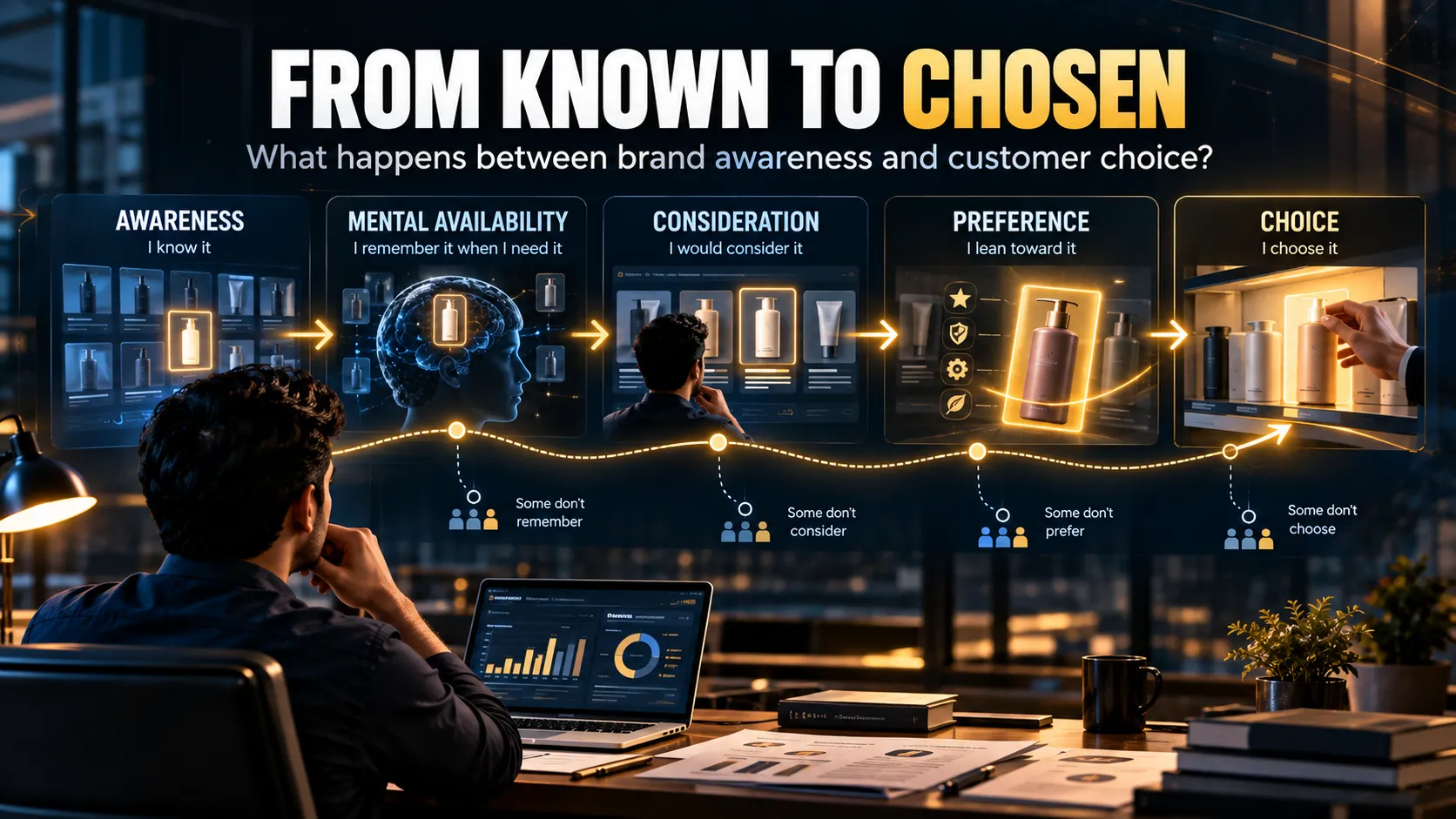
The customer journey is not a simple straight line from seeing an advertisement to buying a product.
Research into consumer decision-making has shown that customers can move through different stages of consideration, active evaluation and purchase, adding or removing brands as they evaluate their options.
For a business trying to diagnose why awareness isn’t translating into sales, a useful way to think about the problem is:
The Awareness-to-Choice Gap
AWARENESS
Do I know this brand?
↓
MENTAL AVAILABILITY
Does this brand come to mind when I have this need?
↓
CONSIDERATION
Would I include this brand among my options?
↓
PREFERENCE
Would I lean toward this brand over the alternatives?
↓
CHOICE
Did I actually choose it?
These stages are related, but they are not interchangeable.
And the gap between them is where many brand problems hide.
Awareness: “Do I Know This Brand?”
Awareness is the starting point.
If people don’t know a brand exists, it has an obvious problem.
But awareness is fundamentally about recognition and recall.
It does not tell you everything about the customer’s relationship with the brand.
A person can recognise a bank without considering opening an account with it.
They can recognise a skincare brand without wanting to buy it.
They can know a consulting firm exists without believing it is right for their business.
So high awareness can be a useful asset without being a sufficient reason for choice.
Mental Availability: “Does It Come to Mind When I Need It?”
This is a more interesting question.
A customer may know ten brands in a category.
But when the buying situation occurs, only a few may actually come to mind.
The Ehrenberg-Bass Institute describes mental availability as the probability that a brand is easily thought of in relevant buying situations. It also links this to category entry points – the situations, needs or cues that bring a category to mind.
That creates an important distinction:
Known does not necessarily mean top-of-mind in the relevant situation.
For example:
Someone may know a particular restaurant.
But when they think:
“I need somewhere quick for lunch near the office.”
a different set of restaurants may come to mind.
The same principle can apply to B2B services, professional firms, consumer products and almost any competitive category.
The question isn’t simply:
Do people know us?
It is:
In which situations do they think of us?
Consideration: “Would I Actually Consider It?”
Now the customer has a need.
A few brands come to mind.
But being remembered doesn’t automatically mean being considered.
McKinsey’s research into the consumer decision journey found that the initial consideration set can be particularly important: brands in that set have a significant advantage because they are already present when active shopping begins.
This is where the difference between awareness and consideration becomes commercially important.
A brand can be:
high awareness + low consideration
That means people know it, but something is stopping it from entering the serious buying set.
Perhaps it doesn’t feel relevant.
Perhaps its value isn’t clear.
Perhaps competitors have stronger associations.
Perhaps the brand is perceived as too expensive.
Perhaps the customer simply doesn’t associate it with the particular problem they are trying to solve.
More awareness won’t necessarily fix those issues.
Preference: “Would I Lean Toward It?”

This is the point where the customer moves from recognition to evaluation.
They know the alternatives.
They have narrowed the field.
Now they have reasons to favour one option over another.
Preference is therefore inherently comparative.
It isn’t enough for a brand to be “good.”
The customer is effectively asking:
Why this one?
That answer can come from many places.
It could be:
- perceived value
- relevance
- trust
- experience
- product performance
- distinctive associations
- convenience
- price
- reputation
- familiarity
- a particular problem the brand solves especially well
Research into brand preference also shows that brand knowledge and consumer experience can contribute to preference formation, and that preference can in turn relate to repurchase intention.
This is why preference is more demanding than awareness.
Awareness gets the brand into the customer’s mental world.
Preference gives the customer a reason to lean toward it.
Choice: “Did I Actually Choose It?”
Even preference isn’t a guaranteed sale.
This is an important point because marketing discussions sometimes treat preference as the final destination.
It isn’t.
A customer may prefer one brand but choose another because of:
- price
- availability
- convenience
- timing
- distribution
- stock
- promotion
- switching friction
- location
- experience at the point of purchase
McKinsey’s consumer decision-journey research makes a similar distinction: entering the initial consideration set is important, but brands still have to win during active evaluation and at the moment of purchase.
So the final question isn’t only:
“Do they prefer us?”
It is:
“When the buying moment arrives, can that preference actually become a choice?”
Why High-Awareness Brands Still Lose Customers
If customers already know your brand, there are several possible reasons they still choose competitors.
And this is where diagnosis becomes more useful than simply increasing marketing activity.
The Brand Is Known but Not Relevant Enough
Recognition doesn’t automatically create relevance.
A customer might know exactly who you are but still think:
“That’s not really for me.”
This is where brand positioning matters: what the customer understands your brand to stand for, who it is relevant to, and why it should be considered over the alternatives.
The Brand Is Remembered but Not Considered
The customer recognises the brand.
But when comparing options, it doesn’t make the shortlist.
This can happen when the perceived value proposition isn’t strong enough or when competitors have become more relevant to the situation.
McKinsey’s research illustrates why this matters: consumers often begin shopping with a relatively limited initial set of brands rather than considering every brand they know.
The Brand Is Considered but Not Preferred
This is a different problem.
Now you’re in the room.
But you’re not winning the comparison.
The customer may understand what you offer and still think another brand provides:
- better value
- greater credibility
- stronger relevance
- a better experience
- greater convenience
- a clearer reason to choose
This is where businesses often discover that visibility was never the main problem.
The brand was visible.
The reason to prefer it wasn’t strong enough.
And that problem should not automatically be confused with visual identity; brand positioning and brand identity play different roles in how a brand is understood and expressed.
The Brand Is Preferred but Still Not Chosen
This is another important distinction.
Suppose customers say your brand is their preferred option.
But the sales data doesn’t reflect that preference.
Now investigate the buying environment.
Is the product easily available?
Is the purchase process difficult?
Is the price structure creating friction?
Is the sales team slow?
Is the competitor simply easier to buy?
The answer may sit outside traditional brand communication.
The Awareness-to-Choice Gap Diagnostic
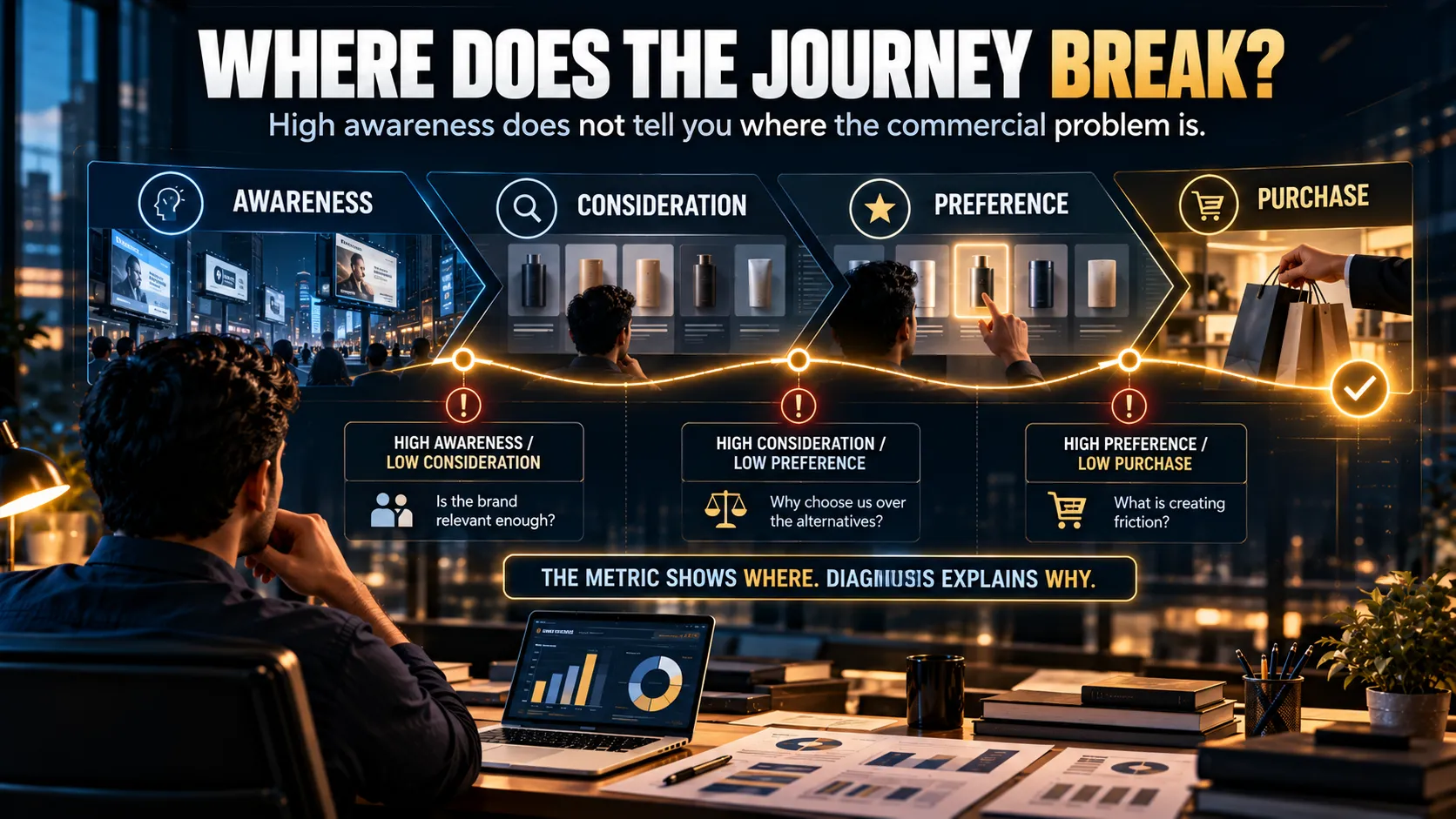
This is the simplest way to use the framework.
| What you’re seeing | What to investigate |
|---|---|
| High awareness, low consideration | Relevance, category meaning, perceived value |
| High consideration, low preference | Competitive meaning, trust, value, experience, differentiation |
| High preference, low purchase | Price, availability, convenience, friction, execution |
| Good first purchase, weak repeat | Experience, satisfaction, retention and post-purchase factors |
The important point is this:
The metric tells you where the problem appears. Diagnosis tells you why it exists.
That distinction can save a business from spending money on the wrong intervention.
Stop Measuring Awareness as If It Were Preference
Awareness is attractive because it is easy to celebrate.
A larger audience.
More recognition.
More reach.
More mentions.
More searches.
More followers.
Those numbers can all be useful.
But they do not automatically answer the commercial question.
A business can have strong awareness while remaining weak on consideration.
It can have strong consideration while losing preference.
It can have strong preference while losing purchases because of execution or availability.
When the underlying reason customers choose competitors remains unresolved, marketing can simply work harder without becoming more effective.
So instead of asking only:
“How many people know us?”
leaders should also ask:
“How many of the people who know us would actually consider us?”
Then:
“Of those who consider us, how many prefer us?”
And finally:
“Does that preference show up in actual customer behaviour?”
That creates a much more useful picture of brand health.
A recent study in the Journal of Brand Management also treats brand preference as an outcome distinct from individual components of brand equity such as awareness, associations and loyalty, reinforcing the value of measuring preference directly rather than assuming it from awareness.
What Should You Fix First?
This is where businesses often go wrong.
They see low sales and immediately increase awareness.
But imagine three different businesses.
Business A
People don’t know the brand.
Awareness may genuinely be the problem.
Business B
People know the brand, but don’t see why it is relevant.
More awareness may simply create more awareness of an unclear proposition.
Business C
People know and prefer the brand, but the competitor is easier to buy.
More awareness is unlikely to solve the immediate commercial friction.
The intervention needs to match the actual gap.
That is why the first question should not be:
“What marketing activity should we add?”
It should be:
“Where does the customer stop moving toward us?”
What This Means for Brand Strategy
This does not make brand awareness unimportant.
Quite the opposite.
Awareness creates the memory structures from which consideration can become possible. Research has found that brand awareness can influence consideration and decision-making, particularly in some categories and buying contexts.
But awareness is foundational, not sufficient.
A commercially useful brand strategy has to think beyond recognition.
It needs to consider:
What situations should bring the brand to mind?
What should the brand mean in those situations?
Why should the customer consider it?
Why should they prefer it?
What experience supports that preference?
And what makes the final choice easy?
That is a much broader strategic problem than simply increasing awareness.
The Marcom Trends View
Being known is valuable.
But being known is not the same as being chosen.
If customers already recognise your brand, don’t automatically assume the answer is more reach.
Find the gap.
Are they not thinking of you at the right buying moment?
Are they thinking of you but excluding you?
Are they considering you but preferring someone else?
Are they preferring you but encountering friction at the point of purchase?
Those are different problems.
And they require different decisions.
Awareness gets a brand into memory. Preference gives customers a reason to lean toward it. Choice happens when that preference meets a buying situation where the brand can actually win.
So if customers know your brand but still don’t choose you, don’t start by asking how to become more famous.
Ask:
Where does the journey from knowing us to choosing us break down?
That is where the real growth question begins.