

For decades, brand strength was built around things that were relatively difficult to copy.
Trust.
Familiarity.
Distribution.
Repeat purchase.
Mental availability.
Then the shelf moved onto a screen.
Quick commerce brand strength is becoming a different proposition. Trust, familiarity and recognition still matter. But once the consumer reaches the digital shelf, a different set of variables starts shaping what happens next.
That doesn’t make brand strength less important.
It changes what brand strength has to do.
The shelf has become much more compressed
Redseer’s 2026 Brand Index offers a useful view of this shift in Beauty & Personal Care.
Its January–March data puts annualised BPC GMV across the top three quick-commerce platforms at approximately $1 billion, with around 30 million monthly BPC shoppers and roughly 90% year-on-year growth. Redseer Strategy Consultants
But the more interesting question isn’t how large the channel has become.
It’s how brands compete inside it.
Redseer found that the top 10 BPC brands account for 25% of quick-commerce GMV, while the next 65 account for another 50%.
That creates a crowded middle.
Several brands can be familiar, trusted and well established.
Yet they still have to compete for the same digital attention.
Trust gets you into the consideration set
A familiar brand has an obvious advantage when the buying decision is fast.
Redseer found legacy BPC brands held 63% of their online GMV through quick commerce versus 53% through traditional e-commerce in its JFM 2026 data. The report attributes part of this advantage to the trust accumulated by legacy brands over decades. Redseer Strategy Consultants
But trust does not control the entire shopping experience.
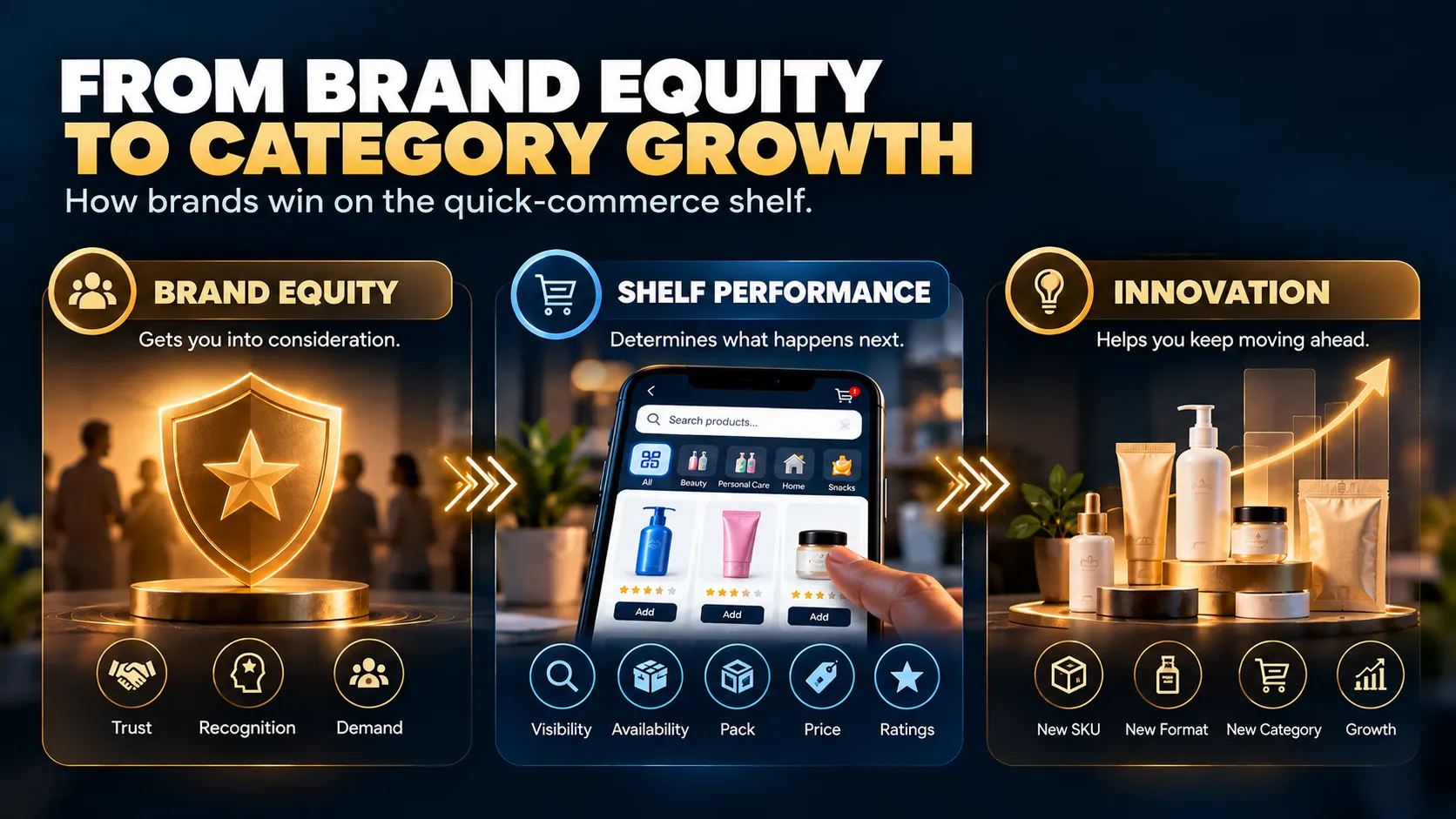
Once the consumer searches, other variables appear immediately:
Where does the product appear?
Is the preferred SKU available?
Is the pack right for the occasion?
Does the price make sense?
Do ratings reinforce the brand promise?
Moneycontrol reported in August that FMCG companies were adapting advertising, assortments, pack sizes and supply chains as competition for visibility on quick-commerce apps intensified.
The physical shelf had merchandising.
That is where quick commerce brand strength starts to look different. The digital shelf has visibility, algorithms, availability and behaviour.
The advantage is moving from recognition to execution
This is where brand strategy and channel strategy increasingly meet.
A strong brand can create demand.
But the channel still has to convert that demand.
Redseer’s analysis separates brand strength from quick-commerce execution, including metrics such as fill rate, in-stock availability and fulfilment. It also points to speed of innovation as a longer-term differentiator as execution capabilities become more standardised.
That distinction matters.
A brand can spend years building equity and still lose a purchase because the right product isn’t available when the consumer searches.
And the shelf can become an innovation engine
This is where the story connects with a broader change in commerce.
Established brands can use an existing quick-commerce presence to test adjacent categories, formats or propositions without starting distribution from zero.
Redseer’s case studies show established brands using quick commerce to validate category extensions and product reformulations at real consumer volume.
That is different from simply using quick commerce as another sales channel.
It makes the shelf part of the growth system.
As we explored in our earlier article on commerce as a product-testing environment, the interesting shift is not simply that products can reach consumers faster. It is that brands can potentially learn faster too.
What quick commerce brand strength looks like now
So perhaps the question for consumer brands is no longer simply:
How strong is our brand?
It is:
What happens to that strength when the consumer encounters us on a digital shelf?
Can trust translate into visibility?
Can distribution translate into availability?
Can brand equity support new products?
And can the brand use the channel to discover its next growth opportunity?
The question for marketers is no longer simply how strong the brand is. It is how effectively that quick commerce brand strength converts when the consumer encounters the brand on screen.
The Marcom Trends take
Quick commerce isn’t making brand building irrelevant.
It is making brand strength more accountable to the buying environment.
The strongest brands still bring trust to the shelf.
But trust is increasingly only the beginning.
Brand equity creates consideration.
Shelf performance converts it.
Innovation extends it.
That may be the more important change happening underneath India’s quick-commerce growth.