

For years, product development followed a fairly predictable sequence.
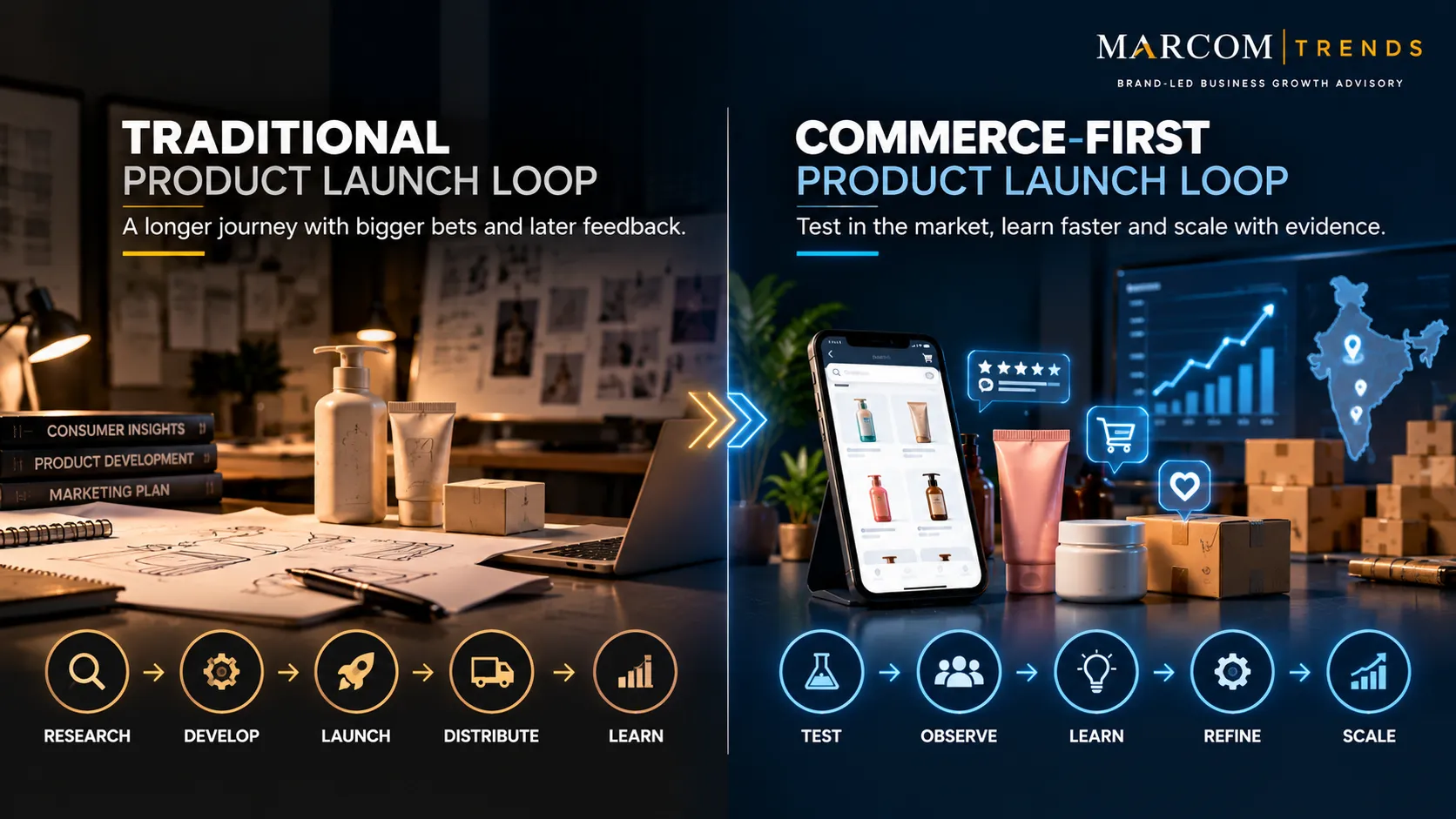
Research the consumer.
Develop the product.
Build the proposition.
Launch it.
Distribute it.
Then wait for the market to tell you whether you were right.
That sequence is beginning to change.
That is why commerce as R&D lab is becoming an important shift in how brands develop, test and scale products.
A new playbook from WPP Media India, launched on September 30, describes e-commerce platforms as environments for demand discovery, product validation and brand expansion, rather than simply places where transactions happen. The playbook argues that brands can use real shopping behaviour to test propositions and gather evidence before committing to wider distribution.
That creates an interesting possibility:
What if the shelf is becoming part of the R&D process?
The product launch is changing
Traditionally, commerce came near the end of the launch process.
The product was already developed.
The positioning was already decided.
The distribution plan was already built.
Commerce’s job was largely to sell it.
The emerging model is different:
Test → Observe → Learn → Refine → Scale
Quick commerce makes this particularly visible because products can be introduced to consumers quickly and the resulting behaviour can be observed much sooner.
A Mint report earlier this year described quick commerce as a growing testing ground for product innovation. Akshayakalpa Organic, for example, used Swiggy to launch a high-protein milk product and assess whether consumers came back to purchase it again. Dairy Day also introduced certain products online before expanding them into general trade.
The important metric wasn’t simply:
“Did people buy it?”
It was closer to:
“Did enough people buy it, like it and come back?”
That is a very different role for a commerce channel.
Commerce as R&D Lab: The Learning Loop Is Changing
Commerce is also changing at the other end of the journey, with AI increasingly moving from product discovery toward helping consumers complete purchases, as we explored in Google + Flipkart Buy Button in Gemini.
A product listing can generate signals that a traditional launch plan may take much longer to uncover.
What are consumers searching for?
Which proposition gets attention?
Which pack size converts?
Which product gets purchased?
Which one gets reviewed?
Which one gets purchased again?
And where does demand appear?
WPP Media’s new commerce-first framework specifically highlights behavioural signals such as discovery, clicks, consideration, abandonment, trial, reviews and repeat purchase as evidence that can inform launch decisions.
That doesn’t make commerce a replacement for traditional consumer research.
It makes commerce another source of evidence.
And potentially a very useful one.
Behaviour is becoming the evidence
This may be the most important shift.
Brands have always asked consumers what they want.
But what consumers say they might buy and what they actually buy are not always the same thing.
A shopping environment captures behaviour closer to the decision.
Someone can say a new product sounds interesting.
A real product listing can show whether they searched for it, clicked on it, considered it, bought it, reviewed it and eventually bought it again.
That difference matters.
It means product development can become less dependent on a single large launch decision and more connected to an ongoing learning loop.
The recent WPP Media framework goes as far as describing behavioural proof as increasingly important alongside stated consumer intent.
Quick commerce compresses the test-and-learn cycle
This is where quick commerce becomes particularly interesting.
The channel isn’t only about delivering a product quickly.
It can shorten the distance between:
Product → Consumer → Feedback
An August 2026 Economic Times report noted that companies are shrinking product innovation and launch cycles dramatically, with some launches moving from timelines of around a year to as little as weeks in response to faster-moving demand and competition.
And quick commerce is becoming commercially significant enough for large FMCG companies to take the channel seriously. An earlier 2026 Economic Times report citing Kotak Investment Banking said quick commerce represented around 6% of FMCG sales, roughly double its FY25 level, with particularly strong contributions to online sales for several large FMCG companies. The Economic Times
So the strategic question is changing.
It is no longer only:
“How quickly can we get this product to consumers?”
It becomes:
“How quickly can we learn whether this product deserves to reach more consumers?”
But a digital test is not the whole market
There is an important caveat.
A quick-commerce test is still a test within a particular consumer and channel environment.
The people shopping on these platforms, the cities they live in, the categories they buy and the occasions that trigger purchase can all influence the result.
So a successful digital launch does not automatically mean a product is ready for national distribution.
This is particularly important in India, where offline retail still accounts for the overwhelming majority of retail activity. WPP Media’s playbook explicitly argues that digitally validated demand should become a proof layer before brands expand into general trade, modern trade and specialised retail. exchange4media
In other words:
Digital proof can reduce uncertainty. It doesn’t eliminate it.
The bigger shift is from launch speed to learning speed
This is where the story becomes bigger than quick commerce.
If commerce becomes part of product learning, the teams responsible for product, marketing, sales, media and distribution can no longer operate as completely separate stages of a launch.
The launch becomes a system.
Product creates the proposition.
Marketing creates attention.
Commerce creates behaviour.
Data creates evidence.
The business decides what deserves to scale.
That is a very different operating model from launching nationally and hoping the market validates the decision afterwards.
And it is particularly relevant for FMCG, beauty, D2C and emerging consumer brands where the cost of getting a product decision wrong can be significant.
The Marcom Trends take
The most interesting thing happening in quick commerce may not be the 10-minute delivery.
It may be the 10-day learning loop.
Commerce is moving closer to product development because brands can increasingly put a proposition into a real buying environment, observe behaviour and decide what to do next.
That doesn’t mean every product should launch on quick commerce.
It means the channel can become part of a broader test → learn → scale system.
And that changes the question marketers should ask.
Not:
“Where should we launch this product?”
But:
“Where can we learn fastest whether this product deserves to scale?”
For brands operating in increasingly fast-moving categories, that may become one of the most valuable questions in the launch plan.