

For years, Google has been one of the places where shopping journeys started.
A customer searched for a product.
They compared options.
They clicked through to a retailer.
Then the actual transaction happened somewhere else.
That journey may be getting shorter.
Google is reportedly testing a Flipkart Buy Button in Gemini and AI Mode in India, allowing some users to move from AI-assisted product discovery into a Flipkart checkout flow without first leaving the AI interface.
It is still an early test.
But strategically, the direction is interesting.
Because AI is beginning to move beyond helping people find products.
It is moving closer to helping them buy them.
What Is Google Testing With the Flipkart Buy Button in Gemini?
According to TechCrunch, some users in India are seeing a Buy button on selected Flipkart product listings appearing inside Gemini and Google’s AI Mode.
The test is currently limited to some users and a relatively small range of products, including smartphones, electronics and mobile accessories.
When the Buy button is available, tapping it opens a Flipkart-branded checkout flow without requiring the user to leave the AI interface first. Other users continue to see Flipkart products without the direct purchase option.
Google has not publicly announced this specific Flipkart test.
A Google spokesperson told TechCrunch that the company is continually testing new features and experiences to help people discover and connect with businesses, but did not provide further details.
So this should be understood as a reported product test, not a fully launched Google shopping feature.
But Google Has Been Building Toward This
The Flipkart experiment did not appear out of nowhere.
Google has been building infrastructure for what it calls agentic commerce.
In January 2026, Google introduced the Universal Commerce Protocol (UCP), an open standard designed to help AI agents and commerce systems work together across the shopping journey, including discovery and checkout. Flipkart was among the companies endorsing the protocol.
Google subsequently expanded its shopping infrastructure through products such as Universal Cart, which is designed to connect shopping activity across Google surfaces including Search and Gemini.
Google has also said that its AI shopping experience is intended to help users move from inspiration and research toward purchasing.
In India, Google already offers conversational shopping experiences in Gemini and AI Mode, including product listings, comparisons, prices and other shopping information.
The reported Flipkart test therefore represents an important next step:
Discovery → Recommendation → Transaction
The Shopping Funnel Could Be Getting Smaller
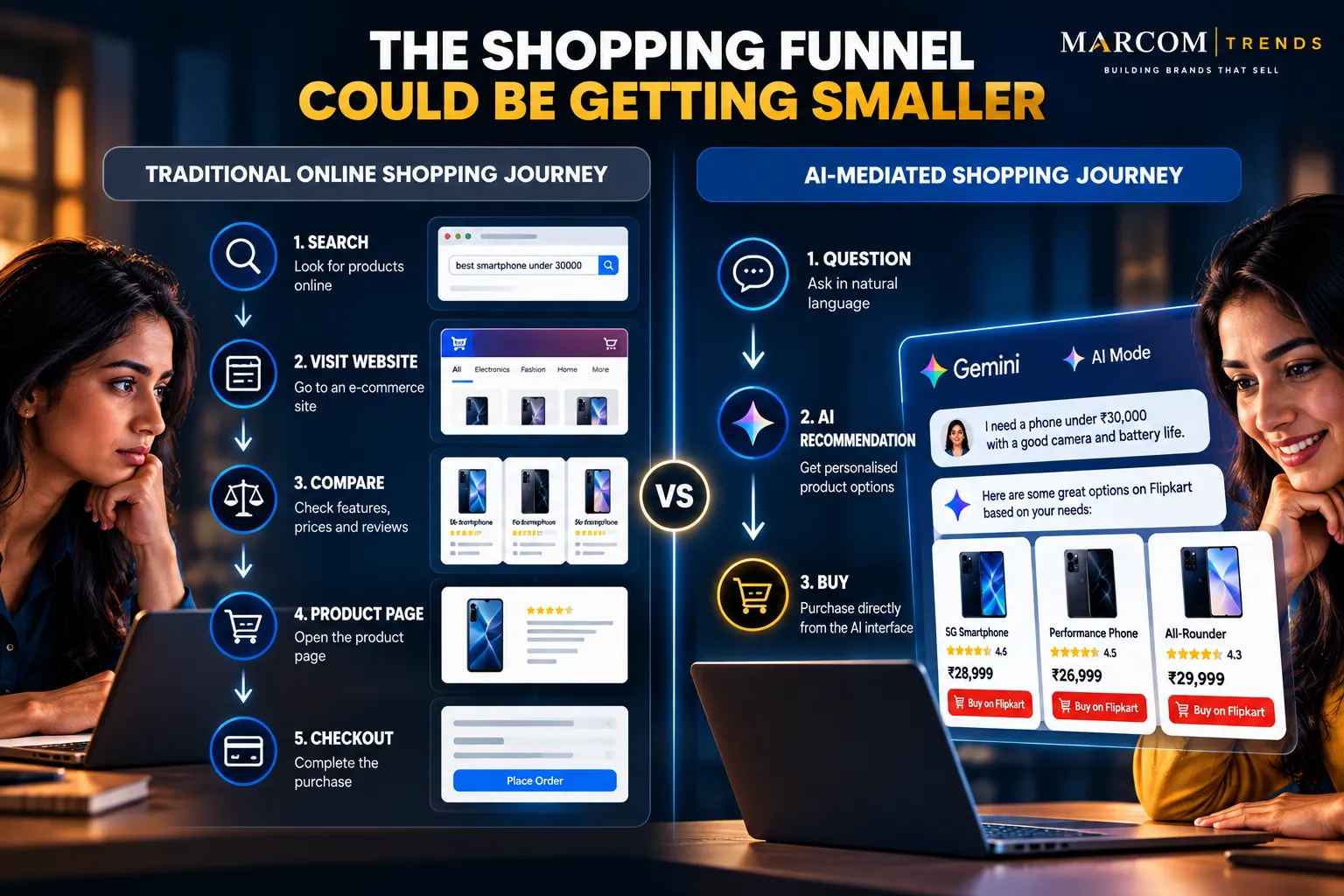
This is where the development becomes more interesting for marketers.
The traditional online shopping journey might look something like:
Google Search
↓
Product discovery
↓
Retailer website
↓
Comparison
↓
Product page
↓
Checkout
AI changes the interface.
A customer might instead say:
“I need a phone under ₹30,000 with a good camera and battery life.”
The AI can help interpret the requirement.
Then it can surface products.
Then compare them.
And increasingly, the interface may provide a route to purchase.
That means fewer steps between question and transaction.
And fewer steps can mean fewer opportunities for a customer to leave the journey.
The Bigger Change Is Not the Buy Button
A Buy button is easy to understand.
The more important change is where the decision is being made.
In traditional search, a brand competes for visibility among links, ads, shopping results and competitors.
In an AI interface, the user may ask a much more complicated question:
“Which one is actually right for me?”
The system then helps narrow the decision.
That creates a different kind of commercial environment.
The brand isn’t only trying to be found.
It increasingly needs to be understood well enough to be considered.
That distinction matters.
AI Shopping Could Change What “Visibility” Means
Google itself is already preparing merchants for this shift.
Its 2026 updates include AI Performance Insights in Merchant Center, designed to give businesses visibility into how products perform across AI surfaces.
Google has also introduced conversational attributes, allowing merchants to provide richer product information in a form that better matches conversational shopping behaviour.
That tells us something important.
Product visibility in AI isn’t simply about having a product feed.
The system needs enough useful information to understand:
- what the product is
- who it is for
- what makes it different
- which use cases it fits
- what alternatives exist
- what customers may care about
In other words, product information becomes part of the brand’s AI-readable commercial story.
This Is Bigger Than Flipkart
Flipkart is the immediate story because of the reported Indian test.
But the underlying movement is much broader.
Google is building agentic commerce infrastructure.
OpenAI is expanding advertising and commerce capabilities around ChatGPT.
Retailers are experimenting with AI shopping assistants.
Search is becoming more conversational.
The boundary between search, recommendation and commerce is becoming less obvious.
We recently looked at this from another angle in our analysis of ChatGPT Ads in India.
The common thread is not simply “AI is getting more popular.”
It is that AI is moving closer to commercial decision-making.
What Should Marketers Watch?
There are several questions worth watching as these experiments develop.
1. Who controls the customer relationship?
If discovery happens inside an AI interface, the retailer still needs to maintain the relationship with the customer.
Google’s UCP framework explicitly keeps the retailer as the merchant of record in its described checkout model.
2. What determines which products AI surfaces?
This could become one of the biggest questions in AI commerce.
Traditional search visibility has an established vocabulary:
SEO, paid search, product feeds, rankings and conversion.
AI-mediated shopping introduces another layer:
relevance, product understanding, context and recommendation.
3. Will consumers trust AI-led product selection?
Convenience is one thing.
Trust is another.
When an AI system narrows ten products to three, the customer may increasingly rely on the system’s interpretation.
That makes transparency, product information, reviews and brand credibility increasingly important.
4. Does the retailer website become less important?
Not necessarily.
The website may become less important as the starting point of discovery while remaining critically important as the place where the brand establishes trust, information, service and ownership of the customer relationship.
The Marcom Trends Take
The interesting question isn’t:
“Will people buy products through AI?”
Some already will.
The more important question is:
“What happens when AI becomes the layer that decides which products people seriously consider?”
That’s where the strategic shift begins.
Google’s reported Flipkart test is still small.
It may change.
It may expand.
It may not roll out exactly as currently observed.
But the direction is clear enough to watch.
Search used to help people find.
AI is increasingly helping people choose.
And the next step may be helping them buy.
For marketers, that means the future of digital visibility may not be only about getting a customer to your website.
It may also be about making sure AI understands why your product belongs in the conversation in the first place.