

There is a familiar moment in business growth.
Sales are slowing.
The pipeline doesn’t look strong enough.
Marketing is asked to generate more enquiries.
So the business increases advertising.
More campaigns are launched.
More content is published.
More forms are created.
More leads begin appearing in the dashboard.
And everyone feels better for a while.
Until the sales numbers come in.
Revenue has barely moved.
The sales team is busier.
Follow-ups have increased.
The pipeline is full of people who are not ready, not qualified, not interested enough or simply not the right fit.
The business has generated more leads without creating proportionally more business.
This is where lead quality becomes more important than lead volume.
The problem is not that lead generation doesn’t matter.
It does.
The problem is assuming that more leads automatically create more growth.
They don’t.
A lead is only the beginning of a commercial journey.
What matters is whether the right people enter that journey, whether they are qualified, whether they move forward and whether enough of them eventually become valuable customers.
Google’s current guidance for lead generation makes the same distinction: businesses should map the journey from initial lead to sale and identify the conversion stages that signal real business value, including qualified and converted leads.
That changes the question completely.
Instead of asking:
How can we generate more leads?
A better question is:
How can we generate more of the right leads and convert them more effectively?
The Problem With Treating Every Lead as Equal
A lead is not a customer.
It is not even necessarily a sales opportunity.
It is simply a person or organisation that has shown some form of interest.
That interest can vary enormously.
One person may be actively looking for a solution and ready to buy.
Another may only be researching.
Another may be comparing five suppliers.
Another may have clicked an advertisement because the headline caught their attention.
Another may not even fit the business’s target market.
Yet many businesses put all of them into one number:
100 leads.
That number can look impressive.
But it tells you very little about the commercial quality of those leads.
Consider two businesses.
Business A
100 leads
20 qualified
8 serious opportunities
3 customers
Business B
50 leads
30 qualified
15 serious opportunities
7 customers
Business A generated twice as many leads.
Business B generated more customers.
That is the difference between lead quantity and lead quality.
The larger number is not automatically the stronger pipeline.
Salesforce makes a similar point in its current lead-conversion guidance: thousands of leads do not make a healthy pipeline if those leads do not become customers, and it recommends stronger qualification, lead scoring and consistent follow-up.
What Actually Makes a Lead High Quality?
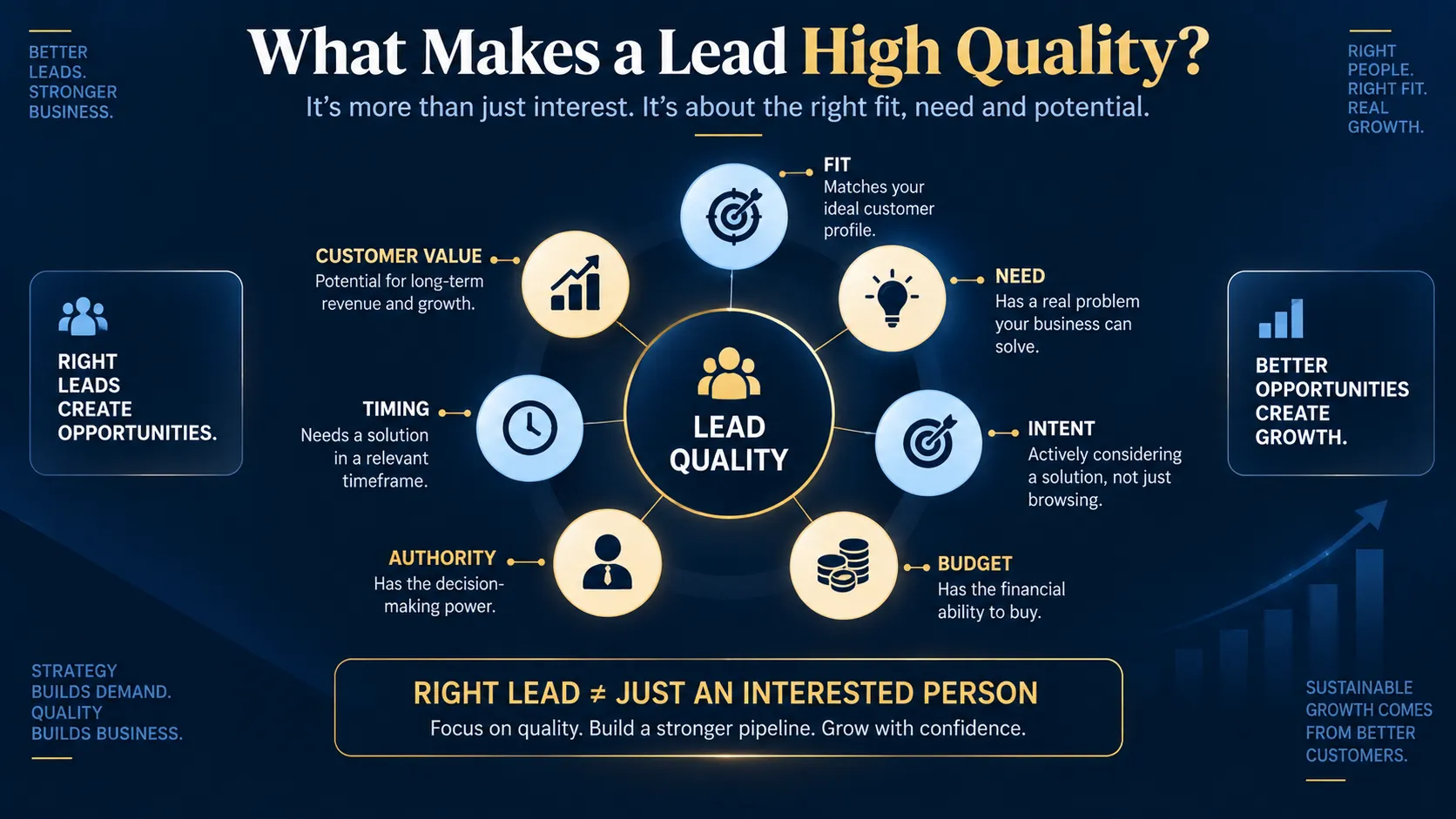
Lead quality is not simply about whether someone submitted a form.
A high-quality lead has a stronger probability of becoming a commercially valuable customer.
That usually depends on several factors.
Fit
Does the prospect actually match your target customer?
Need
Do they have a problem your business can solve?
Intent
Are they actively considering a solution?
Ability to Buy
Do they have the budget, authority or commercial ability to proceed?
Timing
Is the problem important enough for them to act now?
Potential Value
Could this become a commercially worthwhile customer?
Not every business needs to use the same qualification framework.
But every business should have some definition of what a good lead actually means.
Without that definition, lead generation becomes a numbers game.
More Lead Generation Can Hide a Lead Quality Problem
This is where businesses can get trapped.
Suppose a campaign generates:
50 leads at ₹500 per lead.
The team decides the campaign is performing well.
Then the business increases the budget.
Now it generates:
200 leads.
The dashboard looks four times better.
But suppose most of the additional leads are poor-fit prospects.
The sales team now has four times more people to contact without four times more sales opportunities.
The result can be:
- more calls
- more WhatsApp conversations
- more follow-ups
- more unqualified enquiries
- more wasted sales time
- more frustration
- but little additional revenue
This is why lead generation without lead quality control can create operational noise rather than growth.
Lead Quality Starts Before the Lead
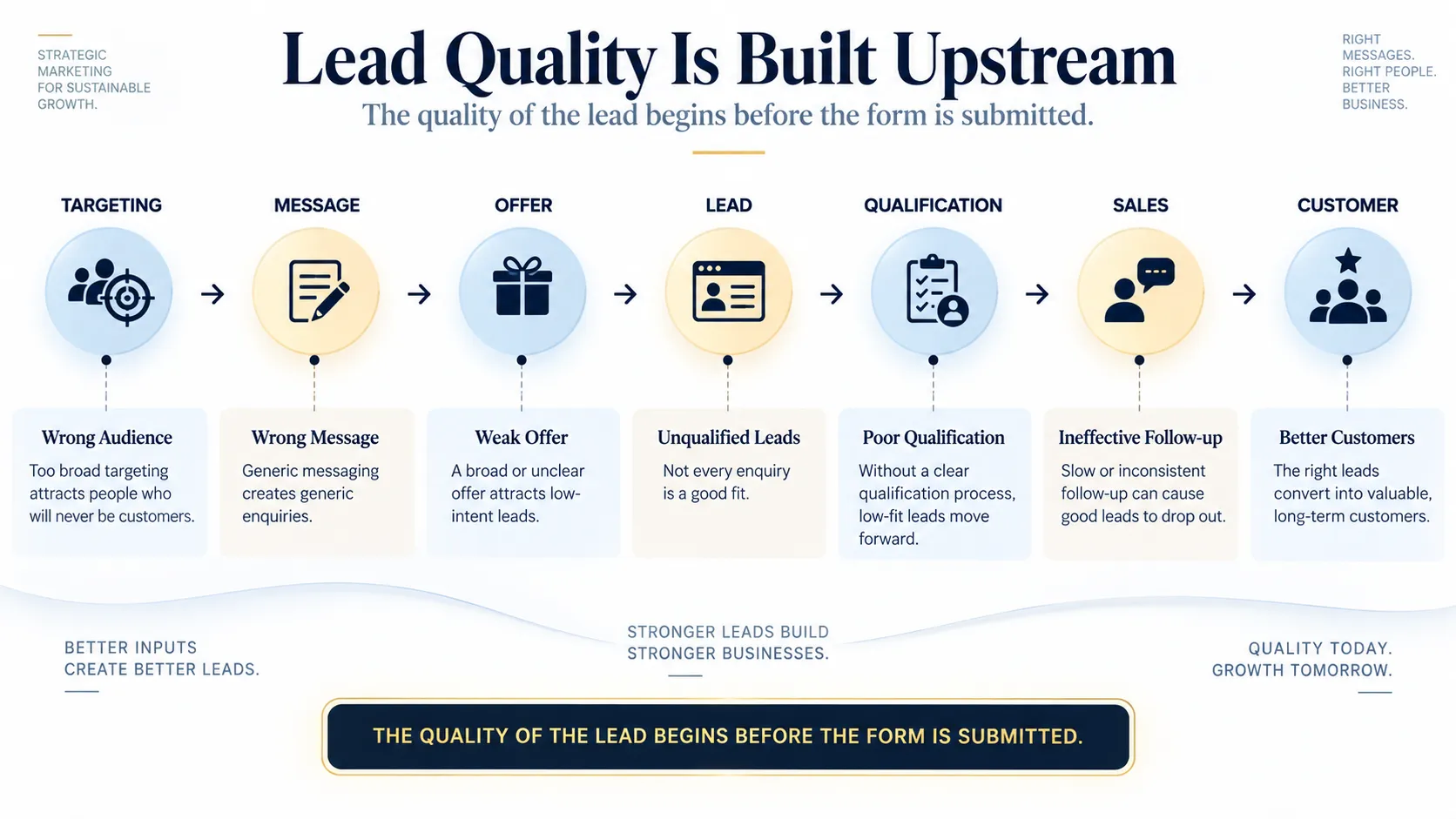
One of the biggest misconceptions is that lead quality is purely a sales problem.
It isn’t.
Marketing influences lead quality long before someone fills out a form.
It begins with:
Who you target.
Then:
What you say.
Then:
What you offer.
Then:
What expectation you create.
Then:
What action you ask the person to take.
If the targeting is too broad, lead quality suffers.
If the message attracts the wrong audience, lead quality suffers.
If the offer appeals mainly to price shoppers, lead quality can suffer.
If the advertisement promises something the business does not actually deliver, lead quality suffers.
In other words:
Lead quality is partly designed upstream.
That makes it a marketing strategy issue, not simply a sales follow-up issue.
Your Positioning Influences Who Raises Their Hand
This is where lead quality connects directly with brand positioning.
A vague message can attract a broad audience.
A precise message attracts a more specific audience.
Consider the difference.
Generic
Digital Marketing Services for Businesses
versus:
Specific
Brand-Led Growth Advisory for Founder-Led Businesses That Have Outgrown Their Existing Marketing
The second message will not necessarily produce more enquiries.
But it may produce more relevant enquiries.
That distinction matters.
Good positioning does not always maximise the number of people who respond.
It helps increase the likelihood that the right people recognise themselves in the message.
This is one reason why lead quality cannot be separated from positioning.
A Lead Can Be Interested Without Being Qualified
This distinction is often missed.
Interest is not qualification.
Someone can download something.
Click an advertisement.
Send a WhatsApp message.
Fill out a form.
Call the business.
And still not be a good sales opportunity.
For example, a person might be interested in your service but:
- have no budget
- need a completely different solution
- be outside your geographic market
- be looking for something you don’t offer
- have no authority to make the decision
- or have no immediate intention to buy
The lead is real.
The commercial opportunity may not be.
That is why businesses need a clear qualification process.
Qualified Leads Matter More Than Raw Lead Volume
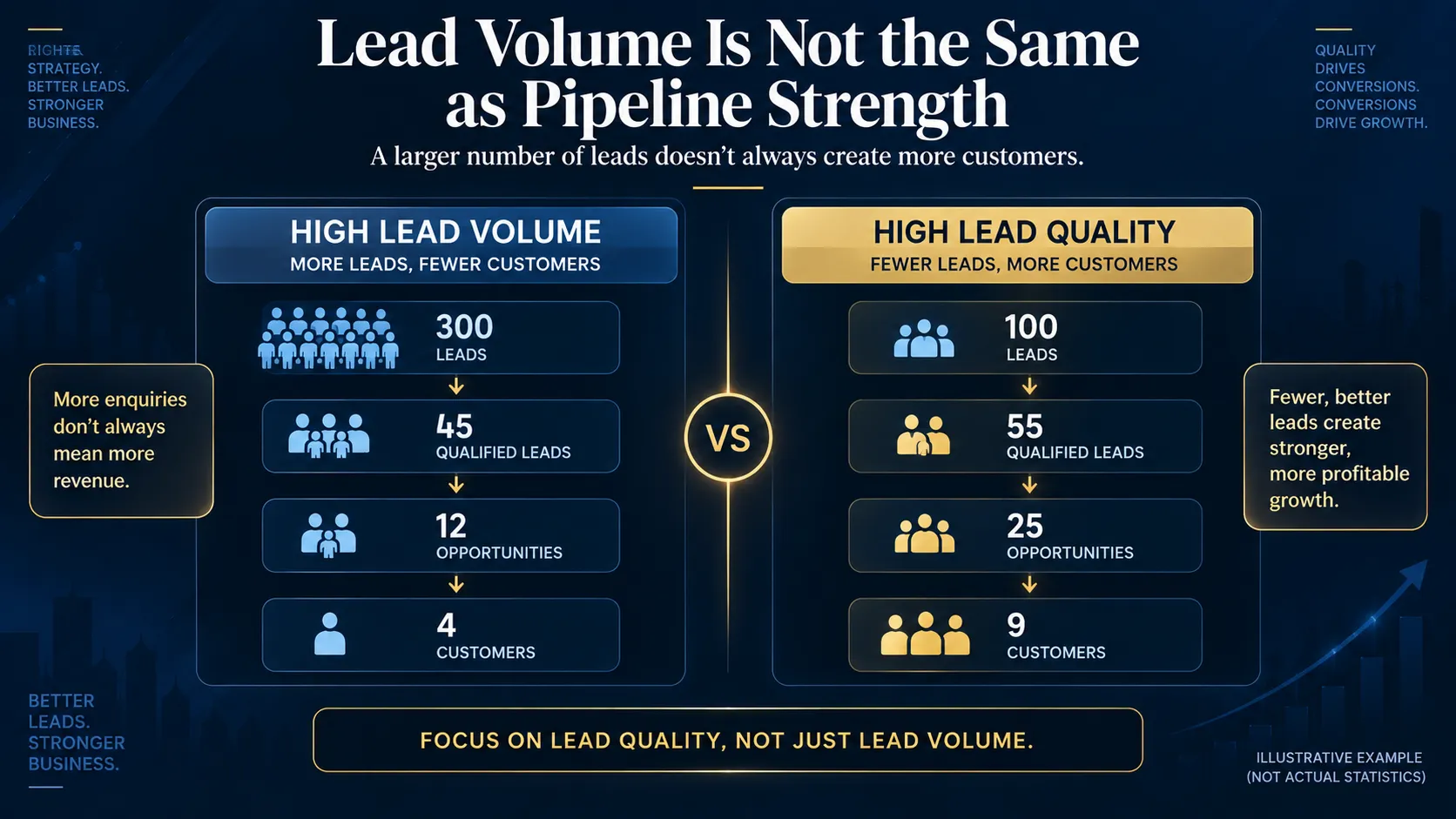
The important progression is:
Lead → Qualified Lead → Opportunity → Customer
Not:
Lead → Lead → Lead → Lead
The difference may seem obvious.
But many marketing reports stop at the first stage.
A campaign generates 300 leads.
The campaign is declared successful.
But what happens next?
How many were qualified?
How many had genuine need?
How many entered a sales conversation?
How many received a proposal?
How many purchased?
How much revenue did they generate?
Google’s current lead-generation guidance explicitly recommends mapping these stages and choosing conversion goals that align with business outcomes rather than optimising around shallow lead signals alone.
That is a significant shift in how lead generation should be evaluated.
The Sales Team Often Knows the Real Lead Quality
Marketing dashboards can tell you:
Cost per lead.
Lead volume.
Conversion rate.
But sales teams often know something the dashboard doesn’t:
Which leads are actually worth pursuing.
They hear the questions.
They understand objections.
They see budget limitations.
They recognise buying intent.
They know which sources consistently produce serious prospects.
That information should move back into marketing.
If the sales team repeatedly says:
“The leads from Campaign A are mostly price shoppers.”
That is not merely a sales complaint.
It is marketing intelligence.
If:
“The leads from Campaign B understand the problem and are ready to discuss solutions.”
That should influence future targeting and budget allocation.
Lead quality should therefore become a shared marketing-and-sales metric.
Your Cost Per Lead Can Improve While Your Business Gets Worse
This is a particularly dangerous situation.
Imagine:
Campaign A
Cost per lead: ₹800
100 leads
15 qualified
5 customers
Campaign B
Cost per lead: ₹300
300 leads
10 qualified
2 customers
Campaign B looks better if you only measure:
Cost per lead.
But Campaign A produces more customers.
This is why a cheaper lead is not automatically a better lead.
A low-cost lead can be expensive if the sales team spends time chasing it and almost nobody converts.
The real commercial question is closer to:
How much does it cost to acquire a valuable customer?
That is a very different metric.
Lead Quality Also Affects Sales Efficiency
This becomes particularly important when developing a B2B marketing strategy, where multiple stakeholders and longer decision journeys can make raw lead volume an especially weak measure of progress.
Sales capacity is limited.
A salesperson has only so many hours.
A founder has only so much attention.
A business development team can only conduct so many meaningful conversations.
If poor-quality leads consume that capacity, the opportunity cost can become significant.
Imagine a salesperson has ten hours available for prospect conversations.
If eight hours are spent on poor-fit leads, only two hours remain for genuine opportunities.
The business may therefore have a lead-generation problem on paper but a sales-capacity problem in practice.
Improving lead quality can increase sales efficiency without increasing lead volume.
That is an important growth lever.
The Offer Can Change Lead Quality
Lead quality is also influenced by what you offer.
A broad offer attracts broad interest.
A highly specific offer can filter that interest.
For example:
Free Marketing Consultation
may attract almost anyone curious about marketing.
But:
30-Minute Growth Diagnostic for Founder-Led Businesses Facing Stalled Growth
creates a much clearer expectation.
The second offer may generate fewer enquiries.
But those enquiries can be more commercially relevant.
This is why fewer leads can sometimes be a positive outcome.
If the reduction in volume comes with an increase in relevance, the business may actually be improving.
More Leads Can Increase the Wrong Kind of Growth
This is the deeper problem.
Imagine a business doubles its leads.
But:
- conversion stays flat
- sales workload doubles
- customer acquisition cost rises
- follow-up becomes slower
- customer experience deteriorates
In a founder-led business, additional demand can also expose a founder bottleneck if too many sales decisions, customer relationships or operational decisions still depend on one person.
The business has technically generated growth at the top of the funnel.
But it has not necessarily improved the business.
It has increased activity.
That distinction matters.
Growth should ultimately improve commercial outcomes.
Not simply dashboard numbers.
What Should You Measure Instead?
This is where a broader business growth strategy becomes important: the objective is not simply to increase activity but to improve the entire commercial system.
A stronger lead-generation dashboard should move beyond lead volume.
Track:
Lead Volume
How many leads are being generated?
Useful—but only as the starting point.
Lead Quality
How many match your ideal customer profile?
Qualification Rate
What percentage become qualified leads?
Lead-to-Opportunity Rate
How many become genuine sales opportunities?
Opportunity-to-Customer Rate
How many opportunities become customers?
Customer Acquisition Cost
What does it actually cost to acquire a customer?
Revenue per Customer
How much commercial value does the average customer create?
Retention / Repeat Business
Does the customer remain valuable after the first transaction?
This creates a much clearer picture of whether lead generation is actually contributing to business growth.
A Simple Lead Quality Diagnostic
Before increasing your marketing budget, ask these questions.
1. Who is our ideal customer?
Can we describe the customer clearly enough to target them?
2. What makes someone a qualified lead?
Do marketing and sales agree?
3. Which sources produce our best leads?
Not the most leads.
The best leads.
4. Which messages attract the right prospects?
Do we know which positioning and offers produce higher-quality enquiries?
5. Where do leads drop out?
Between enquiry and qualification?
Between qualification and proposal?
Between proposal and purchase?
6. How quickly are qualified leads contacted?
A good lead can become a lost opportunity if follow-up is weak.
7. Which campaigns generate customers rather than just leads?
This should be visible.
8. Can the business handle more demand?
If not, generating more leads may create another bottleneck.
The Goal Is Not More Leads. It Is Better Commercial Flow.
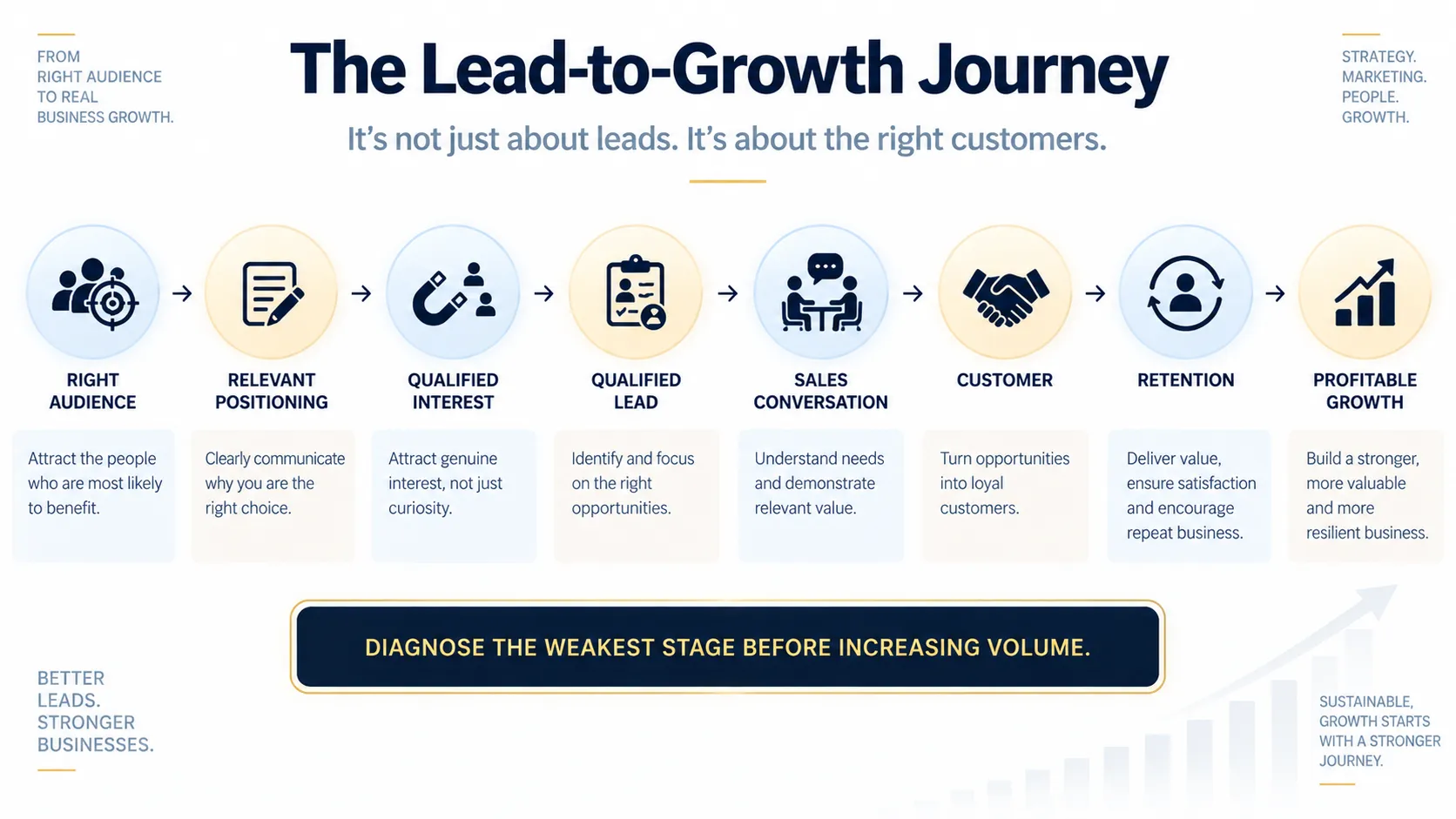
If lead volume is increasing but the business is still not moving forward, lead quality may simply be one part of a larger growth constraint.
This is the distinction that matters.
A strong growth system looks more like:
Right Audience
↓
Relevant Positioning
↓
Qualified Interest
↓
Qualified Lead
↓
Effective Sales Conversation
↓
Customer
↓
Retention
↓
Profitable Growth
Lead generation sits inside that system.
It is not the entire system.
That is why a business should resist the temptation to treat lead volume as the ultimate growth metric.
The better objective is:
Generate enough of the right demand, qualify it effectively, convert it efficiently and retain the resulting customers profitably.
When More Leads Actually Make Sense
This article is not an argument against lead generation.
There are situations where increasing lead volume is absolutely the right move.
For example, when:
- lead quality is already strong
- qualification is working
- conversion rates are healthy
- sales capacity exists
- customer economics are positive
- delivery capacity is available
- retention is strong
Then increasing demand can make sense.
The problem is scaling before those foundations are understood.
If the current system leaks badly, adding more leads simply sends more water into the leaking pipe.
The Marcom Trends Perspective
At Marcom Trends, we don’t believe every growth problem should be answered with:
“Generate more leads.”
Sometimes the business genuinely needs more demand.
But sometimes the business needs:
better positioning.
better targeting.
better offers.
better qualification.
better sales processes.
better follow-up.
better retention.
Or simply a clearer understanding of where the growth system is breaking.
That is why lead quality matters.
Because the objective is not to create the largest possible number of enquiries.
It is to create the right commercial opportunities and give them the best possible path to becoming valuable customers.
Final Takeaway
More leads can make a business look busy.
They do not necessarily make it grow.
If lead volume is increasing while revenue, conversion rate and sales efficiency remain weak, the next move should not automatically be another campaign.
Look at lead quality.
Look at qualification.
Look at conversion.
Look at follow-up.
Look at the offer.
Look at positioning.
Look at customer economics.
And look at what happens after the lead enters the business.
Because the real growth question isn’t:
“How many leads can we generate?”
It is:
“How many of the right opportunities can we turn into profitable, lasting customers?”
That is where lead generation becomes business growth.
Not sure what’s actually holding your growth back?
If you’re generating leads but aren’t sure whether the real issue is lead quality, positioning, conversion or something deeper, start with the Business Growth Diagnostic.