

A business can publish content every week and still have no real content strategy.
It can have a content calendar.
It can have social media posts scheduled.
It can publish blogs.
It can produce videos.
It can send newsletters.
And yet, when someone asks:
“Why are we creating this content?”
the answer is often surprisingly unclear.
That is where the difference between content strategy and content marketing becomes important.
The two terms are closely connected, but they are not interchangeable.
One determines the direction.
The other puts that direction into action.
When businesses confuse the two, they often end up producing more content without becoming more relevant, visible or commercially effective.
The real question is therefore not:
“Do we need content marketing?”
It is:
“What does our business actually need content to accomplish?”
What Is Content Strategy?
Content strategy is the broader thinking that determines why a business creates content, who it is creating it for, what subjects it should cover, what role content should play in the customer journey, where content should appear and how its effectiveness will be evaluated.
In simple terms:
Content strategy decides the direction.
It answers questions such as:
- Who are we trying to reach?
- What do they need to know?
- What problems are they trying to solve?
- What should our business be known for?
- Which topics are commercially relevant?
- Which formats make sense?
- Where should content be distributed?
- How will content support the wider marketing strategy?
- What does success look like?
That makes content strategy more than a publishing calendar.
A calendar tells you when something will be published.
A strategy explains why it deserves to be published in the first place.
This distinction is important because content marketing works best when it is connected to a documented strategic direction. The Content Marketing Institute defines content marketing as a strategic approach involving valuable, relevant and consistent content designed to attract and retain a clearly defined audience and ultimately drive profitable customer action.
What Is Content Marketing?
Content marketing is the practical process of creating, publishing, distributing and promoting content to attract, engage and influence a defined audience.
That content might include:
- Blog articles
- LinkedIn posts
- Videos
- Case studies
- Guides
- Newsletters
- Webinars
- Research reports
- Infographics
- Social media content
- Email sequences
Content marketing is therefore much closer to execution.
If content strategy says:
“We need to become a trusted source of information for founders trying to solve business growth problems.”
Content marketing turns that decision into:
“Let’s publish an article explaining why business growth stalls.”
Then perhaps:
- turn the article into LinkedIn posts
- create a short video
- develop an infographic
- distribute it through email
- connect it to a relevant service
- measure what happens
The Content Marketing Institute also emphasizes that content marketing involves creating and distributing valuable and relevant content for a clearly defined audience, with the ultimate objective of profitable customer action.
So the simplest distinction is:
Content strategy = direction and decisions.
Content marketing = execution and distribution.
Content Strategy vs Content Marketing: What Is the Difference?
The easiest way to understand the difference is to compare the questions each one answers.
| Content Strategy | Content Marketing |
|---|---|
| Why are we creating content? | What content are we creating? |
| Who should it serve? | Who are we distributing it to? |
| What topics matter? | What format should we use? |
| What should the brand be known for? | How do we communicate it? |
| Which customer problems matter? | Which content should we publish next? |
| What role does content play? | Where should we distribute it? |
| How should content support growth? | How do we promote it? |
| How will success be measured? | How did the content perform? |
Neither is more important than the other.
They perform different jobs.
A business without content strategy can become busy without direction.
A business with strategy but no content marketing can have excellent thinking that never reaches the market.
The strongest system connects both.
Why Businesses Confuse Content Strategy With Content Marketing
The confusion is understandable.
Both involve similar words.
Both involve content.
Both may involve the same people.
And both can use the same platforms.
A business owner may say:
“We have a content strategy.”
What they actually have is a spreadsheet showing:
- Monday: LinkedIn post
- Wednesday: blog
- Friday: Instagram Reel
That is a publishing schedule.
It may be useful.
But it is not necessarily a strategy.
A strategy would explain why those pieces exist, who they are designed for, what business problem they address and how they connect to the customer’s decision-making process.
This distinction becomes particularly important for small businesses.
Limited budgets mean wasted content effort has a real cost.
Every article that nobody needs, every video without a clear purpose and every social post disconnected from the business proposition consumes time that could have been used elsewhere.
The Problem With “We Just Need More Content”
“More content” sounds like a solution because content is visible.
If engagement is low, publish more.
If website traffic is low, publish more.
If leads are low, publish more.
If competitors are publishing more, publish more.
But volume does not automatically solve relevance.
A business can publish 100 pieces of content and still fail to answer the questions that matter to its customers.
The more useful question is:
What information would help the right customer understand their problem, evaluate their options and become more confident about choosing us?
That changes the role of content.
Instead of asking:
“What should we post today?”
you start asking:
“What does our customer need to understand next?”
That is a strategic question.
What a Real Content Strategy Should Decide
A useful content strategy should make several decisions before the production process begins.
1. Who Is the Content For?
The audience should be more specific than:
“Anyone interested in our industry.”
A strong strategy identifies the people whose problems are most commercially relevant to the business.
For example, a business may decide to focus on:
- Founder-led businesses
- Growth-stage companies
- Healthcare businesses
- Professional service firms
- B2B decision-makers
The exact audience depends on the business model.
But the principle remains the same:
Content becomes more useful when the audience becomes more specific.
2. What Problems Should the Content Address?
Customers rarely search because they want to consume content.
They search because they want to solve something.
They may want to know:
- Why growth has slowed
- Why leads are poor quality
- Whether they need to reposition
- How to improve marketing
- Whether they should invest in SEO
- How to choose between marketing channels
- Why customers are not converting
This is where search behaviour and customer understanding overlap.
The strongest content strategies do not begin with topics the business wants to talk about.
They begin with problems the audience already cares about.
3. What Should the Business Be Known For?
This is where content strategy connects directly with brand positioning.
A business should not create disconnected content across twenty unrelated subjects simply because each topic has search demand.
The topics should reinforce the position the business wants to occupy.
For example, if a consulting firm wants to be associated with strategic business growth, its content should consistently demonstrate thinking around:
- Growth problems
- Positioning
- Marketing strategy
- Founder dependency
- Customer acquisition
- Business transformation
Over time, the collection of content becomes evidence of what the brand understands.
That is more powerful than individual articles operating independently.
For businesses still defining their market position, brand positioning becomes an important part of deciding which content deserves to exist.
4. Which Topics Deserve Consistent Coverage?
A content strategy should create priorities.
Not every possible topic deserves equal attention.
A useful approach is to identify several core topic areas and build depth around them.
For example:
Core topic: Business Growth
Supporting topics:
- Why growth stalls
- Growth strategy
- Lead quality
- Customer acquisition
- Founder dependency
Core topic: Brand Strategy
Supporting topics:
- Brand positioning
- Brand differentiation
- Repositioning
- Brand identity
- Brand relevance
This creates a connected content ecosystem rather than a collection of unrelated articles.
It also creates opportunities for internal linking and stronger topical relevance.
5. What Role Does Each Piece of Content Play?
Not every piece of content has the same job.
One article might attract search traffic.
Another might educate a prospect.
Another might demonstrate expertise.
Another might help a sales conversation.
Another might convert an existing visitor into a consultation.
A strong strategy identifies these roles.
For example:
Awareness content
Answers broad problems and questions.
Consideration content
Helps customers compare approaches or understand solutions.
Decision content
Helps prospects evaluate whether the business is the right choice.
Conversion content
Moves an interested prospect toward an enquiry, consultation or purchase.
Without these distinctions, businesses can end up producing large amounts of awareness content while creating very little content that supports commercial decisions.
When Content Marketing Becomes the Right Execution Layer
Once the strategic decisions are clear, content marketing becomes much easier.
You know:
- who you are speaking to
- what problems matter
- which topics matter
- what your brand should communicate
- which formats make sense
- where the audience can be reached
- what the content needs to accomplish
Now the production process has direction.
An article is no longer:
“Something we should publish this week.”
It becomes:
“A piece of content designed to answer a specific problem for a specific audience and move them toward a useful next step.”
That is a much stronger basis for execution.
Do Small Businesses Need a Content Strategy?
Yes, but it does not need to be complicated.
In fact, small businesses may have more to gain from strategic content decisions because they have fewer resources to waste.
A small business does not necessarily need:
- 30 content formats
- five social platforms
- daily publishing
- a large editorial department
- hundreds of articles
It needs clarity.
A one-page content strategy can be enough to establish:
Audience → Problems → Positioning → Topics → Formats → Channels → Goals → Measurement
That is often more useful than a 40-page content document that nobody uses.
Content Strategy for Small Business: A Practical Framework
If you are building a content strategy from scratch, start with these eight questions.
1. Who are we trying to reach?
Define the priority audience.
2. What problems are they trying to solve?
Identify the questions, frustrations and decisions that matter.
3. What should our business be known for?
Connect content with positioning and expertise.
4. Which topics support that position?
Create a focused set of content pillars.
5. Which stage of the customer journey does each topic address?
Balance awareness, consideration and decision content.
6. Which formats can we produce consistently?
Choose formats based on capability, audience behaviour and business goals.
7. Where will the content be distributed?
Decide which channels actually matter.
8. What business outcome are we trying to influence?
Connect content measurement to meaningful outcomes rather than simply counting production.
That last question is where many content programmes become weak.
What Content Marketing Should Actually Measure
A content team can easily measure activity.
It can report:
- number of articles published
- social posts created
- videos produced
- impressions
- page views
- followers
- engagement
Those numbers can be useful.
But they do not automatically tell you whether content is helping the business.
Depending on the business model, stronger measures might include:
- qualified organic traffic
- enquiries
- consultation requests
- leads influenced by content
- conversion rate
- returning visitors
- branded search growth
- assisted conversions
- sales opportunities
- revenue influenced by content
The appropriate measurement system depends on the role content is expected to play.
A content strategy without measurement is incomplete.
A content marketing programme without strategic objectives is simply production.
What Happens When You Have Content Marketing Without Content Strategy?
This is probably the most common problem.
The business is producing content.
But:
- topics change constantly
- the audience is unclear
- messaging varies
- content is duplicated
- some articles compete with each other
- social posts have no connection to website content
- content does not support sales
- nobody knows which subjects deserve more investment
The business is active.
But the content system has no centre.
This resembles the wider problem of businesses doing more marketing without necessarily creating more growth.
The same principle applies:
Activity is not the same as strategic progress.
If your wider marketing is facing the same problem, the issue may be larger than content itself.
What Happens When You Have Content Strategy Without Content Marketing?
The opposite problem is also possible.
The strategy is excellent.
The audience is clearly defined.
The topics are well researched.
The content pillars make sense.
The customer journey is mapped.
But very little gets produced.
This usually happens because the organisation lacks:
- ownership
- resources
- processes
- editorial discipline
- production capacity
- distribution capability
Strategy without execution creates potential.
It does not create market impact.
The solution is not necessarily a bigger strategy document.
It may simply require a more realistic operating system.
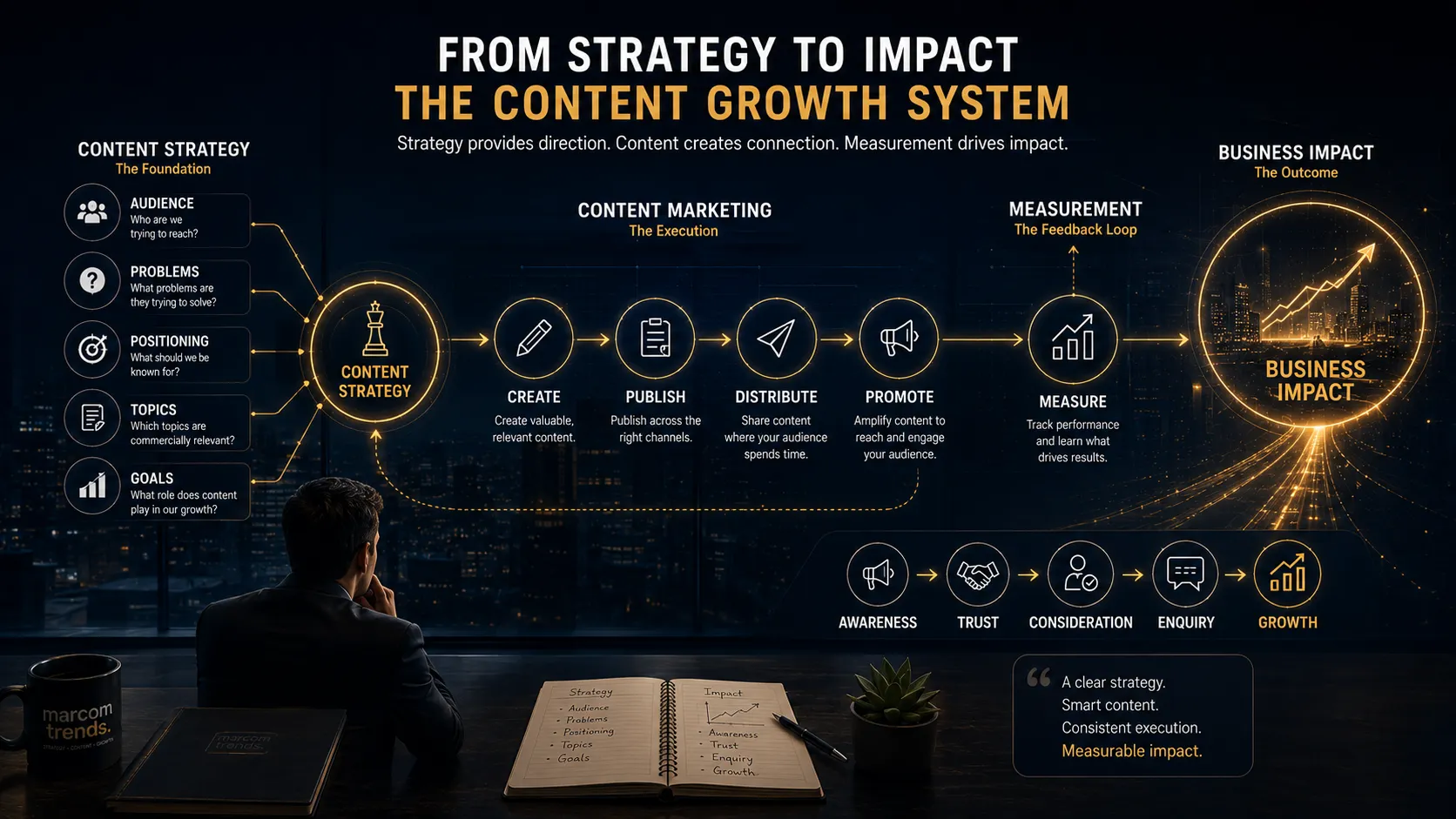
Content Strategy and Content Marketing Should Work Together
The relationship can be understood simply:
Content Strategy → decides what matters.
Content Marketing → creates and distributes what matters.
Measurement → shows what is working.
Learning → improves the strategy.
This creates a continuous loop:
Research → Strategy → Creation → Distribution → Measurement → Learning → Refinement
That is much stronger than:
Idea → Post → Publish → Repeat
The second model creates activity.
The first creates a system.
When Should You Focus More on Strategy?
You probably need more strategic work when:
- you are publishing without clear objectives
- different people choose completely different topics
- your content does not support your positioning
- traffic is increasing but enquiries are not
- you cannot explain who your content is for
- content topics keep changing
- the same subjects are being repeated
- your team spends too much time deciding what to publish
- you are producing content simply because competitors are doing it
In these situations, producing more content may make the problem worse.
The business needs better decisions before it needs more output.
When Should You Focus More on Content Marketing?
You may need stronger execution when:
- the strategy is already clear
- the audience is well understood
- the topics are prioritised
- content responsibilities are defined
- the customer journey is mapped
- the business knows what it wants content to achieve
- but content is still not being produced consistently
At that point, the constraint is no longer primarily strategic.
It is operational.
The answer may be better workflows, resources, production processes or distribution.
The Real Question Is Not Strategy vs Marketing
The debate between content strategy and content marketing can sometimes become unnecessarily complicated.
You need both.
But you do not need them in equal proportions at every stage.
If your business has no clear audience, positioning or objective, start with strategy.
If the strategy is clear but nothing is getting published, improve execution.
If content is being published consistently but results remain weak, go back to strategy and diagnose the problem.
That creates a more useful management question:
Where is the constraint in our content system right now?
That question is much more valuable than asking:
“Should we create more content?”
What Does Your Business Actually Need?
The answer depends on where the problem sits.
If you don’t know what to publish
You probably need content strategy.
If you know what to publish but cannot execute consistently
You probably need content marketing execution.
If you are publishing consistently but getting little business value
You probably need to revisit the strategy.
If your content gets attention but does not build preference
You may need to revisit positioning and messaging.
If your content generates traffic but not enquiries
You may need to examine the wider customer journey, offer and conversion system.
If your content is disconnected from the rest of your marketing
You need a more integrated marketing strategy.
This is why content should not be treated as an isolated department.
It is part of the broader growth system.
Final Takeaway
Content strategy and content marketing are not competing alternatives.
They are different parts of the same system.
Content strategy decides the direction.
Content marketing turns that direction into market activity.
The mistake is starting with production before making the strategic decisions.
If you are publishing three times a week but cannot explain who the content is for, what problem it solves, what your business should be known for or how it contributes to growth, more content is unlikely to solve the problem.
Start with the decisions.
Then build the content.
Then distribute it consistently.
Then measure what happens.
And then improve the strategy based on what you learn.
The goal is not to create more content.
The goal is to create content that deserves to exist.
Explore the Marcom Trends business growth advisory approach