

A marketing strategy for small business rarely starts with a shortage of ideas.
It has the opposite problem.
There are too many.
One person says you need Instagram.
Another says Google Ads.
Someone else recommends SEO.
Then comes LinkedIn, email marketing, WhatsApp, content marketing, video, influencers, local SEO, partnerships and paid social.
Before long, marketing becomes a collection of activities rather than a strategy.
The business is busy.
The social accounts are active.
The campaigns are running.
The website is getting updated.
But growth still feels unpredictable.
That is usually not a marketing-effort problem.
It is a marketing-strategy problem.
A useful marketing strategy for a small business should answer a much simpler question:
What should we do, for whom, why should they choose us, and which activities deserve our limited time and money?
That is the starting point.
What Does a Marketing Strategy for Small Business Need to Do?
A marketing strategy is the strategic direction that connects your business goals with the customers you want to reach, the value you offer, the position you want to occupy and the channels you will use to create demand.
A marketing plan then turns that strategy into actions, timelines, budgets and responsibilities.
The distinction matters.
The U.S. Small Business Administration describes a marketing plan around elements such as target market, competitive advantage, sales plan, goals, marketing actions and budget, with measurement and updating built into the process.
The American Marketing Association similarly describes marketing strategy as a coordinated plan connected to broader business objectives rather than a collection of disconnected tactics.
For a small business, this becomes especially important because resources are limited.
You cannot afford to do everything.
So the strategy has to help you decide what not to do.
Why Most Small Business Marketing Becomes Random
The pattern is familiar.
A business owner sees a competitor getting attention on Instagram.
So they start posting more.
Then someone recommends Google Ads.
So they start advertising.
A consultant says they need SEO.
So they create a blog.
A social media expert recommends Reels.
So now the team is producing videos.
Nothing is necessarily wrong with any of these activities.
The problem is that there is no strategic connection between them.
Each activity starts answering a different question.
And the business ends up with a marketing calendar without a marketing strategy.
Recent small-business marketing guidance continues to emphasize the need to focus resources rather than spread them across too many channels.
The better question is:
What needs to be true for this business to grow, and which marketing activities can help make that happen?
That changes everything.
The 7 Building Blocks of a Marketing Strategy That Can Drive Growth
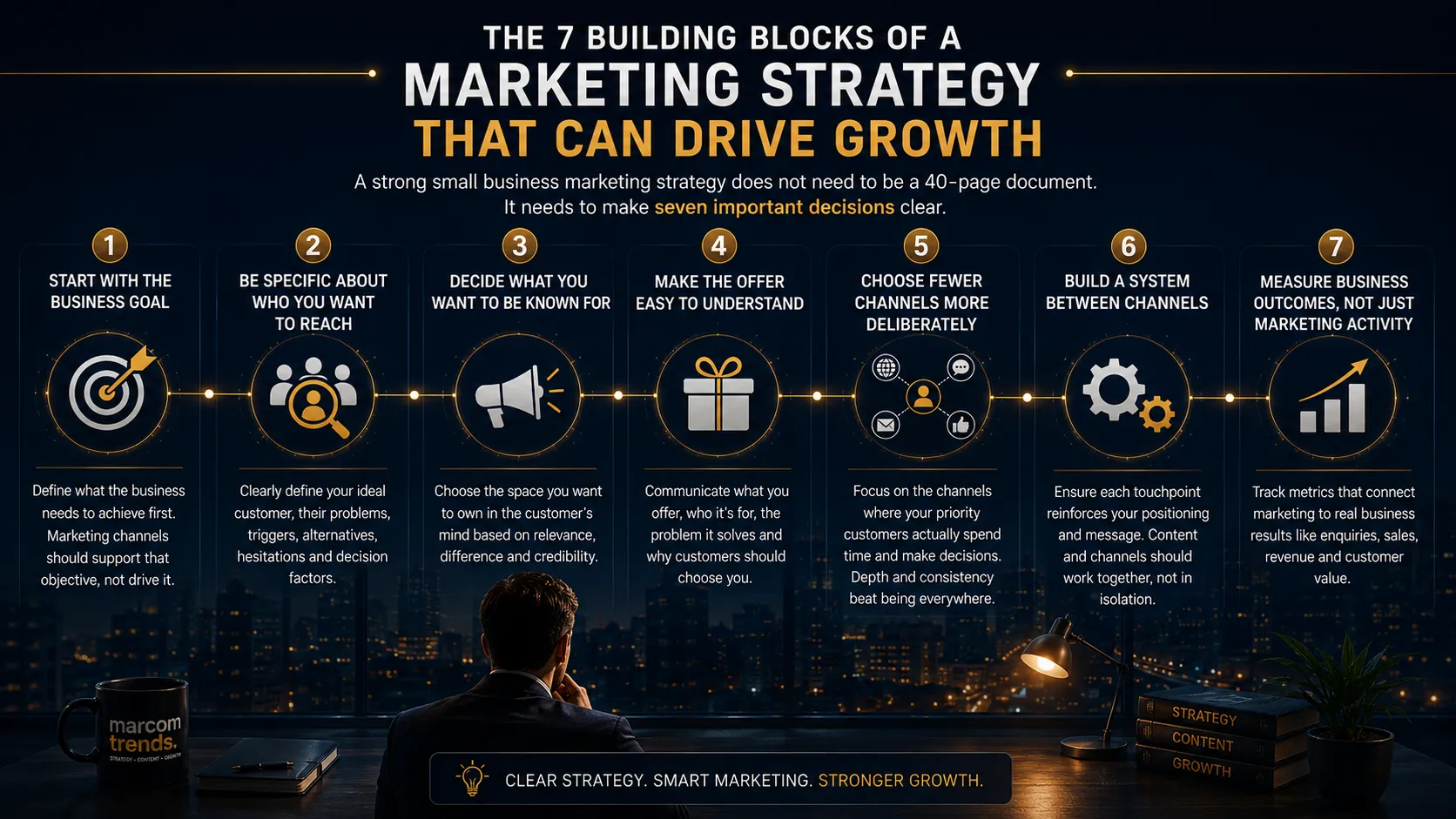
A strong small business marketing strategy does not need to be a 40-page document.
It needs to make seven important decisions clear.
1. Start With the Business Goal, Not the Marketing Channel
This is where many strategies go wrong.
They start with:
“Should we run Meta Ads?”
“Should we do SEO?”
“Should we post on LinkedIn?”
Those are channel questions.
Start with the business instead.
What are you actually trying to achieve?
Perhaps you need:
- more qualified enquiries
- higher-value customers
- stronger repeat business
- entry into a new market
- greater local visibility
- better conversion from existing demand
- a more predictable sales pipeline
The marketing strategy should support that objective.
For example, a business that needs 20 qualified enquiries per month may need a very different strategy from a business trying to increase repeat purchases from existing customers.
Marketing should therefore begin with:
Business objective → customer problem → marketing objective → activity
Not:
Trending channel → content → hope
2. Be Specific About Who You Want to Reach
“Everyone who needs our service” is not a target market.
It is an admission that the business has not made a decision.
The more clearly you understand the customer, the easier it becomes to make decisions about positioning, messaging, channels and content.
You need to understand:
- Who is most likely to buy?
- What problem are they trying to solve?
- What triggers them to look for a solution?
- What alternatives are they considering?
- What makes them hesitate?
- What matters when they compare providers?
- Why might they choose someone else?
This is more useful than simply writing:
Men, women, 25–55, urban, middle class.
Demographics can describe a market.
They don’t necessarily explain buying behaviour.
A useful marketing strategy should understand the problem behind the search.
3. Decide What You Want to Be Known For
This is where marketing strategy meets brand strategy.
A business can sell ten things without needing to be positioned around ten things.
Customers need a reason to remember you.
If your message is:
“We provide quality products and excellent service.”
you have probably said nothing that separates you from competitors.
A stronger strategic question is:
What should the right customer immediately associate with our business?
That might be:
- specialist expertise
- convenience
- speed
- reliability
- a specific customer segment
- a particular problem
- a distinctive approach
- premium service
- local expertise
This is why marketing cannot be separated completely from positioning.
If the market does not understand why your business is relevant, increasing marketing activity simply makes the unclear message louder.
For a deeper look at this issue, see **Brand Positioning in the Age of AI Search**.
4. Make the Offer Easy to Understand
A surprising number of marketing problems are actually offer problems.
A business may have good marketing.
It may have a good website.
It may even have traffic.
But the customer still cannot quickly understand:
What exactly am I getting?
Is this for someone like me?
Why should I choose it?
What should I do next?
Your offer should make those questions easier to answer.
For example, instead of communicating:
“Complete business marketing solutions for modern enterprises.”
a small business might communicate:
“A practical 90-day marketing strategy for founder-led businesses that need clearer positioning and more qualified enquiries.”
The second statement gives the market something concrete to understand.
Marketing becomes easier when the offer itself is clearer.
5. Choose Fewer Channels More Deliberately
Small businesses often ask:
“Which marketing channels should we use?”
There is no universal answer.
The right channel depends on:
- where customers look for solutions
- how they make decisions
- how long the buying cycle is
- whether demand already exists
- how much the business can spend
- how much content or expertise it can produce
- whether the purchase is local, online or relationship-driven
For example, search can be extremely important when customers actively look for a solution.
Social content may be more valuable when trust, expertise and consideration matter.
Referrals can be powerful when reputation drives purchasing decisions.
Paid advertising can accelerate demand capture, but it cannot automatically fix weak positioning or poor conversion.
Google’s current small-business guidance similarly emphasizes matching marketing methods to business circumstances and objectives rather than treating every channel as universally appropriate.
The goal is not to be everywhere.
The goal is to be effective where it matters.
6. Build a System Between Channels
Choosing channels is only half the job.
The bigger question is:
What happens when someone encounters your business?
Imagine someone sees your LinkedIn post.
What happens next?
They may visit your website.
Then read an article.
Then check your services.
Then look for proof.
Then compare you with competitors.
Then contact you.
That journey should make sense.
Your marketing should therefore work as a connected system:
Attention → Understanding → Trust → Consideration → Action → Follow-up
Content can create understanding.
Brand positioning can create relevance.
Proof can create trust.
A strong offer can create consideration.
A clear CTA can create action.
Follow-up can turn an enquiry into business.
When every channel operates independently, the customer experiences fragments.
When the system works together, marketing becomes more efficient.
7. Measure Business Outcomes, Not Just Marketing Activity
This is where many small businesses get distracted.
They celebrate:
10,000 impressions.
500 likes.
1,000 followers.
50,000 video views.
But the business still has no idea whether marketing is producing meaningful commercial results.
The more useful questions are:
- How many qualified enquiries came from marketing?
- Which channel produced them?
- How many became customers?
- What was the average value?
- How long did conversion take?
- Which campaigns produced profitable customers?
- Where are prospects dropping out?
The SBA recommends comparing marketing and sales costs with the revenue they generate and updating the plan based on what the measurement shows.
This doesn’t mean every marketing activity can be measured perfectly.
It means measurement should ultimately connect back to business outcomes.
A Simple Small Business Marketing Strategy Framework
This marketing strategy for small business framework is designed to make those decisions easier to evaluate and act on.
1. What business result are we trying to create?
Be specific.
Not:
“We want more visibility.”
Instead:
“We need 15 qualified enquiries per month.”
2. Who is the highest-priority customer?
Describe the customer by problem, situation and buying need, not just demographics.
3. What problem are we solving?
The customer’s problem should be clearer than your list of services.
4. Why should they choose us?
This is where positioning and differentiation become important.
5. What is our strongest offer?
Make the next step understandable.
6. Where will we consistently reach the right audience?
Choose channels based on customer behaviour and business capacity.
7. What will we measure?
Decide the commercial metrics before launching the activity.
Put those seven answers on one page.
You already have the beginnings of a strategy.
What Small Businesses Should Stop Doing
A stronger marketing strategy is not only about adding activities.
It is also about removing unnecessary ones.
Stop copying competitors
Your competitor’s channel may work because of their audience, reputation, offer, budget or market position.
Copying the visible tactic tells you very little about the underlying strategy.
Stop changing channels every few weeks
Most marketing systems need time to produce meaningful evidence.
Constant switching makes learning difficult.
Stop treating content as the strategy
Publishing content is an activity.
The strategy determines what the content needs to accomplish.
Stop increasing advertising spend before fixing the basics
More traffic does not automatically fix weak positioning, unclear offers or poor conversion.
Stop measuring everything equally
Ten metrics do not automatically create better decisions.
Identify the few measures that tell you whether the business is moving in the right direction.
Marketing Strategy vs Marketing Plan: They Are Not the Same
This distinction is worth making clear.
Marketing strategy answers:
Where are we going and why?
Marketing plan answers:
What are we going to do, when and with what resources?
Marketing execution answers:
Who is doing it today?
For example:
Strategy
We want to become a recognized specialist for a specific customer segment.
Plan
We will publish two expert articles per week, improve the relevant service pages, build proof and run targeted campaigns.
Execution
Tuesday: publish article.
Wednesday: distribute content.
Thursday: optimize campaign.
Friday: review enquiries.
Without the strategy, the plan becomes a schedule.
Without the plan, the strategy remains an idea.
Without execution, neither produces growth.
When Should a Small Business Revisit Its Marketing Strategy?
A marketing strategy should not be treated as permanent.
The market changes.
Customers change.
Competitors change.
The business changes.
And sometimes the strategy was simply wrong.
Review it when:
- growth has stalled
- customer acquisition is becoming expensive
- your target market has changed
- a new competitor has altered the category
- your offer has expanded
- your business has moved upmarket
- your existing positioning no longer fits
- marketing activity is increasing but results are not
- the founder is approving everything
- your channels are producing attention but not enough business
Regular review is also consistent with current small-business planning guidance, which emphasizes measuring results and updating the marketing plan as circumstances change.
The Real Purpose of a Marketing Strategy
The purpose of a marketing strategy is not to make your business look busy.
A marketing strategy for small business should ultimately make it easier to decide where limited resources will create the greatest business impact.
It is to make your marketing decisions clearer.
A good strategy tells you:
Who matters most.
What problem matters most.
What your business should be known for.
What you should offer.
Where you should compete for attention.
What you should stop doing.
How marketing connects to growth.
That last point is the most important.
Marketing should not exist as a separate activity sitting beside the business.
It should support the business’s growth model.
When marketing is disconnected from positioning, offer, sales and customer experience, more activity can simply create more noise.
When those elements work together, marketing becomes much more useful.
Final Takeaway
If your small business is doing more marketing but not necessarily getting more growth, don’t automatically add another channel.
Step back.
Look at the system.
Ask:
Is the right customer being targeted?
Is the problem clearly understood?
Is the business positioned clearly?
Is the offer compelling?
Are the right channels being prioritized?
Does the customer journey make sense?
Are we measuring business outcomes?
Those questions are more valuable than asking which platform you should post on next.
Because a strong marketing strategy is not a longer list of marketing activities.
It is a better set of decisions.
And for a small business with limited time, people and money, better decisions can be one of the biggest competitive advantages it has.
Explore the Marcom Trends business growth advisory approach.