

B2B marketing has never had more channels.
LinkedIn. Search. Email. Webinars. Events. Video. Podcasts. Paid media. Communities. Retargeting. Account-based marketing. AI-generated content. And now AI-powered search and discovery.
The options keep expanding.
But for many B2B businesses, growth isn’t expanding with them.
Marketing teams are producing more content, running more campaigns and managing more platforms, yet the commercial impact often feels harder to see.
The problem isn’t necessarily that the channels aren’t working.
The problem is that more channels can create more fragmentation.
B2B buyers now move between multiple touchpoints before making a decision. McKinsey’s 2026 Global B2B Pulse Survey found that buyers use an average of ten channels throughout the purchasing journey, with expectations for seamless movement between in-person, remote and digital interactions. Omnichannel presence is increasingly a baseline rather than a differentiator.
That changes the marketing question.
It is no longer:
Which channel should we add next?
It is:
How should our channels work together to create a clearer path from market attention to commercial growth?
That is a much harder question.
It is also the more important one.
B2B Marketing Has a Channel Problem, But Not the One You Think
Most B2B companies don’t suffer from a shortage of channels.
They suffer from channel accumulation.
A new platform appears, so the business adds it.
A competitor starts producing video, so the business starts producing video.
LinkedIn is working for someone else, so the company increases LinkedIn activity.
A marketing report says podcasts are growing, so someone suggests launching one.
AI makes content cheaper, so content production increases again.
Before long, the business has a marketing presence everywhere.
But ask a more fundamental question:
What is all of that activity supposed to accomplish?
If the answer changes depending on which team you ask, the problem isn’t channel selection.
It’s strategy.
A healthy B2B marketing system should make it reasonably clear:
- who the business wants to reach
- what those buyers care about
- what the company wants to be known for
- what evidence supports its claims
- which channels are best for discovery
- which channels help evaluation
- where sales becomes involved
- how marketing contributes to revenue
Without those connections, every channel becomes its own mini marketing project.
And that is where complexity starts eating growth.
More Channels Don’t Automatically Mean More Market Coverage
There is an attractive assumption behind multichannel marketing:
If we’re present in more places, more potential customers will find us.
Sometimes that’s true.
But presence isn’t the same as relevance.
A business can be active on six platforms and still fail to reach the right decision-makers with a message that matters.
It can have excellent content and still attract people who will never become customers.
It can spend more on paid search while its underlying proposition remains difficult to distinguish from competitors.
It can have a sophisticated CRM and still lose prospects because the experience between marketing, sales and customer service feels disconnected.
The issue is that channels are distribution mechanisms, not strategy.
Your strategy determines what should travel through those channels.
The B2B Buyer Journey Is Already Omnichannel
The old model of:
Awareness → Lead → Sales Call → Proposal → Customer
is too neat for how many B2B purchases actually happen.
A buyer might discover a company through search.
Read its website.
Ask an AI tool about the category.
See the company mentioned on LinkedIn.
Read a case study.
Watch a webinar.
Talk to a colleague.
Return to the website weeks later.
Speak with a salesperson.
Then go back online to compare alternatives.
That journey is messy because the buyer doesn’t experience your marketing as separate campaigns.
They experience one company.
McKinsey’s latest B2B research reinforces this. Buyers increasingly move between digital, remote and in-person interactions and expect information to remain consistent across those experiences. Inconsistent information is now among the leading reasons buyers switch suppliers.
That creates a significant implication for marketers:
The Customer Doesn’t Care Which Team Owns the Channel
The buyer doesn’t think:
This is the LinkedIn message from marketing.
Then:
This is the website from content.
Then:
This is the sales team’s version of the company.
They simply experience the inconsistency.
That means channel expansion without message consistency can actually make a business look less credible, not more visible.
The Real B2B Marketing Advantage in 2026 Is Coordination
The strongest B2B marketing systems are not necessarily the ones with the largest number of channels.
They’re the ones where each channel has a clear role.
For example:
Search can capture existing demand.
LinkedIn can build professional visibility and point of view.
Long-form content can help buyers understand complex problems.
Case studies can reduce perceived risk.
Email can maintain relevance over time.
Events can deepen relationships.
Sales conversations can turn interest into commercial understanding.
AI search visibility can influence how buyers discover and evaluate companies.
The important thing is not whether every company needs all of these.
It doesn’t.
The important question is whether the channels you choose reinforce the same strategic position.
That is where Marcom Trends’ approach to business growth becomes relevant.
The goal isn’t to make a business visible everywhere.
It is to make the right business understandable, credible and relevant in the places that matter.
AI Has Changed Discovery, But It Hasn’t Eliminated the Fundamentals
This is one of the biggest changes in B2B marketing in 2026.
AI is increasingly part of how people discover information, compare options and research suppliers.
McKinsey’s 2026 B2B research identifies generative AI among the top channels for supplier discovery and evaluation, alongside supplier websites, in-person interaction, web search and videoconferencing.
But this does not mean businesses need a completely separate marketing system called GEO.
Google’s current guidance is very clear: the same foundational SEO practices remain relevant to AI features in Search. There are no special technical requirements or special schema needed to appear in AI Overviews or AI Mode. Google emphasizes crawlability, useful content, internal links, good page experience, textual content and accurate structured data.
That matters because it changes the practical question.
Instead of:
How do we optimize specifically for AI?
Ask:
Is our business easy for both people and search systems to understand?
That means having consistent answers to basic questions:
That starts with clear brand positioning, so buyers can quickly understand who you serve, what you stand for and why your business is relevant.
- Who do we serve?
- What problem do we solve?
- What makes our approach different?
- What evidence supports our claims?
- What do customers say about us?
- What expertise can we demonstrate?
- Are these signals consistent across our digital presence?
AI doesn’t remove the need for brand strategy.
If anything, it increases the value of clarity.
The Problem With Running Every Channel as a Separate Campaign
This is where many B2B marketing teams lose efficiency.
LinkedIn has its content calendar.
Email has its campaigns.
SEO has its keyword plan.
Paid media has its budget.
Events have their schedule.
Sales has its outreach.
Everyone is busy.
But the customer sees one brand.
When these activities are planned independently, several problems emerge.
The Message Keeps Changing
One campaign emphasizes innovation.
Another emphasizes affordability.
The website emphasizes experience.
Sales emphasizes customization.
The founder talks about transformation.
None of these statements may be individually wrong.
Together, they create a weak market position.
Content Becomes Volume Instead of Advantage
AI has made content production dramatically easier.
That creates a new problem.
When everyone can publish more, publishing more becomes less valuable as a differentiator.
Google’s own guidance now emphasizes unique, valuable, non-commodity content for both traditional and generative search.
The strategic advantage therefore moves toward:
Original insight.
Specific expertise.
Useful evidence.
Strong points of view.
Experience that competitors cannot easily reproduce.
Reporting Becomes Fragmented
One dashboard says engagement is up.
Another says traffic is up.
Another says leads are up.
But revenue hasn’t moved.
This is often because the business is measuring channel activity rather than the commercial system.
Five Questions to Ask Before Adding Another Marketing Channel
Before launching another campaign or platform, ask these questions.
1. What Buyer Problem Does This Channel Help Us Solve?
Don’t start with:
Are our competitors using it?
Start with:
Does our target buyer actually need to interact with us here?
2. What Role Does the Channel Play?
Is it for:
- discovery?
- education?
- credibility?
- demand capture?
- nurturing?
- conversion?
- retention?
If nobody can answer that clearly, the channel probably doesn’t have a defined strategic role.
3. What Existing Channel Does It Strengthen?
A new channel should ideally make something else more effective.
A webinar can become a long-form article.
That article can support search.
The article can become LinkedIn content.
The webinar can support sales conversations.
The case study can support proposals.
That is leverage.
4. Can We Maintain Quality?
A channel that requires mediocre content to stay active isn’t necessarily an asset.
A smaller number of high-quality channels is often more valuable than a large number of neglected ones.
5. Can We Connect It to a Commercial Outcome?
Not every marketing activity needs a direct last-click revenue number.
But every significant channel should have a reason for existing.
If six months later nobody can explain what the channel contributes, reconsider it.
The Better B2B Marketing Model for 2026
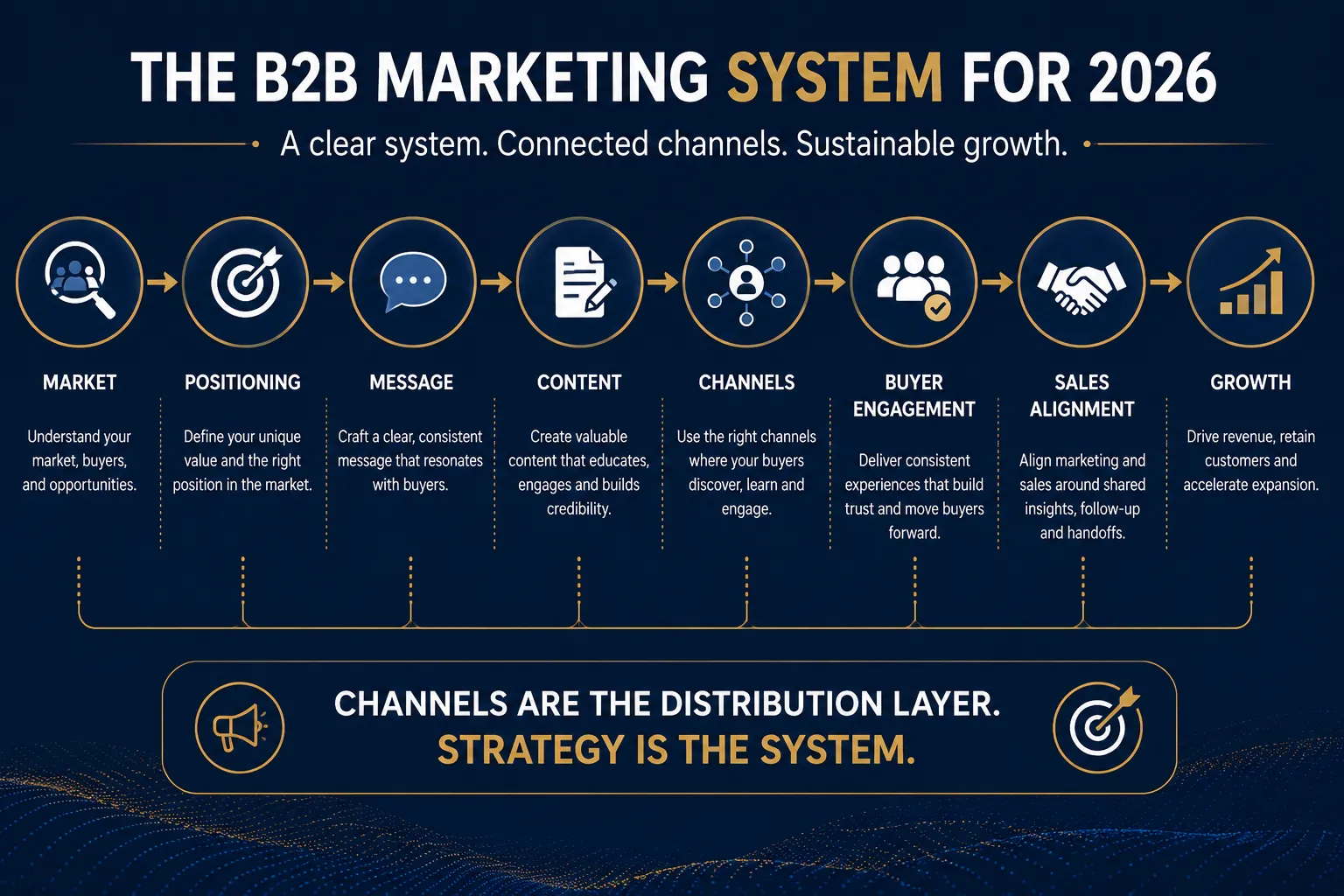
The answer isn’t to become a single-channel company.
It is to move from channel-first marketing to system-first marketing.
Think of the model this way:
Market understanding
↓
Clear positioning
↓
Core message
↓
Strategic content
↓
Relevant channels
↓
Buyer engagement
↓
Sales alignment
↓
Conversion
↓
Customer expansion
The channels sit inside the system.
They don’t define it.
This is where Marcom Trends’ business growth solutions can connect the strategic layer with execution.
What B2B Marketing Leaders Should Be Doing Differently
The strongest shift for 2026 is not simply adopting new technology.
It’s becoming more selective.
Fewer Channels, Better Connected
Choose channels based on buyer behaviour and business objectives.
Don’t build a presence everywhere because the technology makes it possible.
Stronger Point of View
Generic content is becoming cheaper to produce.
That makes original thinking more valuable.
A B2B brand needs opinions worth remembering.
Better Connection Between Marketing and Sales
Marketing should understand what sales is hearing.
Sales should understand what marketing is promising.
The website should support both.
The customer should experience one coherent business.
More Useful Content, Less Content Volume
The objective isn’t to publish five times a week.
It is to create assets that genuinely help a buyer understand a problem, evaluate options or make a decision.
AI as an Operating Layer, Not a Content Factory
AI can help with research, analysis, personalization, workflows and productivity.
But using AI simply to produce more generic content risks making the marketing environment noisier.
The strategic question is:
Where can AI make our marketing more useful, more relevant or more efficient without weakening the brand?
The Metric That Matters More Than Channel Count
A mature B2B marketing team shouldn’t be asking:
How many channels are we active on?
It should be asking:
How effectively do our marketing activities move the right buyers toward a commercial decision?
That requires looking at the system.
Are the right prospects discovering the company?
Do they understand the proposition?
Can they find credible evidence?
Does the content answer their questions?
Is the sales team receiving context?
Does the buyer experience remain consistent?
Does marketing influence revenue, retention or expansion?
If the answer to those questions is improving, you may not need another channel.
You may need to make the existing system work harder.
Final Takeaway
B2B marketing in 2026 is not a competition to occupy the most channels.
It is a competition to create the clearest, most relevant and most connected buying experience.
Buyers already move across digital, remote and human interactions. AI is becoming another part of discovery and evaluation. Omnichannel presence is increasingly a baseline expectation rather than a competitive advantage.
The businesses that benefit won’t necessarily be the ones publishing the most or appearing everywhere.
They will be the ones that know:
who they want to reach, what they want to be known for, where their buyers actually pay attention and how every important touchpoint reinforces the same commercial story.
More channels can create more reach.
Only a coherent marketing system creates leverage.
If your marketing has become busy without becoming more commercially effective, the answer may not be another channel.
It may be time to rethink the system.
Business Growth Diagnostic™ can help identify where the friction sits across positioning, marketing, customer acquisition and growth.