

A business can have a good product, capable people and a healthy marketing budget and still struggle to grow.
The problem is often diagnosed as a marketing problem.
More campaigns. More content. More leads. More channels. More activity.
But sometimes the real problem sits underneath all of that:
The market is not clear on why the business should be chosen.
That is a positioning problem.
Brand positioning is often treated as a branding exercise, something to settle before the website, logo or messaging is developed. In reality, it is much closer to a business decision.
It influences where you compete, who you want to attract, what you want to be known for, how you communicate your value and why customers should choose you instead of the alternatives.
That connection between brand and growth is becoming harder to ignore.
Gartner’s 2026 Brand and Business Strategy research found that companies with a strong brand strategy are twice as likely to exceed their growth goals. Gartner also argues that brand strategy needs to connect with business strategy rather than operate as a marketing activity in isolation.
For founder-led and growing businesses, that distinction matters.
Because when positioning becomes unclear, the symptoms rarely stay inside the brand function.
They spread into marketing, sales, pricing, customer acquisition and eventually growth.
Brand Positioning Is More Than Being Different
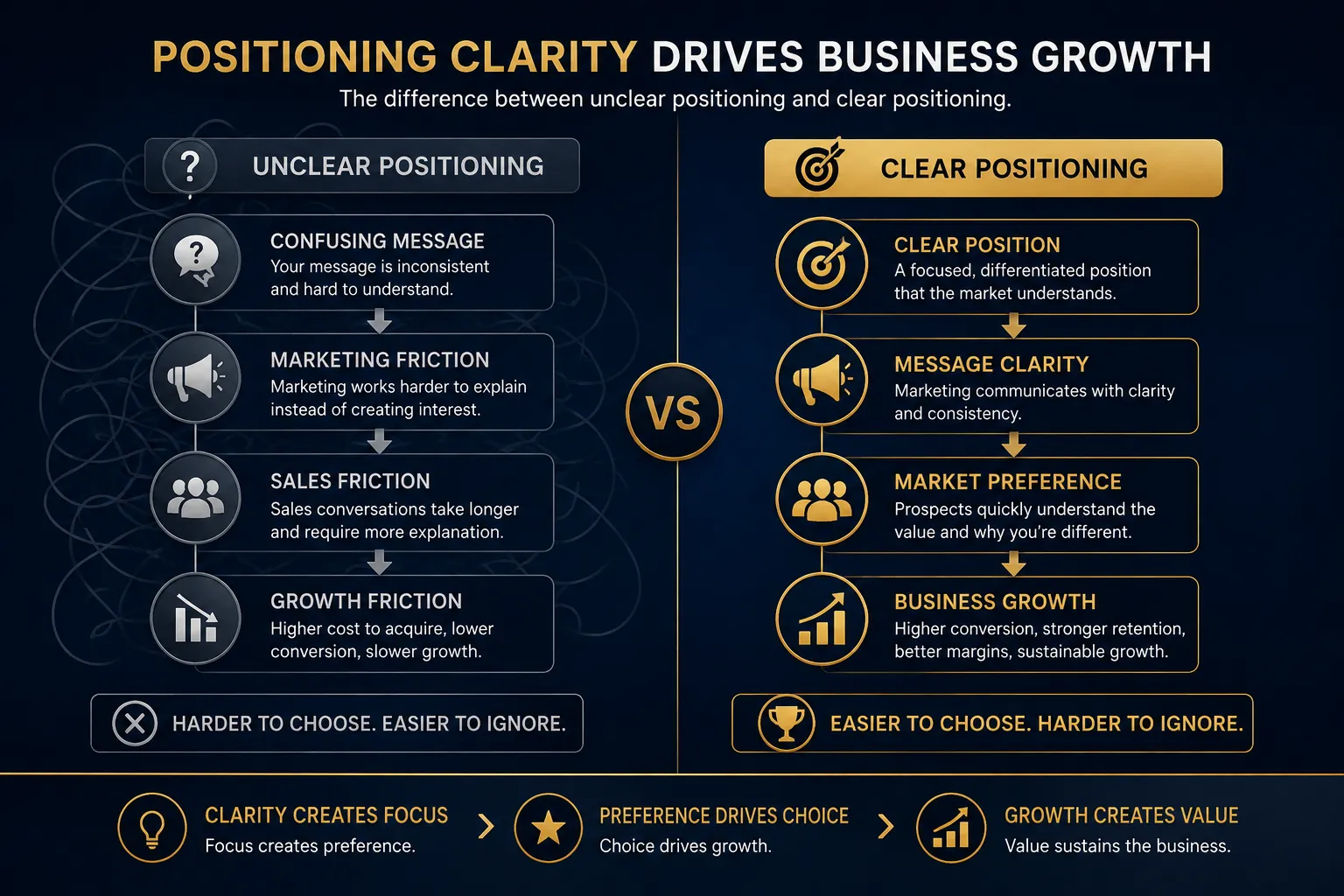
Being different is not enough.
Almost every business claims to be:
- customer-focused
- experienced
- innovative
- reliable
- results-driven
- committed to quality
The problem is that these claims rarely give a buyer a meaningful reason to choose one business over another.
Effective brand positioning answers more useful questions:
Who are we best placed to serve?
What do we want to be known for?
What problem do we solve particularly well?
Why should the market believe us?
NIQ describes positioning as establishing a distinctive place for a brand in relation to its market, competitors and target audience. It also emphasizes that positioning needs to extend beyond marketing into the broader organization.
That distinction is important.
A positioning statement sitting inside a strategy document does not change a business.
Positioning starts to matter when it influences what the company sells, who it targets, how it communicates, what it refuses to compete on and how consistently its teams explain the business.
A Strong Position Creates a Decision Filter
When positioning is clear, it becomes easier to decide:
- Which customers should we pursue?
- Which opportunities aren’t right for us?
- What should our website emphasize?
- Which services deserve more attention?
- What should our sales team lead with?
- What should our marketing say repeatedly?
- What should we stop saying?
That is why positioning belongs much closer to business strategy than to visual identity.
For businesses that need to turn strategic clarity into practical growth decisions, Marcom Trends’ business growth solutions can be the next step.
When Weak Positioning Starts Looking Like a Marketing Problem
One of the biggest challenges with poor positioning is that it rarely announces itself.
Instead, you see symptoms.
Your Marketing Says Everything and Means Very Little
The business keeps producing content, running campaigns and publishing updates, but the overall message feels interchangeable with competitors.
Every individual piece may be perfectly reasonable.
The problem is the accumulated impression.
A prospect finishes reading your website and still can’t explain why your company is particularly relevant to them.
That’s not necessarily a content-volume problem.
It may be a positioning problem.
Your Sales Team Explains the Business Differently
Ask several people inside the company:
What does the business actually do, and why should a customer choose us?
If you get several different answers, something deeper needs attention.
The issue becomes even more serious as a founder-led business grows.
The founder may have a very clear understanding of the business because they lived through its development. New employees, partners and prospects don’t have that context.
If the positioning exists mainly inside the founder’s head, the company becomes dependent on the founder to explain itself.
Prospects Keep Comparing You on Price
Price comparison isn’t always a positioning problem.
But when buyers struggle to see meaningful differences between providers, price becomes an easy comparison mechanism.
If your business sounds broadly similar to five competitors, you have made the buyer’s decision harder.
And when differentiation isn’t clear, the market often defaults to easier signals:
price, convenience, familiarity or availability.
That can become expensive.
Your Website Attracts Attention but Doesn’t Create Preference
Traffic isn’t the same as demand.
A website can generate visitors while failing to answer the more important question:
Why this company?
If your homepage, service pages and calls to action describe what you do but don’t establish why your particular approach matters, visitors are left to make the comparison themselves.
Competitors Start Looking Interchangeable
This is perhaps the clearest warning sign.
If you could replace your company name with a competitor’s name throughout your homepage and most of the copy would still make sense, your positioning probably isn’t doing enough work.
The Business Cost of Unclear Positioning
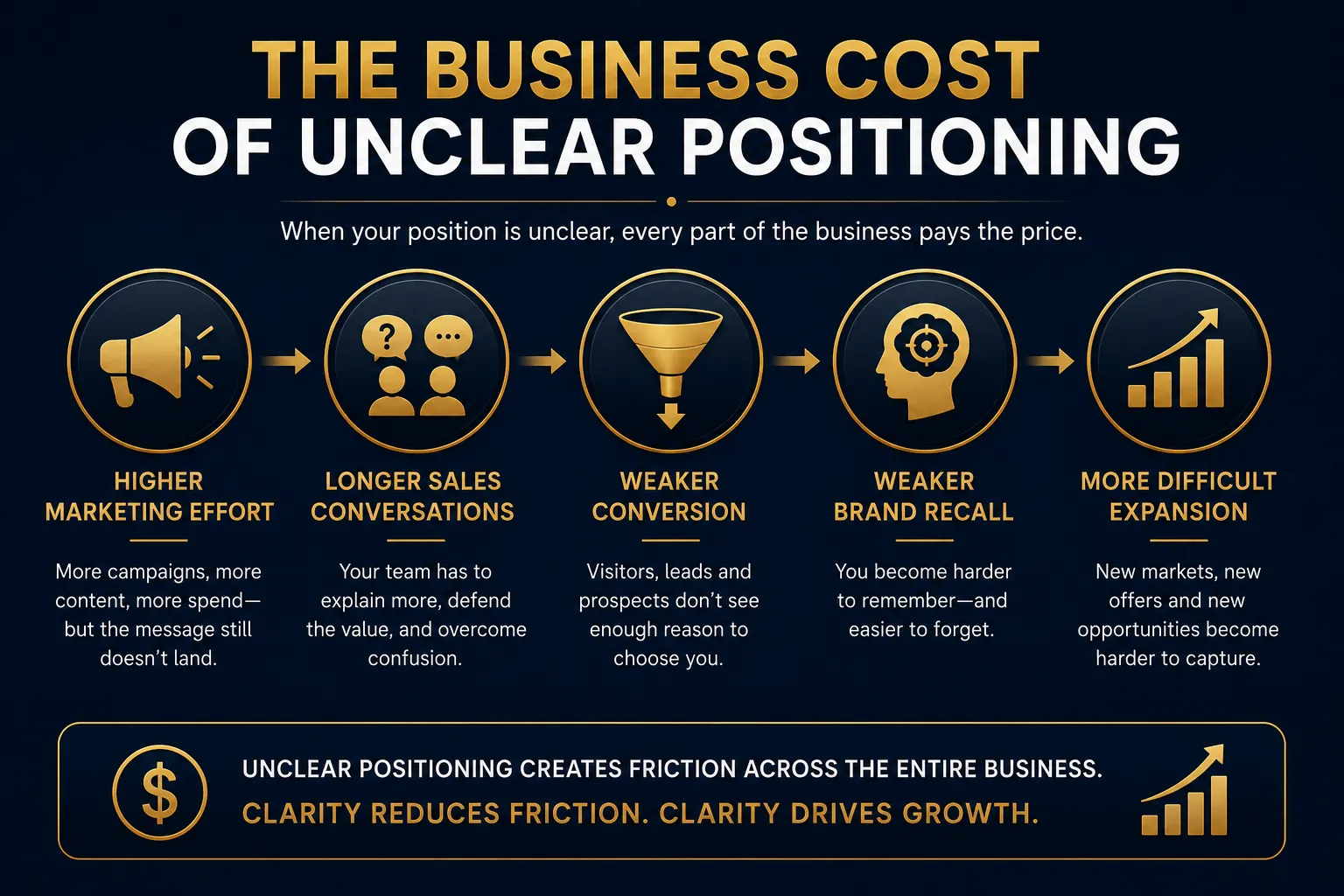
Positioning problems are often discussed in marketing language.
The consequences are commercial.
Higher Marketing Effort
When the underlying proposition is unclear, every campaign has to work harder to explain the business.
You compensate with more content, more creative, more targeting and more campaign variations.
The activity increases.
The clarity doesn’t.
Longer Sales Conversations
A clear position helps a prospect understand relevance before the sales conversation becomes detailed.
An unclear position forces salespeople to explain the category, the problem, the offer and the difference between the company and its competitors.
That makes the sales process more dependent on individual people.
Weaker Conversion
People don’t buy simply because a business is capable.
They buy when they understand the value of choosing it.
If the website communicates a collection of services rather than a clear reason to choose the business, conversion can suffer even when traffic is healthy.
Weaker Brand Recall
Being remembered for something specific is more valuable than being vaguely recognized.
A business that owns a clear idea has something customers can associate with it.
A business that tries to stand for everything often becomes difficult to remember for anything.
More Difficult Expansion
This becomes especially important as a business grows.
A company may add services, enter new markets, target new customer groups or change its business model.
If the positioning isn’t revisited, the brand can become a collection of disconnected promises.
Growth adds complexity.
The brand has to make that complexity easier to understand, not harder.
But even when customers know what a brand stands for, another question remains: does that understanding actually translate into preference and choice?
Why AI Search Makes Positioning Even More Important
There is a new dimension to this conversation.
People increasingly discover information through conversational search and AI-powered interfaces rather than relying only on traditional lists of search results.
But there is an important distinction here.
Google does not say that businesses need a separate AI SEO formula or special GEO markup to appear in AI Overviews or AI Mode. Google says the same foundational SEO practices still apply: crawlability, indexability, useful content, internal links, good page experience, text-based content, appropriate media and accurate structured data.
So the opportunity isn’t to chase a new collection of AI tricks.
It is to become easier to understand.
Who do you serve?
What problem do you solve?
What category do you belong to?
What makes your approach different?
What evidence supports that difference?
Are those answers consistent across your website and other credible places where your business is discussed?
That matters because AI search systems need to interpret information from multiple sources.
For a deeper look at what businesses need to communicate before they can be understood in AI-assisted discovery, read our guide to AI search visibility.
Recent Semrush research specifically examines how AI systems form an understanding of brands from signals across websites, reviews, press coverage, social platforms and other sources. Its research argues that positioning clarity and consistent external signals can influence how AI systems understand and represent a brand.
That makes positioning relevant to the broader AI-search conversation.
AI Visibility Isn’t a Substitute for Brand Strategy
You cannot fix weak positioning with structured data.
You cannot solve a generic value proposition by publishing 100 more articles.
You cannot make an indistinct business strategically differentiated through GEO tactics.
Technical SEO, structured data, content and digital authority all have their roles.
But they work better when there is something clear and credible for the market to understand in the first place.
Clear positioning comes before visibility optimization.
Five Signs Your Brand Positioning Needs Work
You may need to revisit your positioning if several of these situations sound familiar.
Customers Describe Your Business Differently From How You Do
Listen to how customers, salespeople and leadership describe the company.
If their language is consistently different, investigate why.
Your Website Could Belong to Several Competitors
Look beyond the logo.
Read the headlines, service descriptions and value propositions.
Could a competitor use most of the same language?
If yes, the problem is probably deeper than copywriting.
Your Marketing Keeps Changing Direction
A new campaign says one thing.
The website says another.
Sales emphasizes something else.
Then a new marketing strategy arrives six months later.
Constant messaging changes are often a symptom of an unresolved strategic decision.
Sales Conversations Focus Heavily on Features and Price
When buyers don’t immediately understand the value of your difference, the conversation naturally moves toward specifications, deliverables and cost.
Those things matter.
But they shouldn’t be the only reasons you’re chosen.
The Business Has Evolved but the Positioning Hasn’t
This is common in successful founder-led businesses.
The company starts with one audience, one offer and one market position.
Then it grows.
The customers change.
The offer expands.
The capabilities become stronger.
The original positioning remains frozen.
At that point, the brand may be describing the company it was, rather than the business it has become. For a founder-led business going through that kind of change, see who Marcom Trends helps.
What Strong Brand Positioning Should Do
Strong positioning doesn’t need to sound clever.
It needs to be useful.
Make the Right Customer Recognize Themselves
A good position should create relevance quickly.
The right prospect should be able to think:
This is for a business like mine.
That is more valuable than trying to appeal to everyone.
Give the Market a Reason to Choose You
Differentiation needs to be meaningful.
Being different for the sake of being different doesn’t create preference.
The difference has to matter to the customer and be credible enough for the business to prove.
Give Sales and Marketing One Strategic Direction
Positioning should reduce the amount of interpretation required downstream.
Marketing shouldn’t have to reinvent the company’s story every month.
Sales shouldn’t have to create a new explanation on every call.
The website shouldn’t tell a different story from the proposal.
A strong strategic process helps make that consistency possible. Explore our approach to business growth.
Create a Platform for Growth
A strong position should be able to support the business as it develops.
That doesn’t mean it can never change.
It means the strategic idea is strong enough to guide decisions rather than becoming obsolete every time the company launches something new.
Make the Business Easier to Understand
This may be the most important test.
If your positioning is working, the business becomes easier to explain without becoming simplistic.
That’s a valuable advantage.
When Repositioning Becomes the Better Growth Decision
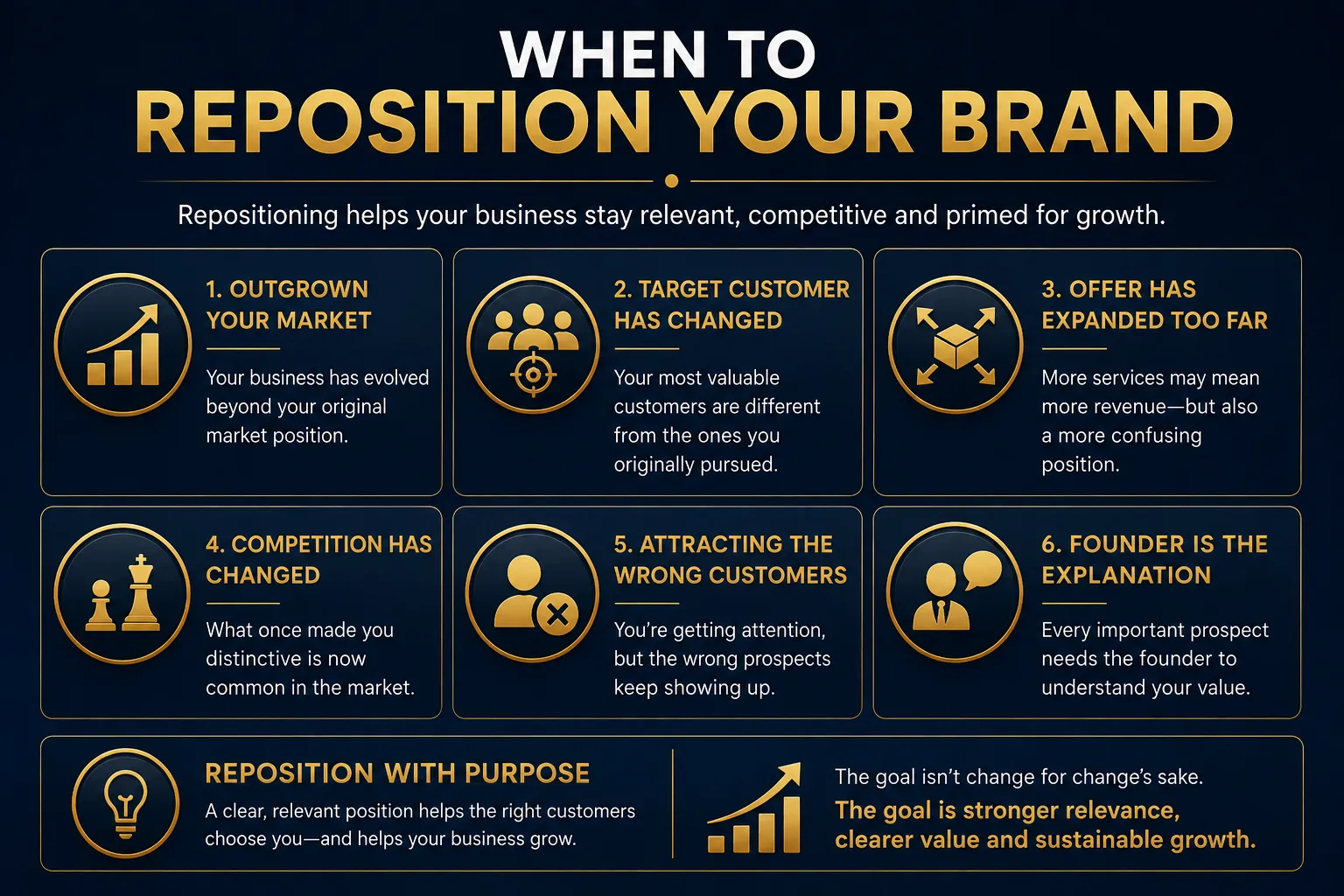
Repositioning isn’t something a business should do every time a campaign underperforms.
It becomes relevant when the relationship between the business and the market has materially changed.
Your Business Has Outgrown Its Original Market
The company may now have capabilities, clients or expertise that weren’t part of the original proposition.
Your Target Customer Has Changed
The business may have discovered that its most valuable customers are very different from the audience it originally pursued.
Your Offer Has Expanded Too Far
More services can create more revenue opportunities.
They can also make the company harder to understand.
The Competitive Landscape Has Changed
A position that was distinctive five years ago may now be common.
What once made the business stand out may have become the category standard.
You’re Attracting the Wrong Customers
If marketing produces attention but consistently attracts prospects who are a poor fit, the issue may be upstream.
The Founder Has Become the Explanation
This is particularly relevant for founder-led businesses. If every important prospect needs a conversation with the founder before they understand the company’s value, the business may have a positioning and communication problem that needs to be solved before it can scale effectively.
The Positioning Question Leaders Should Ask
The question isn’t:
How can we make our brand look more distinctive?
It is:
What should our business be known for by the customers who matter most, and why should they believe we are the right company to deliver it?
That question forces several decisions.
Who do you want to win?
What do they value?
What alternatives are they considering?
Where can you credibly compete?
What can you own that matters?
What are you willing to stop being?
And can the rest of the business consistently deliver what the position promises?
That last question is critical.
A position is only as strong as the business behind it.
Final Takeaway
Brand positioning is often treated as the language surrounding a business.
It is more fundamental than that.
It influences how the market understands you, why customers consider you, how your sales team explains you and where your business can credibly compete.
When positioning is clear, marketing has a stronger foundation.
When positioning is weak, marketing often becomes the place where the underlying problem becomes visible.
And as business discovery becomes increasingly shaped by search, conversational interfaces and AI-mediated recommendations, clarity becomes even more valuable.
The answer isn’t to chase every new optimization tactic.
It is to make the business easier to understand, easier to distinguish and easier to believe.
If you’re unsure whether your growth challenge is really a marketing problem, a positioning problem or something deeper, Business Growth Diagnostic™ can help uncover where the real friction sits.
One comment
Comments are closed.
[…] is why clear brand positioning matters beyond brand communication. It influences who notices you, what they remember, how they […]