
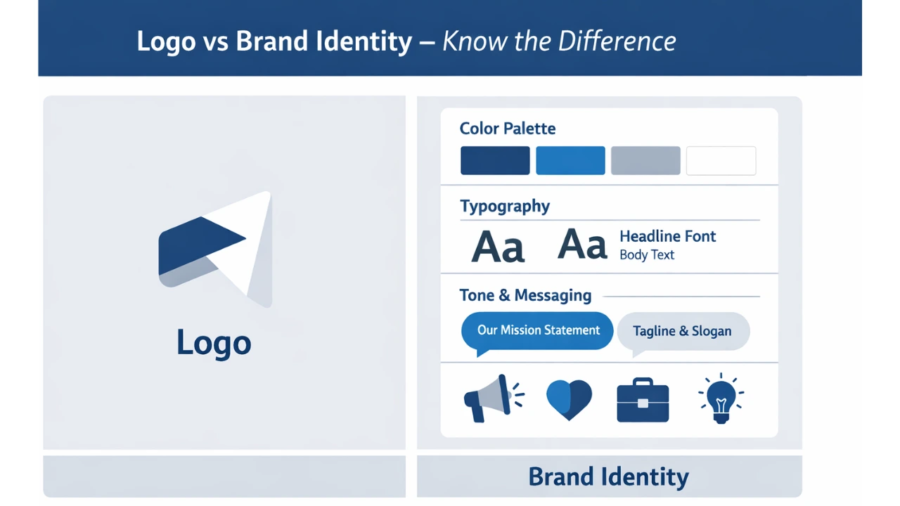
Most people use the terms “logo” and “brand identity” interchangeably. That confusion is common and costly when you brainstorm on logo vs brand identity.
A logo is visible. A brand identity is felt. When businesses fail to separate the two, they often end up with something that looks polished but means very little to their audience.
Here’s what matters. In 2026 and beyond, attention is fragile, trust is selective, and audiences make snap judgments. A logo might get noticed. A strong brand identity earns belief, recall, and loyalty.
Let me break this down clearly, without theory overload.
What Is a Logo?
A logo is a visual mark that identifies a business.
That’s it.
It can be a symbol, a wordmark, a lettermark, or a combination of these. Its job is recognition, not explanation.
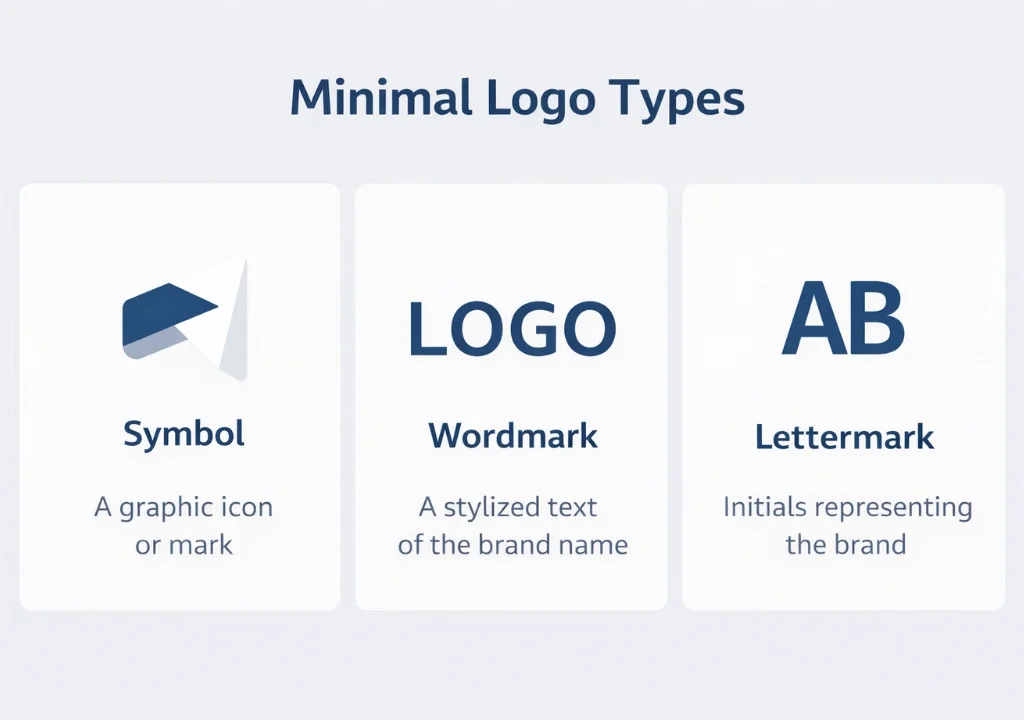
The core role of a logo
- Acts as a visual shortcut to your brand
- Helps people recognize you across platforms
- Creates familiarity over time
Think of a logo as a signature. It tells people who signed the message, not what the message means.
What a logo does well
- Works at small sizes
- It’s easy to remember
- Distinguishes you from competitors visually
What a logo cannot do
- Communicate values on its own
- Build trust without context
- Explain why your brand exists
This is where most businesses overestimate their power.
What Is Brand Identity?
Brand identity is the complete system that shapes how your brand looks, sounds, and behaves. That is where many businesses are struggling because of the brand consistency.
It is intentional perception.
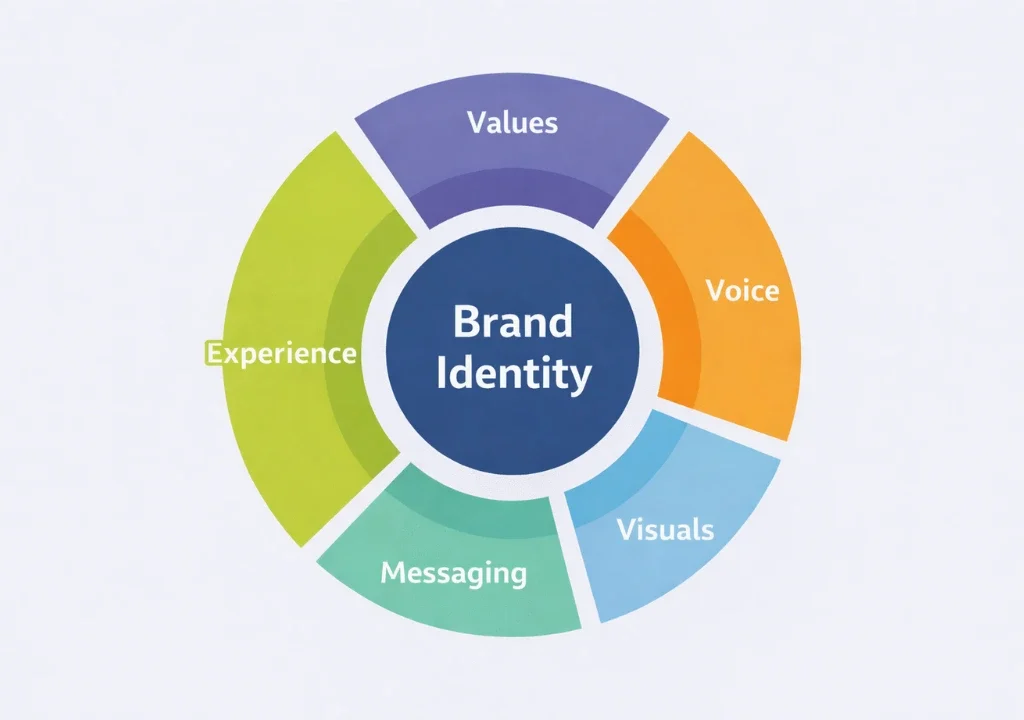
Core elements of brand identity
- Brand purpose and positioning
- Visual system (colours, typography, imagery)
- Voice and tone of communication
- Messaging frameworks
- Brand personality
- Customer experience patterns
Your logo lives inside this system. It does not lead it.
If the logo is the face, brand identity is the body language, voice, and behaviour that follow.
Logo vs Brand Identity: Difference between logo and brand identity
Here’s the simplest way to understand it.
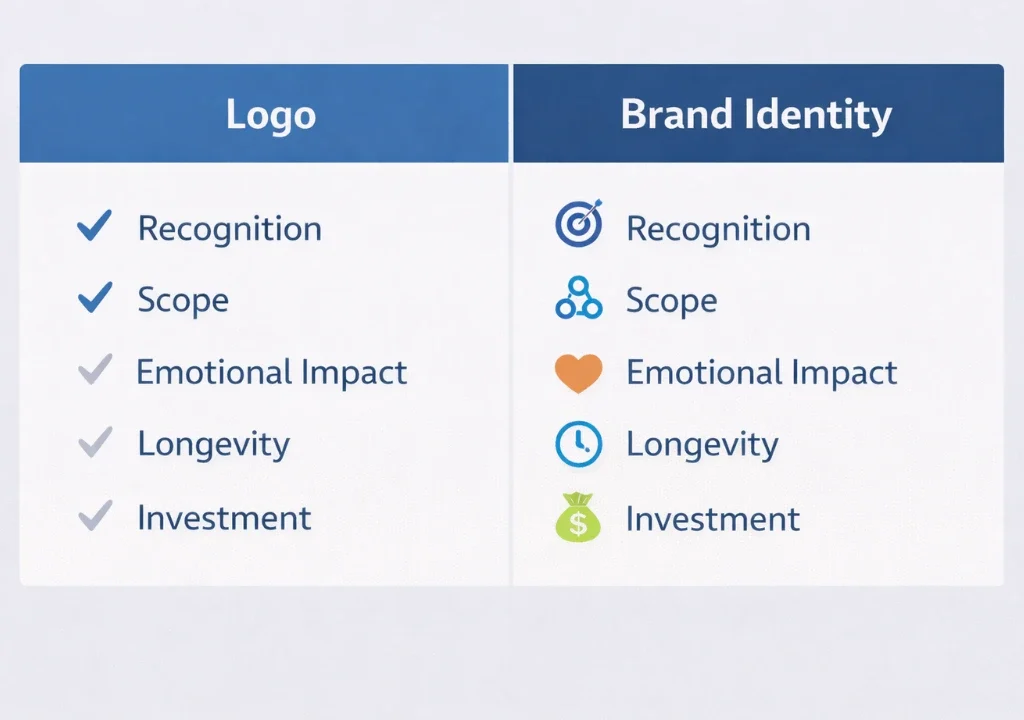
- Logo: What people see
- Brand identity: What people understand and remember
Let me put this into perspective.
You can change your logo and still be the same brand.
You cannot change your brand identity without becoming a different brand.
That’s the logo vs brand identity differences.
Why This Confusion Hurts Businesses
Many small and mid-sized businesses believe branding is “done” once the logo is finalized. This leads to predictable problems.
Common outcomes of logo-first thinking
- Inconsistent social media posts
- Confusing messaging across platforms
- No clear differentiation
- Weak emotional connection with customers
The business looks active but feels forgettable.
In contrast, brands that build identity first use the logo as an anchor, not a crutch.
How Industry Trends Are Changing the Role of Brand Identity
Brand identity used to be visual-heavy. That era is over.
Today, brand identity meaning is shaped by behaviour, content, and consistency across touchpoints.
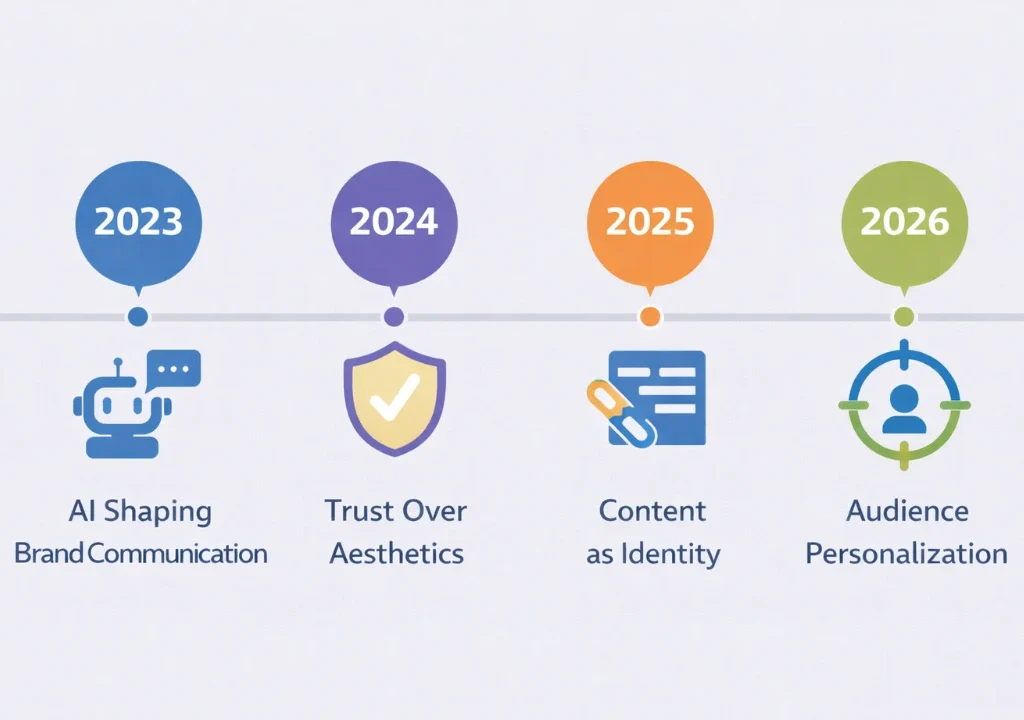
Trend 1: Trust beats aesthetics
Audiences are more skeptical. A clean logo doesn’t impress anyone anymore. Transparency, clarity, and usefulness do.
The components of Brand identity now answer:
- Do you understand my problem?
- Can I trust your expertise?
- Are you consistent over time?
Trend 2: Content is part of identity
Your blog posts, videos, emails, and LinkedIn updates are not marketing extras. They are identity signals.
Your content strategy Tone, depth, and clarity shape perception faster than design.
Trend 3: AI has raised the baseline
With AI tools, everyone can generate logos, websites, and visuals cheaply. Visual uniqueness alone is no longer a competitive edge.
Strategic thinking is.
Brands that win combine clarity of positioning with human insight, not just good design.
Examples That Make the Difference Obvious
Let’s simplify this with a practical lens.
A generic logo scenario
A clinic redesigns its logo. New colours. New font. Everything looks modern.
But:
- The website still talks about services, not outcomes
- Social posts are random
- Patient communication lacks warmth
Result: No meaningful change in perception.
A brand identity-led approach
Another clinic clarifies its purpose: early diagnosis with empathy.
Then:
- Visuals feel calm and reassuring
- Content educates, not just promotes
- Staff communication aligns with the brand promise
The logo is secondary. The experience carries the brand.
What Makes a Strong Brand Identity Today
Strong brand identity is not loud. It is clear.
Key characteristics
- Sharp positioning: who you are for and who you are not
- Consistent messaging across channels
- Visual discipline, not visual noise
- A recognizable voice
- Repeated proof of competence
This is why identity compounds over time, while logos peaks early.
Logo Without Identity vs Identity Without Logo
Let me be blunt.
- A logo without brand identity is decoration.
- Brand identity without a perfect logo still works.
Many respected brands started with average logos and strong ideas. They refined visuals later. They never compromised on clarity.
How to Build Brand Identity the Right Way
If you’re starting or rebuilding, this sequence matters.
Step 1: Define your purpose clearly
Not a slogan. A reason that guides decisions.
Ask:
- What problem do we solve better than others?
- Why does that problem matter?
Step 2: Nail positioning
Decide where you want to sit in the customer’s mind.
Cheap vs premium
Fast vs thorough
General vs specialized
Clarity here prevents confusion later.
Step 3: Build your messaging framework
This includes:
- Core value proposition
- Key messages for different audiences
- Proof points
Step 4: Design the visual system
Only now does the logo come in.
It should reflect the identity, not invent it.
Step 5: Apply consistently
Across the website, social media, presentations, emails, and offline touchpoints.
Consistency is what turns identity into memory.
Where Most Brands Go Wrong
Here’s what I see repeatedly.
- Starting with colours instead of clarity
- Copying competitors’ visuals
- Changing tone every few months
- Treating branding as a one-time project
Brand identity is not a deliverable. It’s a discipline.
Logo vs Brand Identity for Small Businesses
Small businesses often think branding is a “big company thing.” That’s backwards.
Smaller brands need clarity more, not less.
When budgets are tight:
- Identity reduces wasted communication
- Consistency builds recall faster
- Focus beats frequency
A strong identity allows a small brand to punch above its weight.
The Bottom Line
A logo is important, but it is not the brand.
Brand identity is the system that gives the logo meaning.
If you remember one thing, remember this:
People don’t build relationships with logos. They build them with brands that feel clear, credible, and consistent.
Get the identity right. The logo will follow.
FAQs: Logo vs Brand Identity
Is a logo part of brand identity?
Yes. The logo is one element within the larger brand identity system.
Can a business succeed with a weak logo?
Yes, if the brand identity is strong and consistent. Many successful brands improved their logos later.
When should I redesign my logo?
Only when it no longer reflects your positioning, audience, or maturity. Never redesign just to look modern.
Is brand identity only visual?
No. Visuals are just one layer. Voice, messaging, behaviour, and experience matter more.
How long does it take to build brand identity?
Identity is defined upfront but built over time through consistent execution.