
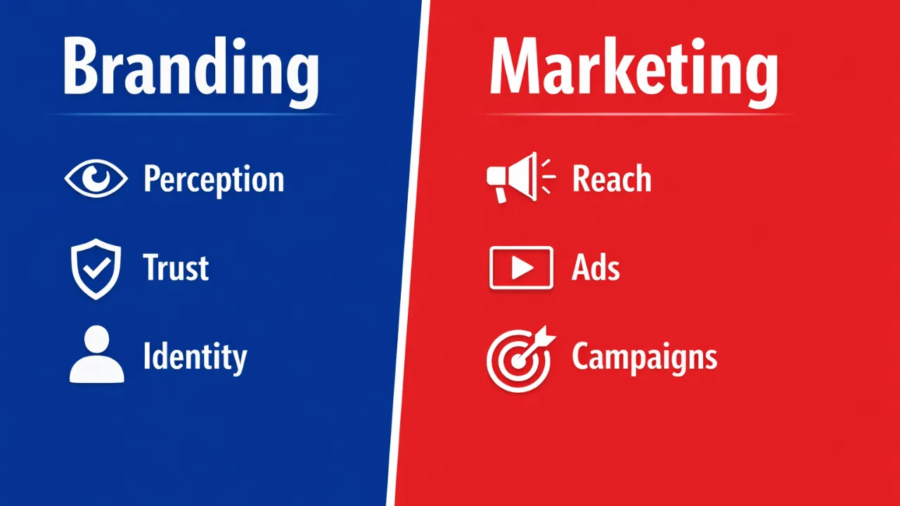
What is Branding vs Marketing? If you ask most business owners whether branding or marketing matters more, you’ll usually get a confident answer. Marketing. Ads. Leads. Sales.
Branding, in their mind, is a logo, some colours, maybe a tagline if they have time.
That misunderstanding costs businesses years of slow growth, price pressure, and constant dependence on ads.
Let me explain what branding and marketing really are, where people often mix them up, and how to use both properly so your business actually compounds instead of constantly starting over.
First, let’s clear the confusion on Branding vs Marketing
First, understand what branding really is

Branding is not your logo.
Branding is not your Instagram grid.
Branding is not your visiting card design.
Branding is the perception people carry about your business when you’re not in the room.
It answers questions like:
- Why should I trust you?
- What makes you different from others offering the same thing?
- What kind of experience should I expect?
- Are you worth paying more for?
Your brand lives in the customer’s mind. Design only helps express it. It doesn’t create it.
Now, what marketing really is
Marketing is the process of delivering your message to the market; we call it marketing channels.
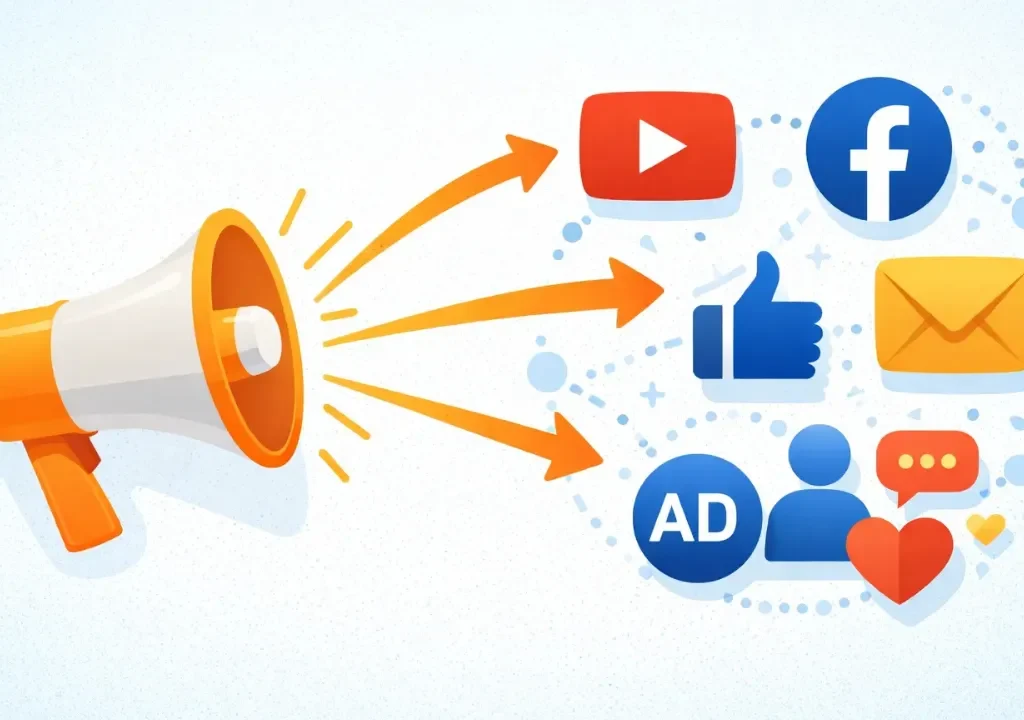
It includes:
- Advertising
- Content
- Social media
- SEO
- Promotions
- Campaigns
- Funnels
Marketing is action. Branding is direction.
Marketing brings people in. Branding decides whether they stay, buy again, and recommend you.
The biggest mistake: treating branding and marketing as the same thing
Many business owners say things like:
- “We’ll do branding once marketing starts working”
- “Right now, we only need leads”
- “Let’s first run ads; brand can come later”
This is like trying to run faster without knowing where you’re going.
When branding is weak:
- Marketing becomes noisy
- Ads get expensive
- Customers compare only on price
- Loyalty disappears the moment a cheaper option shows up
Marketing without branding is short-term attention. Branding without marketing is invisibility.
You need both, in the right order.
What business owners usually get wrong!
Mistake 1: Thinking branding is only for big companies
Small business owners often believe branding is a luxury. Something Tata, Apple, or Nike can afford.
Reality check:
Branding matters more for small businesses, not less.
Big brands already have trust. Small businesses need to build it consciously.
A local clinic, consultant, café, or agency with clear positioning and consistent messaging will always outperform a larger but generic competitor.
Mistake 2: Expecting marketing to fix unclear positioning
If your answer to “What do you do?” takes more than one sentence, marketing will struggle.
No amount of ads can compensate for:
- Unclear target audience
- Confusing offers
- Generic messaging
- “We do everything” positioning
Marketing amplifies what already exists.
If your brand story is weak, marketing will amplify the confusion.
Mistake 3: Chasing tactics instead of building meaning
Business owners jump from one tactic to another:
- First Facebook ads
- Then Instagram reels
- Then WhatsApp broadcasts
- Then influencer marketing
Nothing sticks because there’s no consistent idea holding it together.
Branding gives you a core narrative.
Marketing distributes that narrative.
Without a core idea, every campaign feels disconnected.
Mistake 4: Copying competitors instead of differentiating
This one is common and dangerous.
Same colours.
Same offers.
Same language.
Same “trusted, affordable, quality service” claims.
If your brand sounds like everyone else, marketing becomes a bidding war.
Strong branding answers one critical question clearly:
Why should someone choose you when options look similar?
When considering branding vs marketing, Branding comes before marketing. Always.
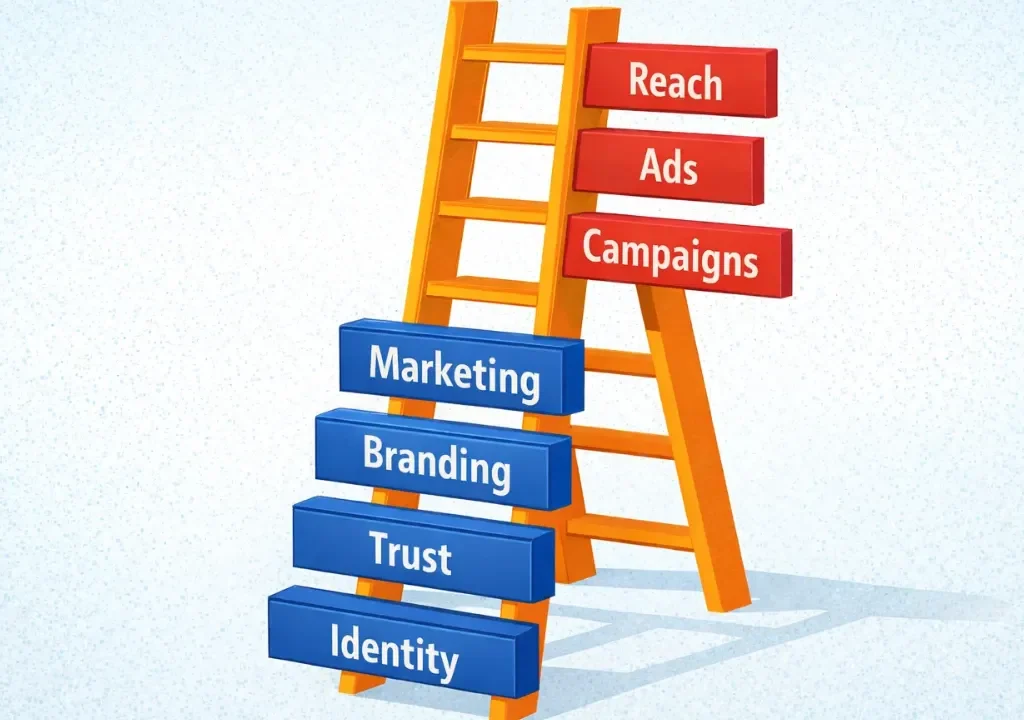
This doesn’t mean you pause all marketing until branding is perfect.
It means:
- You define your brand first
- Then you market consistently from that foundation
A simple branding foundation every business needs
Before spending serious money on marketing, you should be clear on:
1. Who exactly are you for
Not everyone.
Not “all businesses”.
Not “anyone who needs this”.
One clear audience beats five vague ones.
2. What problem are you known for solving
People don’t remember services.
They remember outcomes.
Be known for one strong thing first.
3. Your point of view
What do you believe that others don’t say clearly?
This becomes your content, your tone, your authority.
4. Your personality
Are you calm and reassuring?
Bold and opinionated?
Friendly and educational?
Consistency builds familiarity. Familiarity builds trust.
How branding makes marketing work better
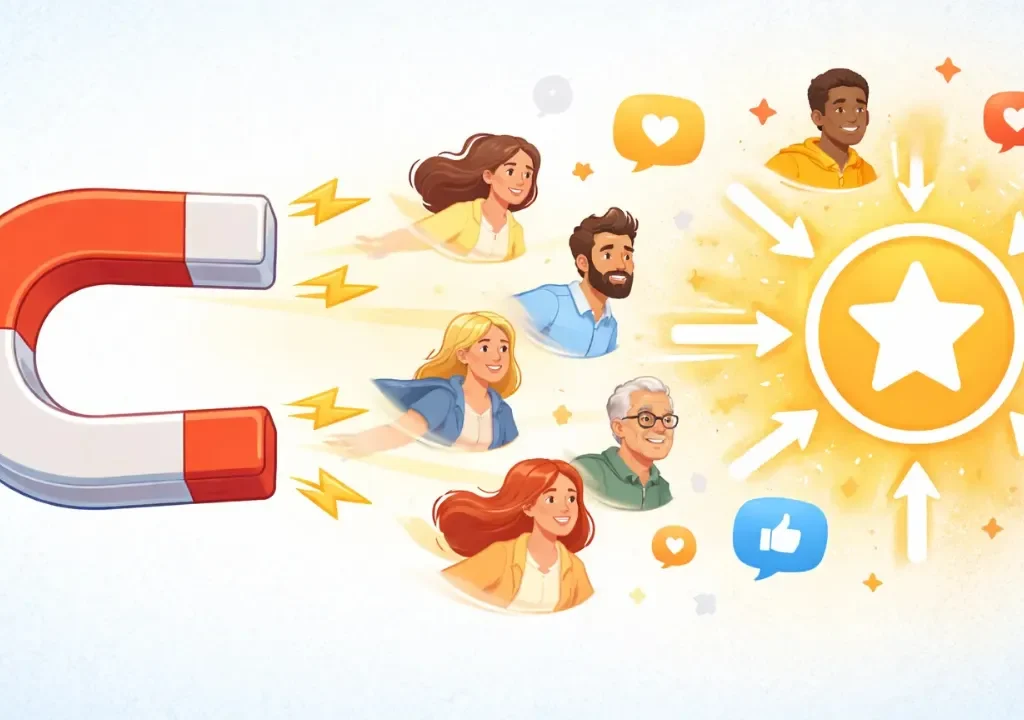
Here’s what changes when branding is done right.
Ads convert better
Because people already understand who you are and what you stand for.
Content feels coherent
Every post sounds like it came from the same brain, not a random generator.
Sales conversations get shorter
You don’t have to explain everything from scratch.
Price resistance reduces
People compare less when they feel aligned with your brand.
Referrals increase
Strong brands are easier to describe to others.
A simple way to think about branding vs marketing
Here’s a practical analogy.
- Branding is why people choose you
- Marketing is how they find you
If people find you but don’t choose you, branding is weak.
If people choose you but can’t find you, marketing is weak.
Most businesses suffer from the first problem, not the second.
Let’s take a Real-world example
Two consultants offer the same service.
Consultant A:
- Talks about services
- Post random tips
- Runs ads saying “Best solutions at affordable prices”
Consultant B:
- Talks about a specific problem
- Shares a clear point of view
- Position themselves as a specialist
- Uses marketing to repeat that story consistently
Both may run ads.
Only one builds a brand that grows beyond the next campaign.
How business owners should approach branding and marketing together
Step 1: Fix clarity before creativity
Clarity beats cleverness.
Message first. Design later.
Step 2: Build brand assets that marketing can reuse
Your:
- Story
- Positioning
- Core messages
- Visual style
These should make marketing faster, not harder.
Step 3: Use marketing to reinforce memory, not chase vanity metrics
Reach matters. But recall matters more.
You want people to remember you when the need arises, not just like a post.
Branding is a long-term asset. Marketing is a daily activity.
Marketing stops when you stop spending.
Branding continues to work even when you’re silent.
That’s why the smartest businesses invest in branding early, then let marketing compound the returns.
Conclusion
If you’re constantly chasing leads, discounts, and new tactics, you don’t have a marketing problem.
You have a branding problem.
Fix the foundation.
Then market with purpose.
That’s how businesses stop competing on price and start building preference.
FAQs
Is branding more important than marketing?
Neither works alone. Branding gives direction, marketing gives reach. Branding should come first; marketing should follow consistently.
Can a small business afford branding?
Yes. Branding is about clarity and consistency, not expensive design agencies.
How long does branding take to show results?
Branding builds over time, but clarity improves marketing results almost immediately.
Do I need a logo before branding?
No. A logo is an output of branding, not the starting point.
Can branding help increase prices?
Yes. Strong brands reduce price sensitivity because customers buy trust, not just features.
[…] Build loyalty and repeat business […]
[…] Most business posts answer the wrong question. They talk about the brand when the audience wants help. This confusion between visibility and value is one of the most common branding vs marketing mistakes businesses make. […]